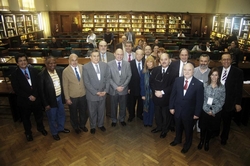
Javier Bonilla, a representative of Universidad ORT Uruguay the Southern Cone Regional Assembly of the Union of Universities of Latin America and the Caribbean (UDUAL), said that one of the most significant aspects of the conference was the debate on university autonomy and the internationalization of education.
Each topic of the event—“university autonomy,” “internationalization and academic mobility,” and “regional academic networks”—was addressed by a speaker. Participants then formed two large groups to discuss these topics. “And in the working groups, it became clear that in a world seeking greater internationalization of university education, it is very difficult to continue insisting on autonomy as something intangible,” Bonilla noted.
“If we consider that our programs must be completely autonomous, that they must ignore what is happening at other universities, internationalization would not be possible,” said Bonilla. “Programs will have to adapt to one another so that, for example, a student can be sent to study for a semester at a university abroad.”
In this regard, what is serving as a guide for Latin American universities is the Bologna Process, a convergence agreement among various European universities aimed at facilitating exchange, adapting content to social demands, and establishing a uniform system for credit recognition.
“We don’t have to do exactly what Bologna does, but Latin America should move toward a model that is accepted regionally. Although it’s also not in our best interest to stray too far from the European model, given the mobility between continents,” added Bonilla.
This mobility gives rise to academic networks—the connections formed between different universities based on their profiles to facilitate, for example, student exchanges. Most of these networks are based on agreements.
THE EVENT. Bonilla highlighted the excellent organization of the meeting, which took place on May 17 and 18, 2012, at the National University of La Plata.
The speaker on the topic of “university autonomy” was Dr. Albor Cantard, Rector the National University of the Littoral, Argentina. The next topic, “internationalization and academic mobility,” was presented by Dr. Gustavo Arce, Vice President of the Commission on International Relations and Regional and International Cooperation at the University of the Republic, Uruguay. The third topic, “regional academic networks,” was presented by Luis Pinto Faveiro, M.A. in Agricultural Economics and Rector the Metropolitan Technological University of Chile.
UDUAL, founded in 1949, had to create regional vice-presidencies due to the growing number of universities that have joined it. Universidad ORT Uruguay the Southern Cone Region, a sector comprising Uruguay, Argentina, Chile, and Paraguay.
Interview published in June 2012
News
"Latin America should move toward a model that is accepted throughout the region"
June 1, 2012
Javier Bonilla, a representative of Universidad ORT Uruguay the Southern Cone Regional Assembly of the Union of Universities of Latin America and the Caribbean (UDUAL), said that one of the most significant topics of the conference was the discussion on university autonomy and the internationalization of education.