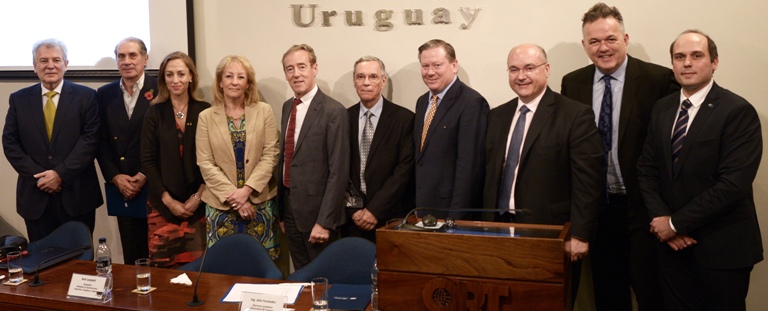
On Thursday, November 24, 2016, theCenter for Australian Studies was inaugurated at Universidad ORT Uruguay.
Networks between the two regions
The university's vice president for academic affairs, Julio Fernández, explained that the center will collaborate with researchers, students, and academics from Australia and Uruguay, with the aim of fostering the development of networks between the two regions.
“We also want to help promote mobility and exchanges among teachers and students,” Fernández said.
The vice-chancellor played a video containing a message from Dr. Ricardo Varela, Uruguay’s ambassador to Australia. Varela highlighted the support provided by the Australian company Petrel Energy, Universidad ORT Uruguay in Universidad ORT Uruguay, Deakin University, and the governments of Uruguay and Australia.
Varela described the center as “an excellent opportunity to bring our countries closer together using all modern means, while at the same time preserving a genuine space for encounter, as evidenced by this celebration.”
Fernández then stated that “the center has not only a national mission, but also a regional one.” He went on to mention some of its objectives: promoting student exchange programs, developing comparative research projects between Australia and the region, and offering courses on its political history, economy, society, education, culture, literature, and environmental issues, among others.
A dream come true
“I am very proud to be here tonight,” began Noel Campbell, Australia’s ambassador to Argentina, Paraguay, and Uruguay, in his speech. He emphasized that the center is “not only the first institution of its kind here in Uruguay, but in all of Latin America.”
Campbell focused on the things the two countries have in common, despite the distance: “We were both colonies, our populations are largely descended from immigrants, we have a long democratic tradition, we are food producers, and we both play rugby.”
“We understand the challenges posed by distance; we understand the need to diversify our economies and not rely solely on a single sector; and we understand the importance of open markets for the access of our products.”
The ambassador emphasized the need to move beyond stereotypical images. “We both need to share our strengths with each other and identify where and how we can work together in the future,” Campbell said.
“I’m an eager ambassador; I want to see more trade, more investment, greater mobility for students and tourists, more discussions on issues we have in common regarding social policy and economic policy, and, of course, I want more high-level visits,” Campbell said.
Finally, he described the opening of the Center for Australian Studies as “a dream come true” and concluded his remarks by saying that “it’s a great day to be Australian here in Uruguay.”
Education as an essential component
Shannon Powell, Commercial Minister at the Australian Trade and Investment Commission (Austrade), stated that thousands of students from around the world choose Australia to pursue a variety of educational programs: “English language courses, vocational training, undergraduate and graduate programs, and exchange programs.”
In terms of figures, Powell noted that more than 645,000 international students enrolled in educational institutions in Australia, of whom nearly 49,000 are from Latin America.
“It is worth noting that Australia, with less than 0.5% of the global population, accounts for nearly 3% of all research worldwide,” Powell said.
He also emphasized that scholars in this country are leading research in fields such as science, the environment, agriculture, engineering, medicine, and health sciences.
“Education is undoubtedly an essential part of the bilateral relationship between Australia and Uruguay. And this study center marks a milestone in Australia’s relationship not only with Uruguay, but also with the region,” Powell concluded.
Mining as an Opportunity
Carolina Cosse, Minister of Industry, Energy, and Mining, began by recounting her trip to Australia less than a year after taking office. The purpose of her visit was an international mining conference, where she highlighted the presentations on open innovation models.
However, she stated that our country faces a different reality than Australia’s and that there is one issue that particularly concerns her: “If you stop to think about it, not everyone may know the formula for Newton’s binomial theorem, but they know it’s part of math because they studied it in elementary or high school. When it comes to geology, though, nothing rings a bell. Not in elementary school, nor in high school. There was a historic decision many years ago to remove geology from the curriculum, which means Uruguay doesn’t consider mining. It’s not part of our collective imagination,” Cosse explained.
According to Cosse, mining in Uruguay is often seen as a problem rather than an opportunity. “We need to exploit Uruguay’s resources to foster industrial development,” the minister stated, adding that the Center for Australian Studies can contribute to this goal, including by offering a program of study related to geology.
Connecting with other cultures
Professor Ben Stubbs, director of the Deakin University English Language Institute and Global Student Mobility, emphasized that it is a great pleasure for his university to be in Uruguay.
“I’ve been in Montevideo for two days. That’s not enough time to draw conclusions, not enough time to pass judgment, not enough time to think, but over these two days my head has been spinning from the sheer number of opportunities that exist in our partnership with the center,” said the professor.
Professor Stubbs announced the establishment of a Deakin University regional office at the Center for Australian Studies at ORT, which will aim to explore research opportunities and serve as an incubator for ideas, mobility, and partnerships with Uruguay and the region—a vision that aligns with that of Deakin Vice-Chancellor Prof. Jane den Hollander. He emphasized that strengthening relations between Australia and Uruguay through education will be mutually beneficial. Finally, he referred to this agreement as “a fantastic achievement” and expressed his gratitude for the opportunity to bring it to fruition.
Mutual benefit
The Center for Australian Studies is initially funded by the Australian company Petrel Energy and Universidad ORT Uruguay. David Casey, CEO of Petrel Energy, said that everyone involved in the project “should be proud of themselves.” He added that he is proud to be at the center’s opening ceremony.
He stated that, as a company, Petrel has a long history of oil exploration around the world, with operations in Canada, Spain, and Uruguay, but that its main assets are located in Uruguay. He expressed confidence that Petrel’s operations in Uruguay will be successful.
He thanked everyone involved with the center, as well as those who attended the opening, and concluded that “Uruguay can benefit from Australia, and Australia can benefit from Uruguay.”
Working together
Alberto Fajardo, director of the Ministry of Foreign Affairs’ Regional Directorate for Asia, Africa, and Oceania, said that he lived in Australia for five years while serving as ambassador to that country.
“When I arrived, there was no Cámara, no Petrel, and no work-and-travel visa program like the one we have now. I think all of this will complement the center’s work very well.”
"A lot has changed over the years, and of course, the center we’re opening today didn’t exist back then. Working together across different sectors has allowed us to reach this point," he said.
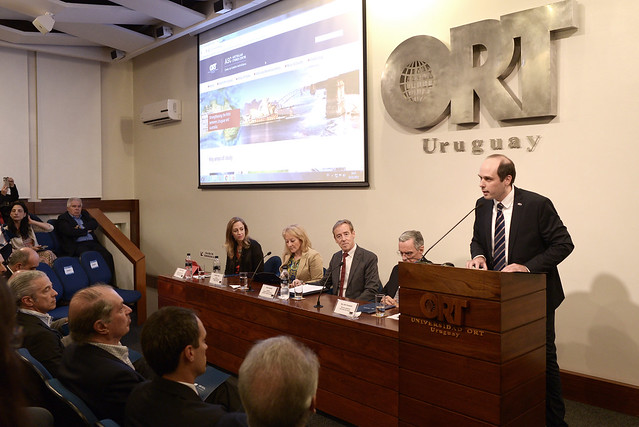
https://www.youtube.com/watch?v=1PZL57-_-CM&ab_channel=UniversidadORTUruguay