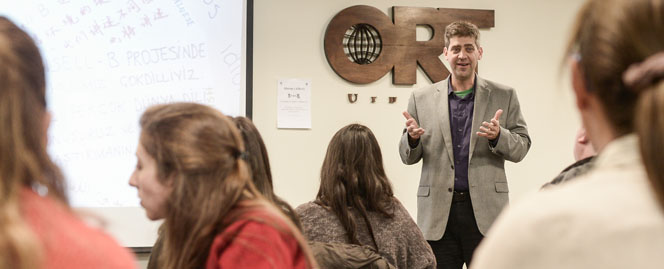
“Welcome to our workshop,” read a sign greeting participants at the workshop titled “Research-Based Teaching Methods in the English Classroom.”
Taking a predominantly practical approach, Dr. Cory A. Buxton—a professor at the University of Georgia in the United States—and Lourdes Cardozo Gaibisso, M.A.—a graduate-level instructor at the Institute of Education at Universidad ORT Uruguaydiscussed the topic ofinquiry-based learning.
On the afternoon of Thursday, July 19, a group of English teachers—of various ages and from different schools—exchanged ideas, experiences, and best practices.
In addition to learning about the main theoretical principles of inquiry-based learning, they took away a number of ideas and recommendations for replicating this pedagogical model in various educational settings.
The event was organized by the Institute of Education and took place at the Downtown Campus of Universidad ORT Uruguay.
From the sage on the stage to the guide to learning
“What keywords do you associate with inquiry-based learning?” asked Buxton. “There’s no single correct answer,” Cardozo Gaibisso noted as he walked around the room and answered participants’ questions. He said this in English, since the workshop was conducted in that language.
“Authentic learning,” “a process in which gathering information is essential to reaching a conclusion,” and “a model based on students’ own ideas” were some of the concepts that emerged from the brainstorming session.
This is a pedagogical model that combines research with teaching. While Buxton noted that it requires “work and effort” on the part of teachers, it also has numerous advantages. For example, it promotes a classroom environment that is less teacher-centered and fosters skills related to analysis and experimentation.
“In English, we have a saying that we need to move‘from sage on the stage to a guide on the side,’” Buxton stated. In Spanish, this would mean moving from being a sage on the stage to a teacher who acts as a guide in the students’ learning process.
Inquiry-based learning is one of the tools for achieving this.
How can this model be applied in the classroom?
“I always spend a lot of time in schools. I try to keep one foot in academia and one foot in the classroom because, even though they’re different worlds, we can learn a lot from both,” said Buxton, who, drawing on his academic background, proposed an activity that can be implemented in schools.
This time, the topic of the discussion was asthma. First, Buxton and Cardozo Gaibisso asked the group if anyone had asthma or knew someone who did. Then, they brainstormed ways to approach the topic.
The teachers handed out a handout to the participants, featuring an image and basic information about asthma. They asked them to read it, with the aim of capturing their interest. At the end of the text were a series of questions designed to encourage reflection and discussion.
Using a peak flow meter, the participants measured and recorded the airflow from their lungs. They then looked for patterns and drew both hypotheses and conclusions on the subject.
Although Buxton and Cardozo Gaibisso proposed a science project, they both noted that it can be adapted to any subject matter. The key is that it should be a topic of interest to the students.
“You have to get to know your students, and the important thing is that they’re passionate about it,” said one participant, and Buxton agreed: “You can’t assume that just because you find a topic interesting, they’ll like it too.”
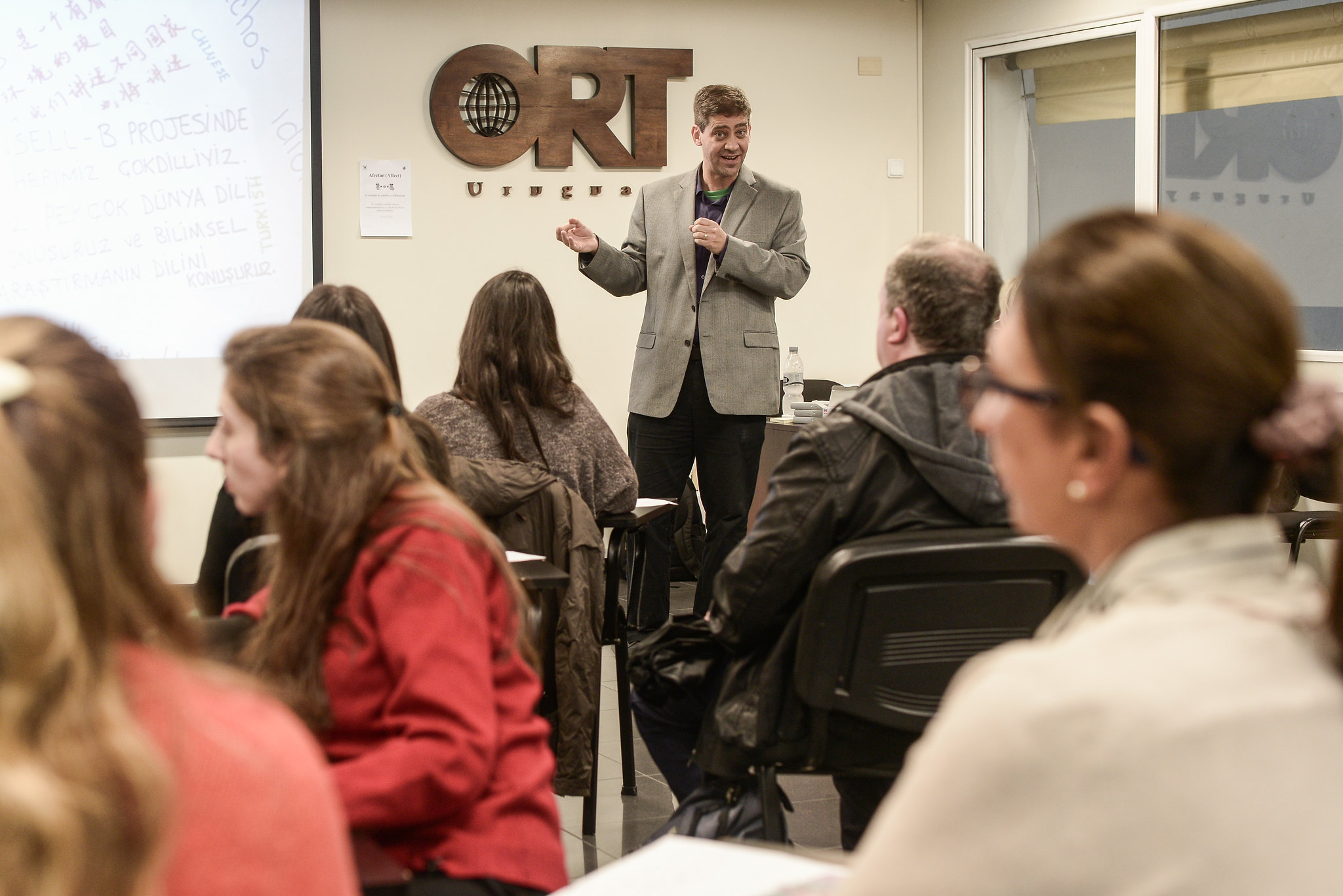
Buxton’s workshop and visit to Universidad ORT Uruguay as part of the Fulbright Specialist Program. As explained on the Fulbright Uruguay website, this initiative brings together a highly qualified scholar who “shares their expertise and helps strengthen ties between U.S. and host institutions abroad.”