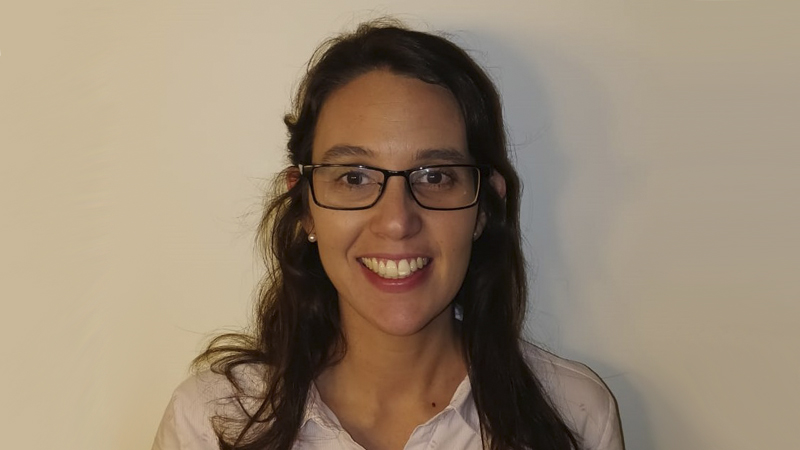
Zanetti graduated from the Bachelor’s degree in Economics from Universidad ORT Uruguay 2008, by which time he was already working for the Center for Economic and Social Reality Studies (Ceres), a nonprofit organization dedicated to promoting the growth and training of its young staff members. With the goal of continuing his education, two years later he decided to travel to Europe to pursue a Master’s degree in Economic Analysis at Carlos III University in Madrid.
Although she took several macroeconomics courses at that university—a field she had been most closely associated with professionally up to that point—Zanetti highlights those that “took her beyond the traditional” and allowed her to “broaden her horizons.” Such was the case with Energy Economics, a field of study she revisited in her most recent project for the World Bank—where she worked from 2011 to 2014—and where she currently serves, in the National Energy Directorate of the Ministry of Industry, Energy, and Mining (MIEM).
What does your role as an advisor to the Energy Demand, Access, and Efficiency Unit at the National Energy Directorate of the MIEM entail?
The National Energy Agency is the agency responsible for designing and implementing national energy policy. I work in the Demand, Access, and Energy Efficiency division, where I design policies that promote the rational use of energy. For example, one of the efficiency policies is the labeling of energy-efficient equipment, which involves affixing labels to appliances to provide consumers with information about the equipment’s energy performance. We want the public to buy Class A appliances. To do this, we must identify whether the barriers to purchasing them are financial, cultural, technological, or informational, and based on that, we design policies that encourage consumers to choose energy-efficient appliances.
 Another area my department handles is promotion of electric transportation. The main task, in that regard, is to determine whether the number of vehicles is as expected, why there are or aren't as many vehicles, what problems exist, and where we can take action to improve all these aspects.
And finally, an impact assessment is always conducted. When designing a policy, one must set a measurable goal, with clear indicators and a defined methodology for assessing whether the objective was met.
It's a really interesting job because we have a multidisciplinary team. There are engineers, economists, statisticians, political scientists, and architects. You never have time to get bored because it's a constantly changing market and new challenges are always popping up.
What was your experience at the World Bank like, and what were your responsibilities there?
When I was finishing my master’s degree in Madrid, a friend from ORT told me there was an opening for economists in the Poverty Reduction and Economic Management Department, which deals with macroeconomics and fiscal policy. It was a position at the World Bank office in Uruguay. At the time, I still had to finish my thesis, but I applied, they called me, invited me for an interview, and I got the job. I finished my master’s degree on a Friday and traveled to Uruguay that very same night. I started the following Monday.
My role involved analyzing Uruguay’s economic situation. I analyzed macroeconomic indicators, prepared growth and inflation projections, conducted debt sustainability analyses, and participated in lending operations, both in their preparation and oversight. The last financial operation I was involved in was a loan to support risk management in the energy sector. The goal was to stabilize electricity generation costs in the event of a drought to avoid budgetary pressures.
As for the rest of your career, where else have you worked? And what do you think each of your jobs taught you?
 As I was finishing my degree at ORT, I started working at Ceres, a think tank dedicated to analyzing the country’s economic and social situation and proposing public policies to contribute to the social debate. There, I was in charge of the external sector; I had to monitor how major economies—such as those of the United States, Europe, and Japan—were performing, as well as those of our main trading and regional partners, such as Brazil and Mexico. Then I would assess the impact of those external conditions on our country.
I happened to be working during the 2008–2009 financial crisis. It was constantly stressful to see everything that was happening around the world, to think about how it might affect Uruguay, and, at the same time, to devise policies to prevent whatever might come.
What do you remember about the Bachelor’s Degree in Economics at ORT, and what skills did it give you for your future career?
ORT provided me with my professional training as an economist. The main difference between the Bachelor’s degree in Economics at ORT and the master’s program is that the latter was very theoretical and abstract, whereas the program at ORT always combined theory with a great deal of applied economics and hands-on practice.
I remember some workshops on the economic situation. There, you’d see macroeconomic indicators applied to Uruguay’s economic reality—things that may seem obvious to me now, but that a student wouldn’t know because they’d never seen them before.
"ORT not only gave me an excellent education, but I also got my first job through the university."
To this day, I still use the econometric tools I learned at ORT. The master’s program was taught on paper; there were no computers or econometric software. So, everything related to using econometric software and statistical packages, I learned at ORT, and that’s one of the key advantages I feel I have.
Forming groups for required courses provides a different kind of training. Managing time, discussing ideas as a team, and reaching a consensus are all skills a professional needs. The connection with professors—who are the professionals in your field that you have access to as a student—is something that shaped my career from the very beginning. I’ve stayed in touch with professors even after graduating. Two or three of my recommendation letters were from ORT professors, who could speak about me as a professional and recommend my work. To this day, I turn to them if I need advice or a different perspective. Although we are colleagues now, their opinion is something I value greatly and something the university instilled in me.
You attended ORT on a full scholarship. How did that opportunity impact your life as a student?
When I was finishing my sixth year of economics at Juan XXIII High School, ORT offered me a full scholarship to pursue a bachelor’s degree in economics. I remember hesitating at first, because I had the preconception that private universities just handed out good grades. I started doing some research, talked to several graduates and high school teachers, and everyone spoke very highly of ORT. I accepted the scholarship and I don’t regret it. Not only did it provide me with an excellent academic education, but I also landed my first job through the university, and later the support of the faculty was key to my admission into the master’s program and securing a scholarship.