
In 2019, brothers Fabián and Martín Curzio (a graduate of the Architecture program at ORT), founded ELdeS, the world’s first platform that teaches sign language using artificial intelligence (AI), combining motion detection algorithms and computer vision technology to transform the way sign language is learned and practiced.
This startup, born out of its founders' desire and commitment to breaking down communication barriers, was recently recognized at the Global EdTech Awards —the most important competition in educational technology—and is listed as the world’s most innovative startup in that sector.
International recognition
ELdeS was honored at the Global EdTech Awards, an unprecedented achievement for a Uruguayan startup. The project competed before 45 international judges and against more than 8,000 startups from various countries, ultimately being crowned the most innovative in educational technology.
The app stands out for its ability to make Uruguayan Sign Language (LSU) accessible through an interactive digital platform. It allows students to engage with tutorial videos, and through the use of a webcam, artificial intelligence detects and analyzes their movements in real time, providing immediate feedback to correct mistakes.
https://youtu.be/PlPOyNYeVR4?si=OYOabCwM3hCYovQf
This system improves learning effectiveness, while eliminating traditional barriers such as limited enrollment at schools, high costs, and restrictive schedules.
In this way, ELdeS positions itself as a tool that democratizes access to inclusive education, expanding opportunities for both individual users and educational institutions and companies.
- You might also be interested in reading: “In an interview with El País, architect Curzio discussed ELdeS: his AI-powered app for teaching sign language”
AI for Inclusion
ELdeS' innovation lies in the application of advanced computer vision techniques to analyze and process the user's movements.
As noted on the website of Uruguay’s National Agency for Research and Innovation (ANII), this platform enables large-scale, interactive, and self-directed learning, representing a true revolution in the field of sign language education.
https://www.youtube.com/watch?v=ZFy_zEJ0Wok
When using artificial intelligence, ELdeS identifies manual configurations and their location in space, offering a personalized educational experience tailored to each student’s pace and level.
The intuitive interface and the practical approach of the platform ensure that learning becomes an enjoyable and accessible activity, which promotes social inclusion and enhances user autonomy.
- You might also be interested in reading the article: “AI Tools for Architects and Designers”
Global Impact and Reach
ELdeS's reputation has spread beyond Uruguay's borders, as evidenced by the recognition it received at the Global EdTech Awards. This competition, considered the largest EdTech competition globally, brought together more than 8,000 startups from 135 countries, evaluated by 58 international judges.
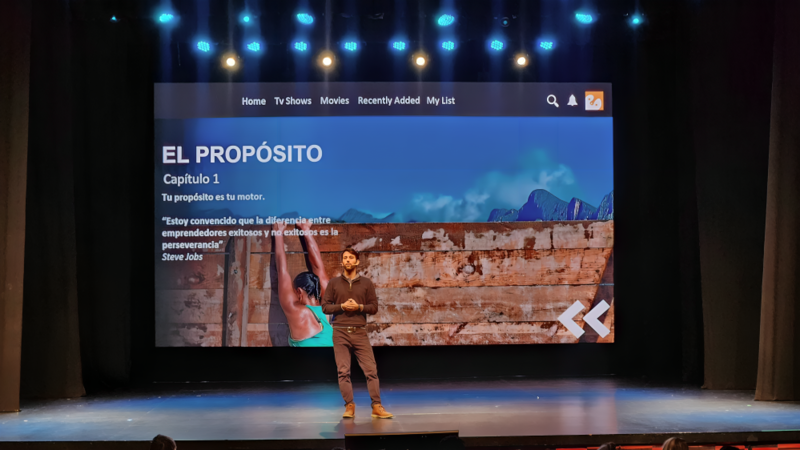
The win in the “Most Innovative Startup” not only positions the platform as a leader in educational technology, but also opens the door to new markets in Europe and other continents. With strategic agreements already in place, such as the one signed with Santander Spain and the partnership with the Once Foundation, ELdeS plans to expand into the European market.
In addition, the opportunity to participate in acceleration and mentoring programs, such as those offered by the EU-LAC Digital Accelerator, will allow the startup to consolidate its growth and attract future investment.
- You might also be interested in reading: “How Artificial Intelligence Is Transforming Architecture”
Social Commitment and a Transformative Experience
As noted in the article “ELdeS, an innovative platform that makes its voice heard,” published in September 2023 by InSitu, Cruzio’s personal story and his social commitment drove the creation of ELdeS.
There, the Architect Martín Curzio recounts how a personal experience—witnessing the communication difficulties faced by a deaf person in an everyday setting—motivated him to create a solution that would facilitate inclusion.
“The day before, I had been at a McDonald’s and saw a deaf person struggling to order an ice cream; that image really struck me and inspired me to create ELdeS.”
This story highlights the founders' empathy and social awareness, making ELdeS a venture that goes beyond technology: it is a tool for transforming lives, break down communication barriers, and promote a more inclusive society.
In addition to teaching sign language, the platform fosters a culture of respect and recognition for the Deaf community, creating a positive impact on society.
- You might also be interested in reading: “Hostile Architecture: Challenges and Alternatives for Inclusive Urban Design”