https://www.youtube.com/watch?v=zdYK4nHwxVQ
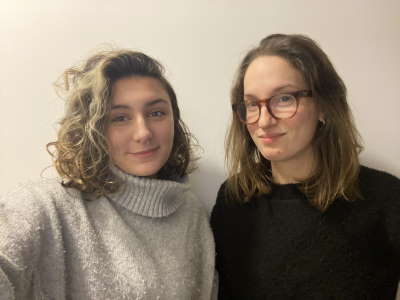 Sofia Caponnetto and Eliana Fernández are advanced students at the Bachelor's Degree in Animation and Video Games. They began to come up with ideas April In 2019, as part of the Production 2 course, they carried out the pre-production phase: conceptualizing the idea, planning, and a large part of the character and set design. Then, in Production 3, they began animating.
“The initial plan was to wrap up production that same year, but we realized that, in order to fully realize our vision, we would have to extend the project’s production beyond the completion of the course,” they said.
They resumed the project in early 2020, but then the pandemic hit and put it on hold. When the university reopened, the designers picked up where they left off and were able to finish it in December. In February of this year, they began the final stage of the process: post-production, editing, soundtrack, and sound design.
“These last two were created in collaboration with professionals in the field. We set out to finish the short film so we could submit it to the International Animation Festival (FIA), and that’s exactly what we did; we premiered *Abril* on September 14 as part of the festival.”
-
What isApril about?
There came a point in Abril’s life when imagination and fantasy could no longer shield her from the reality she was living in: one day, she discovered a new way to escape that would change her life forever.
-
How did the teamwork go, and how were the tasks divided up?
In the early stages, we worked side by side so we could make creative decisions as a team, such as the script and the visual concept. Once production began, we started dividing up tasks to increase productivity; we based this on our individual preferences and skills.
(As for the character, Eliana handled the sculpting and painting of the face and hands, while Sofía was in charge of making the clothes and styling the hair.)
Although we were able to work on some aspects of the project separately, we had to collaborate on others, such as building the skeleton in the industrial design workshop, animating complex scenes, and editing.
-
What role did teacher María Podestá play?
Mostly, it was follow-up work. His background in stop-motion was particularly helpful. He provided us with the essential knowledge we needed to get started on the project.
In addition, the assistance provided by Carlos Galarraga —a professor in the industrial engineering department and the lab supervisor—was essential for building the frame, a task that required operating complex machinery and expertise we lacked. He was always willing to guide us through the process.
Agustín Coutinho advised us on photography and lighting, which are vital to producing high-quality work in this unique animation technique.
At the International Animation Festival organized by Universidad ORT Uruguay, *Abril* won in the categories of Best Student Short Film and Best Uruguayan Short Film. From that point on, the accolades kept coming: the short film was screened at the second edition of Cinemotion, an amateur stop-motion festival in Saint-Herblain, France, where Claude Barras served on the jury; it is in the official selection—and still in competition—at the ADAF Festival in Greece; it has just won first prize in the children’s category at the Stop Motion Film Festival (Mexico), where shorts from all over the world participated.
Expectations
We responded to the course proposal, which offered the option of creating a stop-motion short film, providing the facilities and technical resources essential for working with this technique. We both wanted to take advantage of this opportunity: we were very drawn to the aesthetic and the types of work it could involve (modeling, sewing, carpentry, painting, photography, animation). We sought to tell a story that would make the most of the medium, working with textures, color, and light; it was also important to us that the narrative be moving, that the viewer could empathize: we particularly aimed for a sense of childhood nostalgia.
-
Were you surprised to win the International Animation Festival? Did you get a chance to see the other shorts you were competing against?
We weren't expecting that kind of recognition; we were pleasantly surprised and moved to see the positive and empathetic reaction from the audience, who clearly got the message we wanted to convey—something we weren't sure we'd managed to do.
We got to see some other short films and were thrilled to have had the chance to compete against them; the standard was very high.
-
The short film was then screened at Cinemotion, where Claude Barras was serving on the jury.
Cinemotion is an amateur stop-motion animation festival held in Saint-Herblain, France. We were interested in submitting our work to a festival that focused specifically on this technique.
Claude Barras is the director of *My Life as a Zucchini* (2016), a multi-award-winning film made using this technique. Knowing that an artist of his stature has seen and selected *Abril* is, without a doubt, a great honor. In fact, his film was one of the visual influences behind our short film.
-
In addition, they won first prize in the children's category at the Stop Motion Film Festival.
The Stop Motion Film Festivalis also a festival dedicated exclusively to stop motion, with a longer history and larger scale than the previous one. Being there means forging a connection with the animation industry in Latin America. Being selected alongside just 19 other short films—and being the only one from Uruguay—is a source of pride; not to mention receiving this recognition.
-
As if that weren't enough, they've also been selected for the official lineup of the ADAF festival in Greece.
This festival is the largest and most far-reaching of all those we have participated in so far. Although it is not specifically a stop-motion festival, we are excited to take part in a cross-disciplinary event that values artistic creation. We were specially selected for the limited screening of short films at the in-person edition of the festival, held at the Museum of the Historic Center in the city of Athens.
We always hope to compete in the category we’ve been selected for, but simply being chosen is recognition enough, and the fact that Abril will be seen by as many people as possible is what matters most.
View this post on Instagram