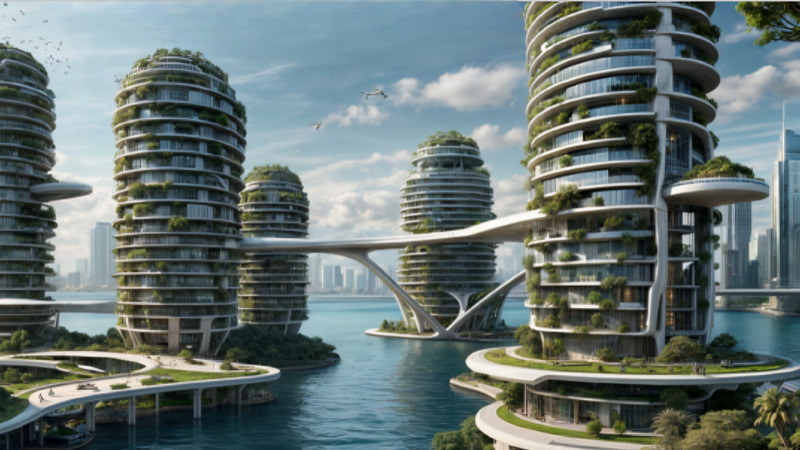
An experience that marks a milestone in the training of architects in Uruguay, the teaching team for the Project 2 course, part of the first year of the Architecture program at ORT, carried out an innovative educational experiment that brings together the latest technologies the discipline has incorporated.
The project focused on the integration of generative artificial intelligence (GAI), augmented reality (AR) and virtual reality (VR) in the architectural design process from the very beginning, at the early stages of professional training.
The goal is for Uruguay’s future architects to explore more ideas in less time and expand their critical thinking starting in their first year. This is how architecture is designed and created today in ORT classrooms.
How to Apply Generative AI, AR, and VR in Architecture
The sand in Piriápolis was still warm when a group of students “erected” a life-size virtual house on the site simply by scanning a QR code.
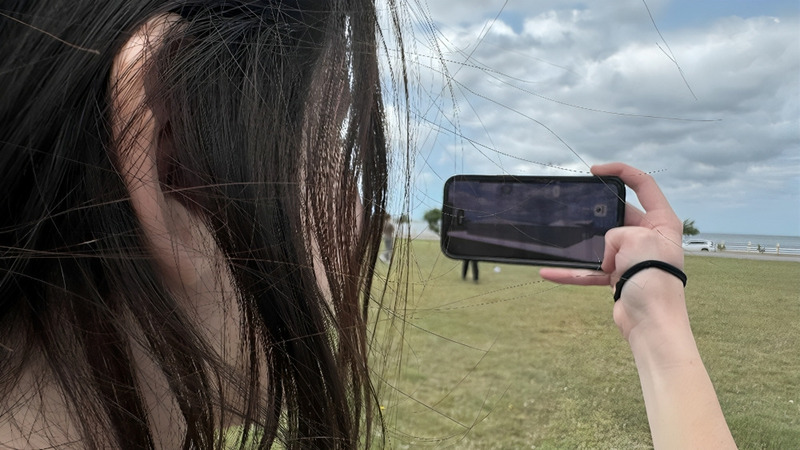
That postcard—more typical of a video game than a university course— encapsulates the new initiative of the Faculty of Architecture at Universidad ORT Uruguay in Universidad ORT Uruguay: to integrate AI, AR and VR at the heart of the curriculum, starting in the first year.
Behind the scenes lies a carefully crafted pedagogical design, funded by the AI-Based Teaching Innovation Fund that the university launched in 2024 to promote replicable best practices.
The project demonstrated that it is possible to boost creativity, shorten project timelines, and enhance critical rigor without technology overshadowing architectural training.
- You might also be interested in reading: “EPICA: Artificial Intelligence to Boost Creativity in Architectural Research”
From CAD to AI: Why in the First Year

“The rise of AI is the third major shift in the way we represent architecture, following CAD and BIM (Building Information Modeling); we must incorporate them while preserving the development of critical thinking,” summarized Architect Gastón Boero, dean of the faculty.
Install the pilot in Project 2 —a first-year, second-semester course—was a strategic decision: the sooner students master the new tools, the sooner they will be able to question and direct them, an exercise in metacognition that became the core of the course.
The workshop “How to Apply Generative AI, AR, and VR to Enhance the Efficiency and Creativity of Architectural Design” took place between August and December 2024, with a teaching team composed of architects Jorge Di Polito, Pablo Frontini, Gustavo Sureda, and Gastón Boero and Gabriel Lambach.
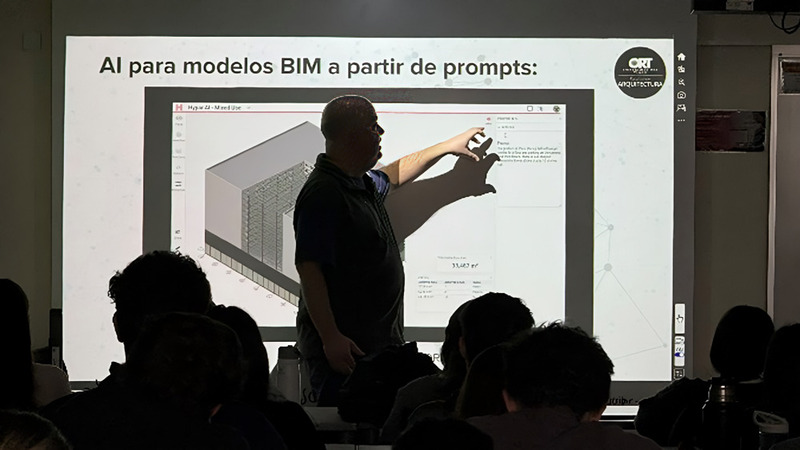
“The main goal was to explore whether these emerging technologies could enhance the efficiency and creativity of design learning, while always fostering students’ critical thinking,” Boero said.
- You might also be interested in reading: “How Artificial Intelligence Is Transforming Architecture”
A Three-Part Methodology
Before going into detail about each phase, it is worth highlighting the overarching focus of the proposal: over the course of a semester, the teaching team combined lectures, workshops, prompting , and field trips to guide students through a sequential process—design with AI, model in BIM, and validate in AR/VR— that turned each assignment into a prototype ready to be explored and critiqued in real time.
The result was a continuous stream of feedback and revisions that, according to the final report, “accelerated content creation and expanded evaluation capabilities in a way never seen before in the first year.”
1. Conceptualization: Envisioning the Architecture of 2124
For three weeks, the students developed hypotheses about what life in the city will be like a century from now. They refined prompts in Midjourney and Stable Diffusion until the images reflected his concepts of density, mobility, and sustainability. The AI acted as a mirror: it forced him to articulate and refine the idea before accepting it.
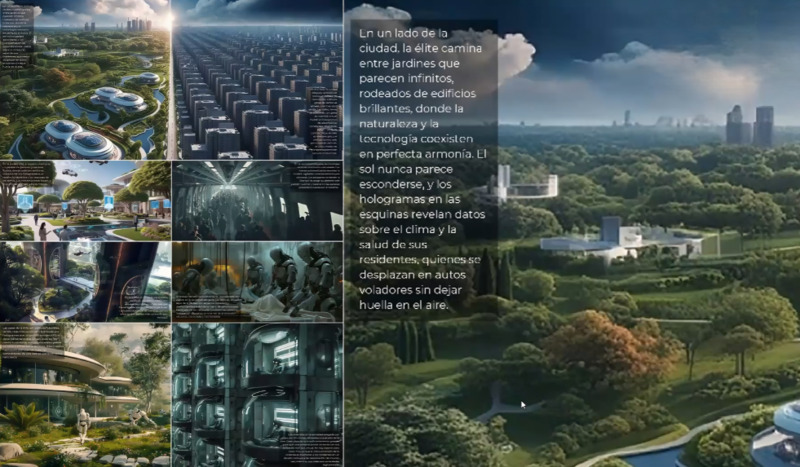
That collection of visions—self-sufficient vertical skyscrapers, floating habitats, or underground cities—served as a basis for discussing climate, resources, and design ethics, incorporating early on a focus on environmental and social impact.
- You might also be interested in reading: “Architecture and Artificial Intelligence: Interview with Architect Gabriel Lambach on ‘Otra Mañana’”
2. Development: From Sketch to Model
Over the next four weeks, the teams translated their sketches into Revit and SketchUp, generated photorealistic renders with Runway and D5 Render and tested materials, textures, and lighting in a matter of minutes, not days.
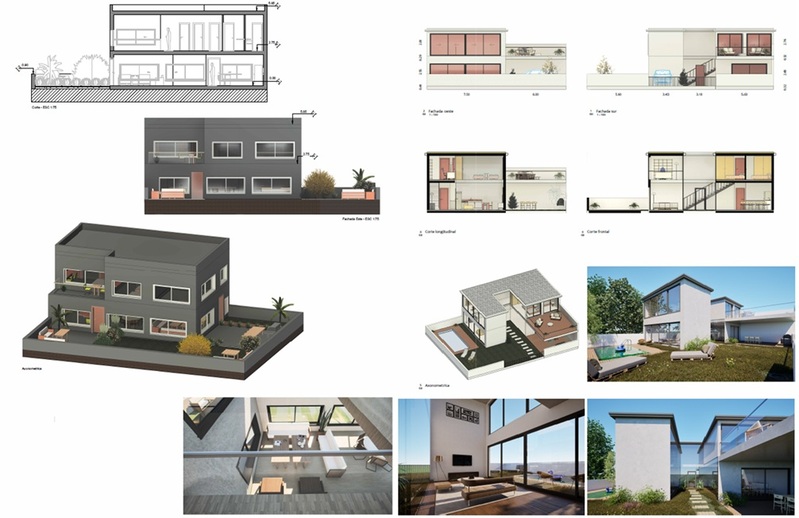
This flexibility made it possible to identify narrow corridors, underutilized double-height spaces, or uneven natural lighting early on, saving time and avoiding last-minute adjustments.
3. Presentation: The House in the Sand
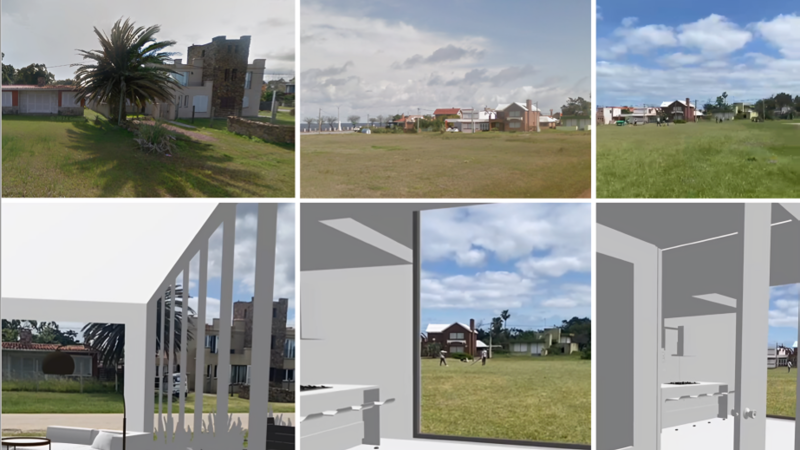
The project was a single-family home on a plot of land in Piriápolis. With Augin, the students superimposed the full-scale 3D model onto the site; they evaluated views, shadows, and the relationship with the coastal topography by walking through their project, tablet in hand.
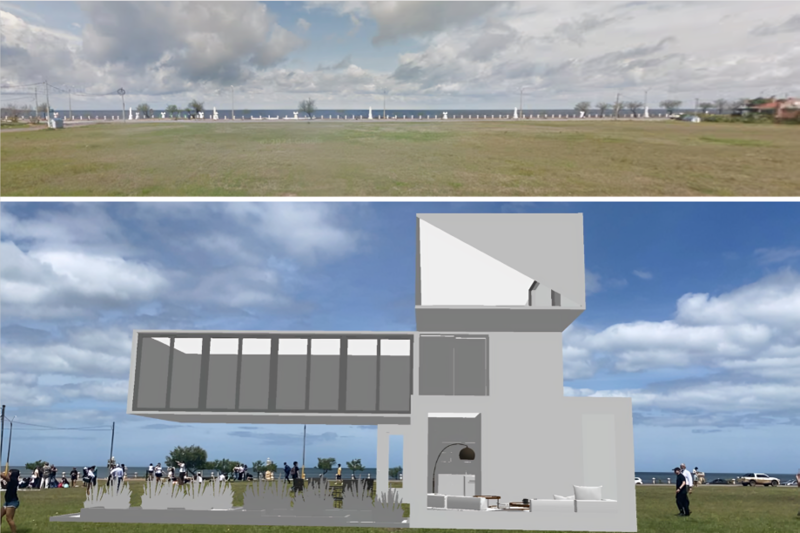
The project culminated in the production of immersive videos edited with Luma AI and Twinmotion, which documented the entire process and served as early portfolios for the participants.
https://www.youtube.com/watch?v=uw5HStmDetY
- You might also be interested in reading: “AI Tools for Architects and Designers”
AI Tools for Architecture
All licenses were free or academic, ensuring equal access for all students:
|
Category |
Tools |
|
Generative AI |
D5 Render, Prome AI, Luma AI, Runway , Minimax |
|
Immersive visualization |
Twinmotion, Augin |
|
BIM / Modeling |
Revit, SketchUp |
By removing the cost barrier, the team was able to measure the educational impact without economic variables or exclusions interfering with the analysis of the results.
- You might also find this article interesting: “Shaping the Future: The Fusion of Technology and Architecture”
Results that speak for themselves
|
Indicator |
Value |
|
Teacher satisfaction (average) |
5.71 / 6 |
|
Dictation accuracy (average) |
5.61 / 6 |
|
Dissatisfied students |
0 % |
These figures are complemented by qualitative achievements:
- Unprecedented diversity of multimedia solutions and presentations comparable to advanced courses.
- More teacher feedback thanks to a constant stream of renders and intermediate models.
Challenges and Lessons Learned
The learning curve in prompting was the biggest challenge: students had to understand the logic behind each generative model and the risks of reproducing visual biases. Additional workshops were held to reinforce ethics and intellectual authorship. In this regard, the project’s final report notes:
“It is imperative that the designer exercise control when defining the intended instructions given to the algorithm in question.”
The pilot project also highlighted the need for intergenerational dialogue: faculty members with expertise in analog representation contributed compositional insight, while colleagues familiar with AI guided the technical aspects, striking a balance between automation and human control.
- You might also be interested in reading: “Architecture and Virtual Reality: Tools, Technological Innovation, and Immersive Design”
Next step: expand the practice
The final report validates the replicability of the method across all project semesters, provided that clear guidelines and ongoing support are maintained to prevent uncritical dependence.
For 2025, the fund outlined a monitoring plan: to measure iteration times, conceptual depth, and student satisfaction in urban planning and construction courses. In this regard, Architect Boero summarized:
“Generative applications have become an ‘extraordinary aid’ in creating good architecture… But human thought remains the guiding principle.”
With digital architecture, the faculty reaffirms its commitment to an educational model in which technical innovation enhances—and never replaces—design thinking, social responsibility, and context-specific creativity.
Would you like to try out these tools for yourself?