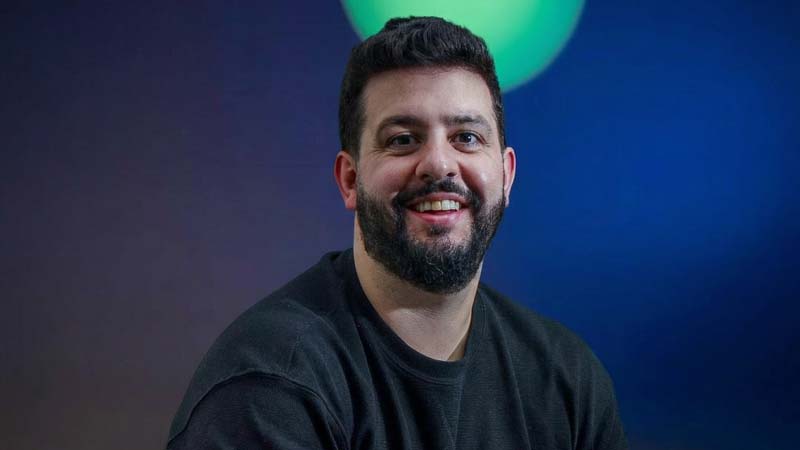
Before founding Akua, Behrend worked at companies such as PedidosYa, dLocal, and Pomelo. At each of these companies, he experienced periods of rapid expansion that shaped his approach to a company’s growth.
“When I joined PedidosYa, there were about 100 of us, and later we grew to 700. It was a great learning experience that taught me how a business expands and what it takes to launch operations in many countries, ”he recalls.
Later, his time at dLocal allowed him to broaden his perspective to include the global market.
“That’s when my mindset shifted a bit. Realizing that you can develop technology in Uruguay and sell it to the world—to companies like Google or Apple—was a major shift in my thinking.”
He also played a role in the early growth of Pomelo, an Argentine fintech company backed by venture capital funds. That experience gave him insight into a different dynamic: that of companies that are launched with the capital needed to grow rapidly.
“You have investment and a very strong mandate for growth. That also gives you a different perspective on how to scale a company.”
A rapidly growing startup
Armed with that experience, he decided to found Akua with his partners about a year and a half ago. The company develops technology infrastructure that enables other companies to launch or improve their payment systems.
Growth was rapid: the team quickly grew to over 60 people, with operations in several countries across the region and dozens of clients.
“We’re currently processing millions of payments a month. We must be doing something right to be growing at this pace,” he explains. In just over a year, Akua has grown its team to more than 60 people, begun operating in several Latin American countries, and now has more than 15 active clients, with others currently in the process of onboarding.
Raising capital with an idea
One of the key moments for any startup is securing initial funding. In Akua’s case, the first round of funding came when the project was still in its very early stages.
When we raised our first round of funding, we did so with a presentation. It was basically an idea, a promise, and the team that would carry it out.
For Behrend, the process of raising capital has unique characteristics that set it apart from other forms of selling. “Ultimately, you’re selling a stake in your company, but also a vision of what it can become.”
As he explains, the venture capital ecosystem is smaller than it seems, and reputation plays a central role. “It’s a world where everyone knows everyone else. Whether you make a good impression or make mistakes, word gets around very quickly.”
He also emphasizes the importance of learning quickly from investor feedback. “You have to constantly iterate. Sometimes you talk to ten funds in a single day, and each conversation forces you to adjust how you tell your story.”
Distributed companies
Akua operates with teams in various Latin American countries, something that, for Behrend, has become a natural part of his way of working. “For me, it’s quite normal now. I’ve been working in companies with teams spread across different countries for years.”
However, he acknowledges that building an organizational culture in that context is one of the biggest challenges. “It’s easier when everyone is in the same office. When the team is spread out, you have to go the extra mile.”
In the early stages of the company, they decided to meet regularly with the entire team to strengthen that shared culture. “The first members of a company end up shaping its culture. That’s why it’s crucial to invest time and energy in building itfrom the start.”
Engineering in the Age of Artificial Intelligence
According to Behrend, artificial intelligence is already profoundly changing the way technology products are developed.
At Akua, he explains, much of the development relies on AI tools, which allow the team to move faster and improve software quality. "We're producing more code, faster, and with better quality metrics. Errors and vulnerabilities have decreased."
From his perspective, this change does not diminish the importance of engineers, but rather transforms their role.
Engineers now have a broader view of the system: how the entire ecosystem works, how it will scale, and how the different components interact.
Thinking of problems as systems
Although he now works in fintech, Behrend points out that his background in telecommunications has shaped the way he approaches technological problems. “Telecommunications teaches you to think in terms of systems—to understand how different components interact, how traffic behaves, and how networks scale.”
He explains that this approach is particularly useful in complex systems such as payment platforms.
“Ultimately, the principles are similar: understanding the entire system, anticipating scenarios, and designing solutions that work at scale.”
The Future of Payments
Looking ahead, Behrend believes that the payments industry will evolve rapidly in the coming years, driven by new technologies. “We’re going to see some major changes. Payments will become increasingly invisible: you won’t need a card or a specific app.”
In this scenario, the user themselves will serve as the payment method. “The merchant will identify you using various technological means, and the payment will be processed almost automatically.”
For Akua, the goal is to build the infrastructure that enables these new payment experiences. “We want to create the technological foundation so that new companies can launch modern financial products and so that merchants have much more control over their payments.”
Learn more about Telecommunications Engineering