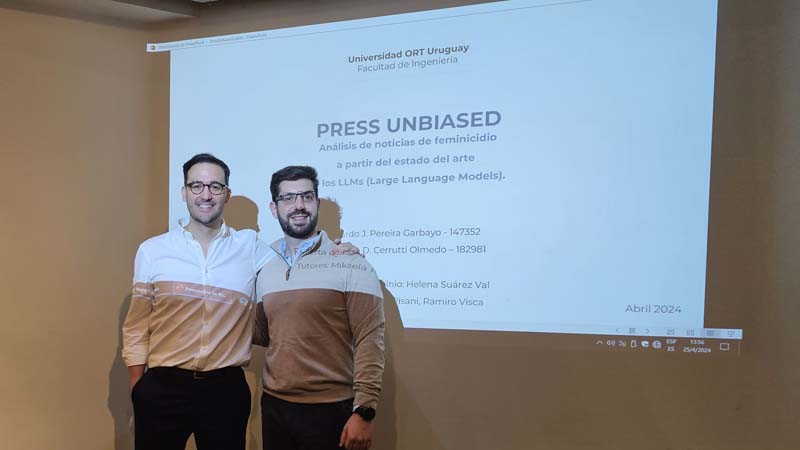
In collaboration with researcher and activist Helena Suárez Val, founder of Feminicidio Uruguay, they have used artificial intelligence tools, such as ChatGPT, to identify and mitigate gender bias in media coverage of these cases. Her thesis highlights significant advances in algorithmic auditing for social justice and proposes innovative methods to improve accuracy and objectivity in journalism.
How do you come up with a topic for your final project?
As a society, we are witnessing the problem of femicide in Uruguay; we see on the news and social media how this alarming situation surrounds us and reveals a reality that is hard to ignore. We don’t need to be personally affected by this violence to understand and empathize with this problem, which restricts the freedom of all women and their human rights. But we can start there: we all have a mother, perhaps sisters, wives, daughters, aunts, cousins, friends, and the list goes on—enough to realize that all women and girls are threatened by this tragic reality.
It was based on this reflection that we decided to put our energy and the knowledge we gained from the Master’s program in Big Data to good use, and through a friend, we got in touch with the NGO Asociación Civil El Paso, which is dedicated to defending the human rights of girls, adolescents, and women.
Through this NGO, we met Helena Suárez Val, a researcher and activist dedicated to feminism and human rights. In 2015, she founded Feminicidio Uruguay, a registry and mapping initiative documenting cases of femicide in the country, and since 2019, she has co-led the international participatory action research project *Data Against Femicide*.
At those meetings, we were able to learn about studies, publications, research, and developments related to the issue of femicide, and in some cases, artificial intelligence was used as a tool.
Amid discussions aimed at exchanging ideas and finding solutions to outstanding issues, Helena shared a concern that had been on her mind for some time: identifying gender biases in media coverage of femicide cases.
Understanding and attempting to mitigate these biases could lead to a more ethical and responsible portrayal of femicide cases, ensuring that victims are treated with greater respect, reducing the perpetuation of harmful stereotypes, and helping to raise awareness about this social issue, ultimately contributing to a more just and equitable society.
Driven by advances in artificial intelligence—and particularly by the rise of tools like ChatGPT, which allow users to ask questions and receive answers of near-human quality—the idea emerged to explore its potential as a tool for addressing the issue described: identifying and mitigating bias in news coverage of femicides.
What research was included in this thesis?
Throughout the research, we used an iterative, incremental approach that involved:
- Process for consolidating bias rules based on publications and guidelines regarding bias in news coverage, and the development of prompts for rewriting news stories using the list of bias rules as a foundation.
- Process for creating a novel list for bias detection, as well as the corresponding refinement of the prompt, and the evaluation and comparison of bias detection capabilities (without providing a support list) among the selected models
- Process for compiling a list of biased phrases based on the knowledge present in LLMs, along with their respective explanations, remediation, and validation through expert judgment.
What were the most significant findings of the analysis? Were there any results that surprised you?
- The research shifted toward an approach more closely aligned with what is known as Algorithmic Auditing for Social Justice, as evidence was systematized and presented regarding the performance of the Large Language Models (LLMs) studied in relation to their ability to identify and mitigate biases, rather than developing a specific technological solution.
- The importance of defining and implementing an adaptive, continuous-learning approach given the constant evolution of large language models (LLMs), and the need for ongoing reassessment and adjustment to effectively manage the improvements in each model.
- Despite the tactics used to completely eliminate the hallucinations generated by these models, we were able to establish certain boundaries to mitigate them, though not to eliminate them entirely. We want to emphasize that it is we humans who consider certain responses given by the model to be “hallucinations” because we interpret them as false or fabricated; the truth is that the model responds correctly, since fundamentally what it does is generate, through a process, the word that mathematically has the highest probability of being correct.
- The ability to identify biases in the models studied follows a stochastic pattern, meaning that each run is unique and may omit certain identifications. We recommend running the same prompt multiple times and combining the responses to generate the final result.
- This thesis demonstrates that addressing the challenge of bias in LLM models must involve multidisciplinary collaboration—specifically, but not limited to, experts in gender studies, sociology, and engineering—in order to sustain spiral learning.
We were surprised by how ChatGPT, Claude, and Gemini improved over the course of our thesis work—particularly Claude, with the addition of Constitutional AI, which aims to ensure that its model’s responses are safe and aligned with the UN Declaration of Human Rights.
How could these findings be used to improve objectivity and accuracy in journalism or other fields?
The findings of this thesis provide tools for improving objectivity and accuracy in news reporting and other fields. How? Through a replicable methodology, rigorous research techniques, Helena’s active participation as a subject matter expert—which highlights the importance of including stakeholders in these topics as an integral part of our research in big data and artificial intelligence—and, finally, the creation of original documents to support journalists’ work in promoting more responsible journalism and a better-informed society.
In particular, journalists can make use of the archives, which include a set of rules for rewriting and identifying bias, as well as a dictionary containing 45 biased phrases, each accompanied by an explanation and a suggestion for how to address the bias.
What specific knowledge of big data did you find most useful during your research?
Having a general understanding of artificial intelligence—and specifically its subfields, such as machine learning, deep learning, natural language processing, generative AI, and large language models—provided us with the foundation to understand how GPT models work through the Transformer architecture and its innovative self-attention mechanism, which was the key to achieving this emergent property of human-like text generation.
It also helped us understand the challenges of using an open-source model, both in terms of the need for properly labeled data in the supervised learning process and the significant computational power required to train a model of this kind.
Understanding reinforcement learning through human feedback —a feature present in models such as ChatGPT, Claude, and Gemini—has helped us recognize the need for a different approach, introduced by Claude, known as Constitutional AI, which may be the key to ensuring that these models’ responses are grounded in a framework of nonviolence and respect for human rights.
Have a mechanism for conducting tests, as well as the use of metrics such as Bleu, Rouge, and sentiment analysis to facilitate comparisons between models/versions.