
In less than three years, ChatGPT achieved unprecedented adoption. In July 2025, the study "How People Use ChatGPT"—published by OpenAI, Duke University, and Harvard University—estimated approximately 700 million monthly users. By October of that same year, Sam Altman, CEO of OpenAI, announced that the number of weekly active users had reached 800 million.
The change isn't just technological: it's redefining how we teach, how we learn, and what it means to be prepared for the future.
In response to this challenge, Universidad ORT Uruguay a clear leadership role in our country by integrating artificial intelligence (AI) into its educational model—not as just another subject, but as a fundamental component of university education.
“The greatest challenge posed by artificial intelligence is not technological; it is human. We have to teach people the importance of lifelong learning,”said Dr. Jorge Grünberg, rector ORT, at the AI 2025 Summit, held on June 20 in Montevideo.
This approach translates into concrete actions that involve both teachers and students in the responsible use of AI.
https://www.youtube.com/watch?v=2egAOZZWo7M
Teachers who learn, teach, and create
The integration of artificial intelligence into university education takes place not only in the classroom but also in ongoing teaching practice. At ORT, faculty members are not merely users of technology; they are active participants in the process of educational adaptation and innovation.
As Dr. Grünberg argued during the conference "Artificial Intelligence in Education: A Discussion of Threats and Opportunities," held in Bulgaria in 2024, AI should not be subject to restrictions, but rather an active part of the educational process, incorporated responsibly and critically into students' education.
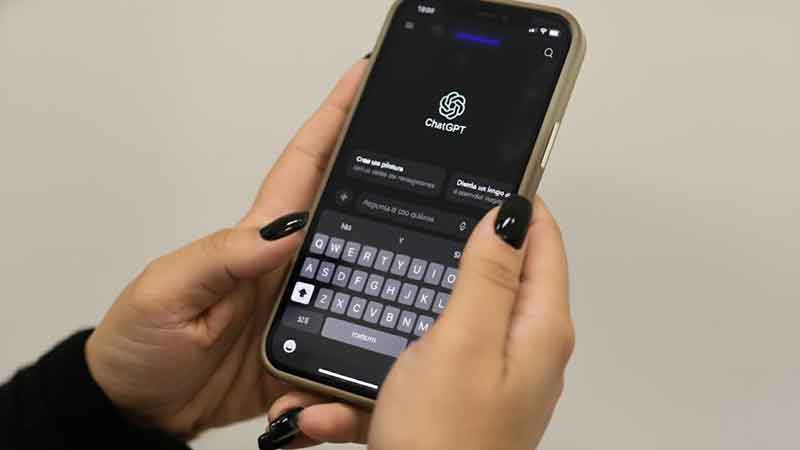
The university encourages each faculty member to explore how AI tools can enhance course planning, assessment, and student support, within a clear ethical and pedagogical framework.
For example, in 2025, the AI-ORT Teaching Assistant was introduced—an in-house application that enables teachers to plan lessons, create activities, design assessments, and provide personalized feedback.
In addition, there is an ongoing teacher training program coordinated by the Center for Continuing Education in Higher Education (CAES). Hundreds of teachers have already participated in workshops on generative AI, assignment design, and academic assessment in hybrid settings.
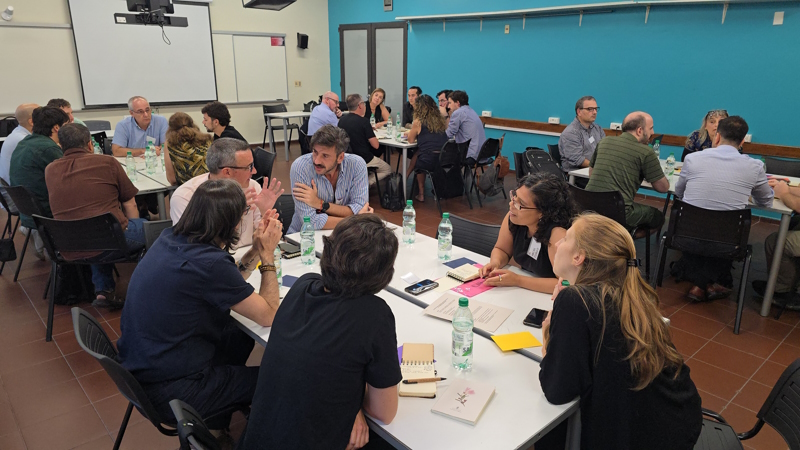
The guidelines developed by the Institute of Education and CAES—including "The Use of Generative Artificial Intelligence Tools in Teaching" (2023) and "Assessing Learning in the Context of Generative AI Use" (2023)—set a standard: to promote the ethical and creative use of AI, requiring transparency and pedagogical value.
AI in the curriculum
In the School of Engineering, courses in artificial intelligence, machine learning, and data science are integrated into the curriculum from the very beginning. In programs such as Systems Engineering, the Certificate in Artificial Intelligence (CerIA) provides a well-rounded education that combines theory, practice, and ethics.
“We can only understand the phenomenon of generative artificial intelligence if we gain some understanding of how it works and what its risks are, ”said Eduardo Mangarelli, dean of the School of Engineering, during a workshop for journalistsheld on August 11.

This integration is already explicitly reflected in the curricula of short-term degree programs such as Software Analyst and Information Technology Analyst, which include specific courses such as AI-Assisted Web Development and Full-Stack Development Integrated with AI.
In these courses, students use programming co-pilots and generative tools as development assistants, streamlining coding, documentation, and testing processes. They also learn to integrate AI services and APIs into their applications, replicating practices found in the professional world.
In the School of Management and Social Sciences, discussions about artificial intelligence take place both in the classroom and in teaching practice. The dean, Dr. Teresa Cometto, has emphasized the importance of strategically integrating generative AI to enhance learning, redesign assessment, ensure transparency in the use of these tools, and train professionals with ethical standards and a clear sense of purpose.
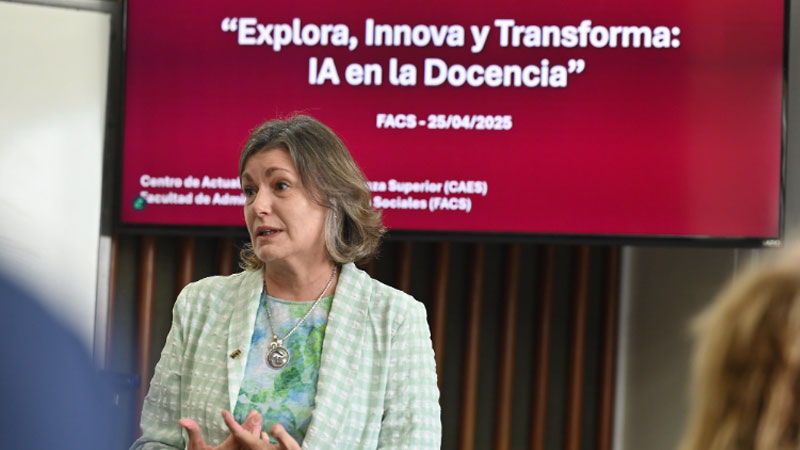
In turn, events such as the recent conference“Artificial Intelligence and Accounting: A Journey Toward Innovation”expose students and graduates to real-world examples where AI serves as a strategic ally in management, accounting, and finance, reinforcing the idea that understanding and applying AI is now an integral part of the university’s business curriculum.
Creativity and Critical Thinking with AI
In the School of Communication, educational initiatives such as the "AI for Journalists" workshop (August 2025) have set a new standard.
The discussion focused on how media outlets can use AI to verify information, analyze audiences, and detect bias, as well as how to train journalists to critically explain these systems.
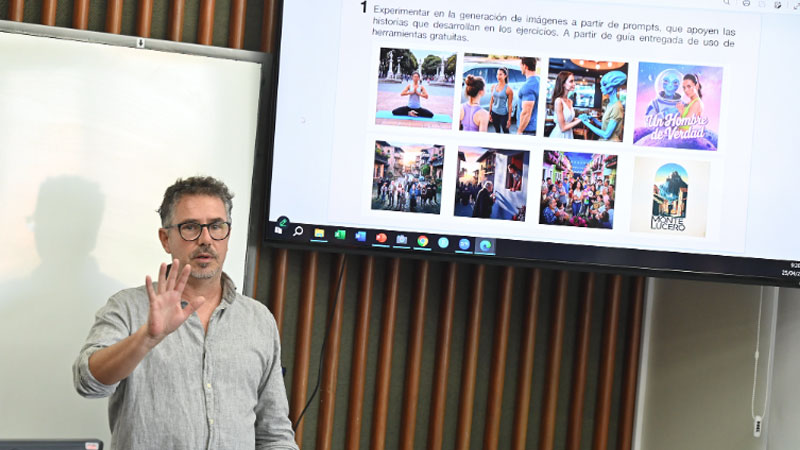
“We have incorporated artificial intelligence into our curriculum and offer it to our students, but we do so in an informed manner, with a focus on academic integrity and on providing them with the best tools while fostering a critical understanding of its use,” said Dr. Esteban Zunino, dean of the faculty.
In the School of Design, artificial intelligence has been integrated into the curricula of various degree programs since 2023 as a tool for creative exploration and to support conceptualization processes.
One notable example was the recreation of the voice and face of Uruguayan poet Delmira Agustini using generative AI—a project that, two years ago, combined technology, art, and cultural sensitivity, prompting reflection on the limits of digital creation and artistic representation.

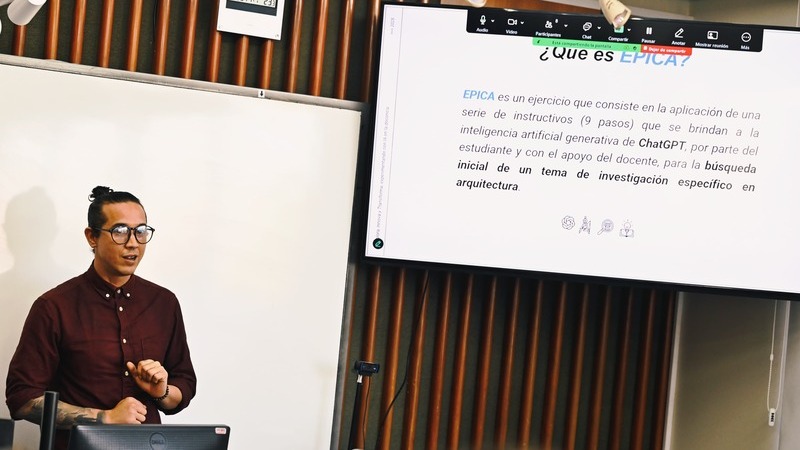
In addition, the School of Architecture has implemented an eight-class course that leverages artificial intelligence as a tool for design thinking, guiding students through a process in which generative AI models are used to explore, compare, and refine ideas in architectural research.
Thus, AI serves as a creative stimulus rather than a substitute for human judgment: it expands the capacity for inquiry, accelerates conceptual exploration, and fosters reflective learning about the limits and possibilities of technology-assisted design.
Learning to Learn in the Age of AI
At Universidad ORT Uruguay, artificial intelligence is neither a standalone subject nor a passing fad, but rather a distinctive educational feature that permeates degree programs, projects, and research.
Back in 2024, ORT issued a call to its faculty members to embrace experimentation, innovation, and rethinking educational practices using artificial intelligence. A total of15 projects were implemented, involving more than 30 faculty members, which allowed for the sharing of experiences and lessons learned—insights that now inspire new approaches at the university.
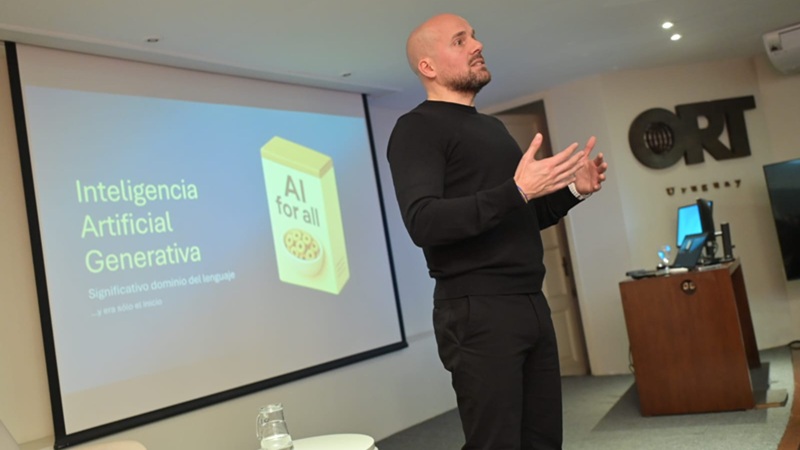
Students here learn to use AI as a natural part of their education: to create, analyze, solve problems, and, above all, to learn how to learn in a world that is changing at the speed of its own tools.
At Universidad ORT Uruguay, artificial intelligence is now more than ever an integral part of the academic fabric.
It not only transforms the way we teach and learn, but also redefines how we conceive of knowledge: flexible, critical, and oriented toward constant change.