https://www.youtube.com/watch?v=OuLXgVTyFN8
In the early 20th century, Latin American countries needed their own identity to establish themselves as nations. In Uruguay, a group of intellectuals decided to create the heroes who would shape the patriotic narrative of independence. Among them, Juan Manuel Blanes, the “painter of the homeland,” invented the faces that are still displayed today in every school, office, plaza, and on every coin in the country. But everything could change when an Artigas fanatic hires the world’s most renowned forensic artist to reveal the hero’s true face.

The documentary *Detrás del mito*, directed by Marcelo Rabuñal, who holds a degree in Audiovisual Communication, opens in theaters on June 29. Starting July 14, it will be shown at Cinemateca Pocitos and, through the Uruguayan Cinema Network, will be screened at cultural centers across the country.
When did your interest in Artigas—and, specifically, in the image that has been constructed of him—begin?
I've always been interested in issues related to the construction of identity—how our cultural traits are formed—and Artigas plays a key role in that.
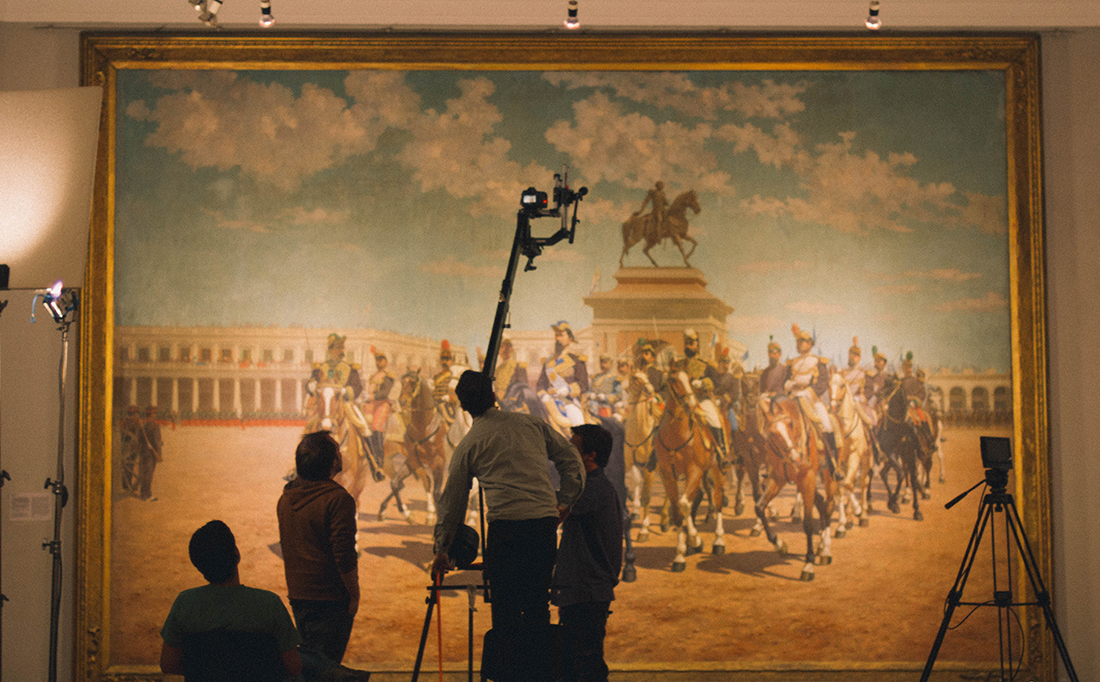
In the case of the film, it was more of a journey than a specific interest; I began by studyingJuan Manuel Blanes and his works, and during that research I discovered thathis most widely reproduced painting—one that’s so present in our lives— hadn’t been studied very much. Beyond specific works by Laura Malosetti or Carlos Demasi, there wasn’t as much literature on it as there was on the “Treinta y Tres” painting, for example. So that’s when the idea arose that something could be done about it that wasn’t just a rehash.


When did you come up with the idea for this documentary, and when did you start working on it?
I believe it was in 2012 that the ICAU added the “Documentary TV Series” category to the grants it awards for production. At that time, it occurred to me that I could submit a series on Uruguayan painting, with each episode focusing on a different painter, their life, and their work. Naturally, I started with Blanes, since he is the first Uruguayan painter, and I developed that episode in greater depth. Then I showed it to some friends, classmates from college, and they told me that with a few tweaks, it could become the script for a feature film.
In 2013, I introduced it as Behind the Myth for the Ópera Prima documentary fund, and we won. With that support, I spent several months continuing my research. During 2014 and 2015, we shot and edited most of the footage.
How did you first get into this topic? Where did you start?
There wasn’t a specific approach; part of what I set out to do when I began was to learn as I went along and stay open to whatever came my way. I did a lot of research before filming, but not with a specific goal in mind: I researched Blanes, his life, and his paintings, but also the construction of Artigas as a hero, as well as the influence of works of art on our perception of our history. That’s how I came across several very interesting works on these topics, notably the book *The Construction of Uruguayan Identity* by Carolina González Laurino , and the essay *The Construction of a Supreme Hero* by Carlos Demasi. Along the way—among other things—I went to read Blanes’s handwritten letters, which are in the Historical Archive, or to look for old films about the Treinta y Tres at the Sodre Image Archive. By the end of the research and filming process, I had accumulated a great deal of information, so the editing process was a difficult one. I would like, at some point, to publish more material that didn’t ultimately make it into the film.
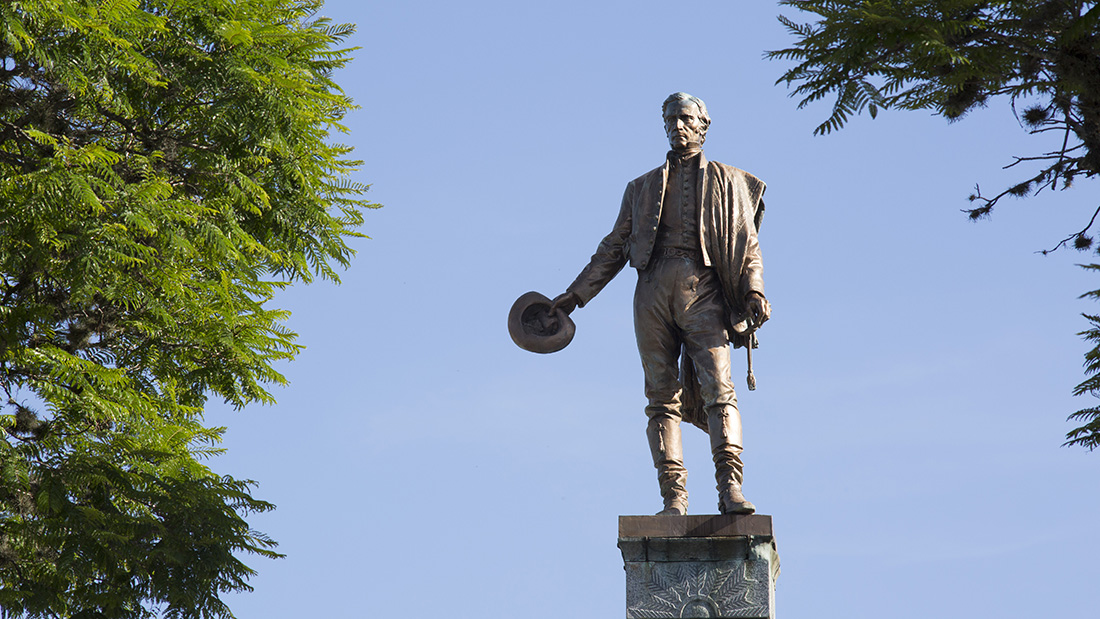
The film features dozens of images and monuments of Artigas—in schools, offices, public squares, and so on. Did you conduct a survey, or did you simply document them as you filmed and came across them?
Most of the shots of the Artigas paintings at the entrance to the Citadel were planned in advance; the producer, Martín Ubillos, his assistant, Jimena Vila, or I would go out to visit public offices and decide whether they were suitable for filming. We would then make the necessary arrangements, since you can’t film in these kinds of places without permission.
The statues were easier to handle because they were in public places; we shot those on the fly. We knew where some of them were, like the ones in Maldonado, Montevideo, and San José (which is the first one to appear), and we looked for others on our way to other locations, such as Estancia Ordoñana, where Blanes stayed when he went to do research for the painting of the Treinta y Tres. We would enter each town, look for the plaza, and film the monuments.
I think there are about twelve hours of footage of monuments from all over Uruguay.
The documentary presents a little-known portrait of Artigas: a frontal view of him in his old age. It was commissioned and created by the American Stephen Mancusi, a forensic artist who has worked for the New York Police Department.
Before seeing the film, what did you know about Blanes’s version and Mancusi’s?
Before the research, I knew almost nothing about the history of the painting; I knew a little more about Blanes’s life, but I found it increasingly interesting as I worked on the film. I also learned about Mancusi’s portrait during the research; the news appeared in the newspapers, and that’s when I contacted the people involved. I interviewed Nelson Caula, the journalist who provided the historical information for Mancusi to create his portrait, and during the interview he told me that it had been Dr. Osvaldo Aren who had hired the American forensic expert. I sent him an email, since Aren lives in Chile, and the next day he was calling me, absolutely thrilled, to tell me his whole story. When he finished, I said, “Now you’re going to have to tell me everything again on camera,” and he did so with the same energy as the first time.
Almost all the experts consulted mention that it would be, at the very least, interesting for us Uruguayans to reevaluate the image we have of Artigas in our minds. What do you think?
I believe that, as part of our journey into adulthood, we need to debunk certain myths we’re taught in school. Analyzing the image and understanding its symbolic meaning is part of a broader process: understanding where our concept of nationhood—of what it means to be Uruguayan—comes from. This does not mean we should replace all of Blanes’ paintings or tear down the statues in the squares, but rather that we need to understand why they are there in order to become more mature as a nation. Today we are experiencing a crisis of community, due to various economic and cultural causes; the idea of brotherhood within a nation is being lost, and there are many subgroups that view others as enemies. Something similar happened at the beginning of the 20th century; the Great War and the subsequent clashes between the Blancos and the Colorados had divided society, and that is when the decision was made to reinforce unity by exalting certain values, associating them with heroes like Artigas. Perhaps today we need to reconsider whether those symbols are still valid or whether they need to be adapted to current problems.
Now that the film is finished, what are your thoughts?
It's hard to judge; making a film is a very long process in which your goals shift due to circumstances or because you yourself change. I'd rather have those who watch it be the ones to judge it.
What I’d like to see is for as many people as possible to see it, and for it to spark a broader discussion about our culture, the value of national art, and its influence on education.