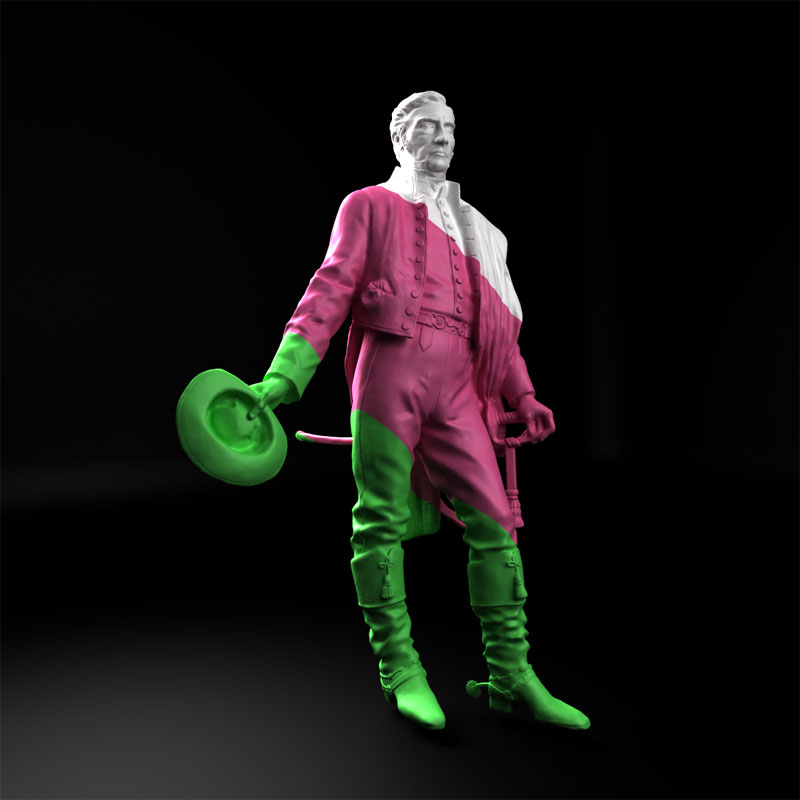
How would you describe the Herencia Blanes project?
The stories from 1900 are incredible. I’m listening to the news right now, and I can’t believe that in 100 years there will be someone looking back and saying, “How wonderful,” just as I say today when I look back.
Maybe it will happen. *Herencia Blanes* is a traffic accident, a collision at Millán y Castro at 20 miles per hour, a spear piercing the left side, several men in hats lifting the pierced body and carrying it to the pharmacy.
Who would think of going to the pharmacy these days to ask for help? Perifar? Aspirin?
The deceased is Blanes' son: Juan Luis. Some sources refer to him as the first Uruguayan sculptor.
He had been commissioned to create the first three-dimensional sculpture of Artigas, but he was unable to complete it.
His father agreed to create the sculpture on the condition that as many copies as possible be made.
Each copy would bear the name of a child. Years later, the state cast the sculpture into dozens of replicas, always using bronze donated by the public.
The Herencia Blanes project makes the 3D scan of the sculpture available to the public for free reproduction.
What are its main objectives?
The same objectives as someone who writes a poem. No objective and all of them at once.
Why did the project come about?
I’ve had a taste for 3D scanning since the Hack.
You use colors that, at first glance, seem strange and difficult to associate with Artigas. Why did you decide to use those colors?
The initial intention was to do everything with 3D printing. It was excessive. Much more enthusiasm than the answer can convey.
I assumed that each person (who joined in the effort) would have their own role to play and that none of them was insignificant in the face of necessity.