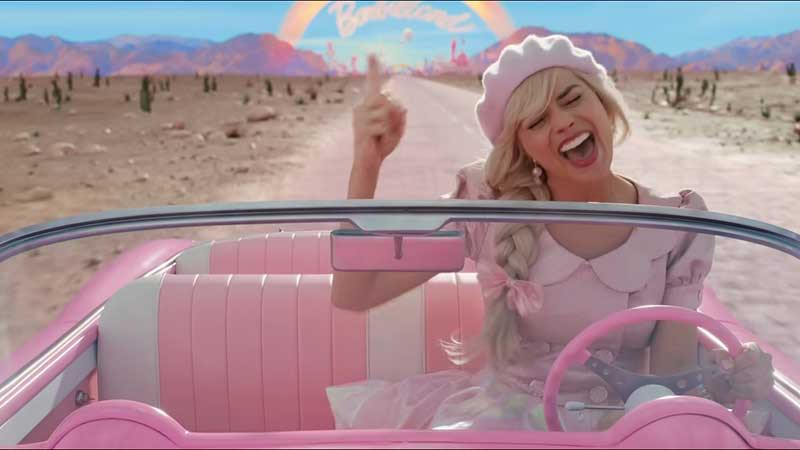
“I don’t have a history with Barbie,” admits Enrique Badaró, a visual artist, theater set designer, and professor of Art Direction in the Bachelor’s Degree in Communication (Audiovisual Track ) and the Associate Degree in Audiovisual Production at ORT. Before seeing the film, the only thing connecting him to Barbie was his daughter’s childhood—she is now 29—and he went to the movies with her to see the film. “I view the Barbie icon from a very particular perspective, given my age (almost 70) and my theoretical background.”
Building a character based on an icon
Badaró believes that the character portrayed in Greta Gerwig’s film is “very well done” because the viewer begins by “accepting this Barbie who is shaped by the Third World’s perspective on the United States, on American culture, and on stereotypes.” Through actress Margot Robbie, “Barbie has it all: she’s gorgeous, blonde, blue-eyed, with the proportions society demands.”
At the same time, viewers see another side of Barbie—one of female empowerment—through roles that were not accepted in the 1960s, when the famous doll was first released. “So that blonde, Anglo-Saxon Barbie begins to transform in the film; she starts to be challenged by Barbies of African descent, Asian Barbies, plus-size Barbies, and Barbies with disabilities: a whole world that is beginning to break free from those stereotypes.”
https://www.youtube.com/watch?v=Ser2f-RCe80
-
Barbieland: An Ideal World
The world depicted here is, in a way, a projection of an ideal world—a perfect world as imagined by a child.
There, an element of an imaginary natural world is incorporated, drawing on architectural elements from Los Angeles but transformed into that toy-like, fictional, unproblematic world: there, everything is perfect.
-
The theatricality of embracing fiction
The game world is so vividly recreated that, when the dolls go to drink water, no water comes out, but they drink it anyway; what we see is the theatricality of the gesture. That’s when something quite magical begins: the viewer is truly drawn into the mind of the girl who is playing.
Everything works in that world where the basic rules of reality don't make much sense. For example, they don't go down stairs; instead, they move from top to bottom as if the girl were passing the doll from one step to another.
There is a whole world where fiction is stark: reality bears little resemblance to anything other than the dreamlike world of the game, and reality belongs to that fictional world, where that theatricality exists. And one must accept that fiction, that unreality where we embrace those codes without any qualms.
Art design and the use of color
The professor believes that the art direction plays a fundamental role in Gerwig’s film, as it presents a world that, in a way, recreates “the architecture, spatiality, and atmosphere of a children’s playground.” Everything is organized from a chromatic perspective “in a perfect way”: the colors are all high-saturation, pastel shades, slightly muted with white, which gives it “a childlike, romantic, dreamlike tone,” he elaborated.
The use of color becomes essential for changing scenes or introducing new characters, as is the case with “Weird Barbie”: the pastel white disappears, but very pure colors are still visible, so it’s very subtle, according to Badaró.
To be fair, Barbie was just being honest here. Get tickets now for #BarbieTheMovie, NOW PLAYING in theaters only: https://t.co/p0sygCEvZr pic.twitter.com/0cjr9vWC96
— Barbie Movie (@barbiethemovie) July 24, 2023
“Barbieland is the world of dollhouses, with that slightly hybrid, eclectic, very simple style—flat floors, grand columns, lots of pink wallpaper, and large Los Angeles-style windows that open up to the outside without any boundaries,” the professor explained. The “Weird Barbie” house proposes the opposite: “American colonnades, a bit stately, everything slanted, everything turned upside down, transformed—the orthogonal becomes an element based on slanted lines.” “This could be a class on color art direction, because we could delve into how to use color: the same colors with a little white already create a different world, and both are part of Barbiland.”
https://www.youtube.com/watch?v=PMnTHTf7q8k
Create authentic worlds and connect with the audience
Enrique Badaró is convinced that all professionals involved in making a film must, above all else, focus on empathy and sincerity, just as they would with any artistic work. He noted that art, in any of its forms—whether theater, film, photography, or printmaking—is always fiction, “because it is always the vision of creators who bring us closer to reality through their eyes, their hands, and their tools.”
Great art occurs when, without needing to rely on realism, the viewer feels empathy and believes that what they are seeing is true—at least for that moment. That is the magic of art in general.
https://www.youtube.com/watch?v=nTRHTLsYxEE
“When you go to the movies,” says Badaró, “you’re moved, you laugh, and you cry because ‘the director, the art director, the cinematographer, and the actors are convinced of what they’re doing—for them, that’s reality.’” Everything else, he continued, “is about adding layers of information and context.”
Creating worlds is the result of teamwork—“of respect and discussion among those who handle the more theoretical aspects, those who write the script, those who design the set or select a location, those who ensure a character’s entrance is consistent with their specific costume, and those who consider how those colors not only represent the characters but also interact with the set, the backdrop, and the other characters.”
As an example, he described the scene where, “after all that crass seduction” of the Barbie world, the protagonist arrives in Los Angeles dressed in fuchsia pink, “totally Barbie,” and walks into the Barbie company. At that moment, the colors change, and almost all the characters are dressed in black. “When that woman in pink walks in, I feel like she’s lost, that she’s in a place that isn’t hers, she’s in a place where she’s going to seek help but won’t find it,” reflects Badaró. “So through color, the art director or the cinematographer manage to make me believe the scenes that are unfolding.”
https://www.youtube.com/watch?v=d8PpD5xnLr4
References to film history
The film gets off to a masterful start, Badaró argues, with a nod to the history of cinema and art, specifically to Stanley Kubrick’s *2001: A Space Odyssey* (1968). “In our minds, those girls overlap with the Australopithecus or hominids that Kubrick presented 50 years ago,” given that the set design, the colors of the sky, and, above all, the music are the same as in Kubrick’s work.
“It is essential to understand the conceptual fusion of Richard Strauss’s soundtrack *Also sprach Zarathustra*, composed in 1896—a leitmotif that Gerwig uses at the beginning of the film to reinforce the phallic/Paleolithic mindset—in the company meeting attended solely by men dressed in black,” Badaró notes. “That is why history—the history of cinema, music, and art—is essential for understanding cinema, and contemporary cinema in particular.”
“2001: A Space Odyssey” vs. “Barbie”
— R E P L I C A N T (@Roybattyforever) December 17, 2022
I don’t see any differences.
pic.twitter.com/hAJMr0gwd6
Barbie is having that kind of impact. To begin with, we need not only the ability to accept that reality as if we were children, but also the flexibility to shift from one space to another and the capacity for a cinematic memory.