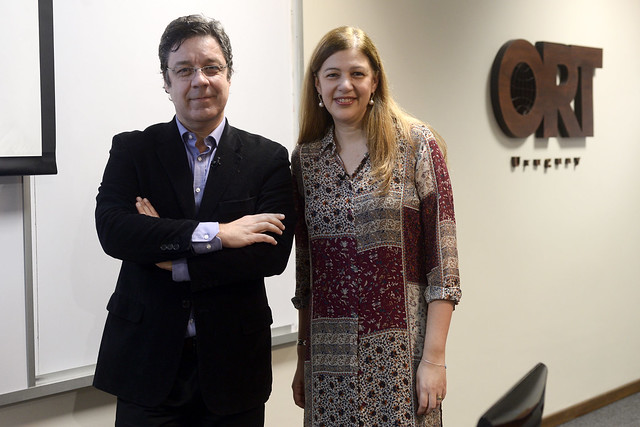
Those were some of the questions answered by both Dinorah Margounato—who holds a bachelor’s degree in Management and Administration and serves as associate academic coordinator of Marketing at Universidad ORT Uruguayand Gonzalo Sobral—who holds a bachelor’s degree in Social Communication, a master’s degree in Business Administration, and is a professor.
The conference “Marketing for Millennials” was held on Tuesday, September 13, 2016. It was part of the Management and Business Lecture Series organized by the Graduate School of the Faculty of Administration and Social Sciences.
Who are they?
Gonzalo Sobral was tasked with presenting the results of the research conducted by the Observatory of Innovation in Digital Communication.
There, they analyze the messages posted by millennials in Uruguay every month. These amount to between five and six million tweets. Sobral explained that they chose this medium because it is one of the ways millennials use to express themselves.
Similarly, the journalist first clarified what is meant by the term “millennials.” While there are various definitions, the Observatory defines them as individuals born between 1981 and 1995. In Uruguay, about 25% of the population are millennials, which amounts to roughly 800,000 people.
According to Sobral, more than 80% have Internet access. They are known for being discerning consumers who seek personalization and also tend to pay attention to advice from “influencers.”
What are they talking about?
Soccer and sports are the main topics of conversation among millennials on Twitter. Posts are generated in equal measure by men and women. Therefore, Sobral sees this as an “incredible” communication and marketing opportunity for brands.
The expert also said that there is a response to social causes. For example, in April, regarding the tornado in Dolores, and in May, regarding the incidents in the Marconi neighborhood: “Every month, different social causes emerge that concern millennials and force them to take a stand on one side or the other.”
At the same time, he explained that there is an “Argentine influence” in culture and music. This is because that generation mainly talks about Marcelo Tinelli, Argentine YouTubers, and the singer Lali Espósito.
According to him, there are “few elements of deep-rooted Uruguayan identity that appear in the bulk of the messages millennials are posting on Twitter.”
What they do
Margounato delved into the characteristics of millennial social media users. On average, they have 3.5 social media accounts—more than the average of 3.1—and they primarily access these platforms via their cell phones.
“If people spend 60 minutes on social media, on average 37 minutes of that time is spent on a cell phone, 20 minutes on a desktop or laptop, and three minutes on a tablet,” he said. “This leads us to reflect on corporate communication, which must be designed to be compatible with all devices.”
The vast majority have a Facebook account and follow Instagram and Twitter. Furthermore, according to Margounato, 96% of Facebook users log in at least once, although they generally do so several times a day. That is why, he said, Facebook is the “king of social media”: “It allows you to connect with everyone quickly, through short, intense campaigns.”
He also pointed out a difference between usage and satisfaction. While Facebook is the most widely used platform, it is not necessarily the one that brings the most satisfaction to its users, as it is the only one with a lower satisfaction rate than its usage rate.
The scholar compared that social media platform to what watching the news meant to her generation: “It was something you had to do; it wasn’t necessarily enjoyable.”
On other social media platforms, even though it’s harder to find users, it seems like they’re “having a better time.”
Why do they use them?
What are millennials looking for on social media? “Clearly, entertainment,” Margounato replied. But also learning or a “social shield.” The expert explained that, for this generation, pulling out a cell phone is “an unspoken game” that everyone goes along with: everyone “pretends” to be “busy” so as not to risk striking up a conversation with a stranger.
However, “it’s not all roses,” he noted. “Being on social media isn’t all fun and games for this generation; there’s a lot of pressure to ‘have to be there.’”
“92% of them believe that many people are addicted to social media, and 44% agree that social media contributes to people’s isolation. This is an important finding. Many would like to spend less time online, but they don’t dare to do so for fear of being left out,” he emphasized.
In fact, when asked what would happen if social media were to disappear, several millennials drew a distinction. According to the speaker, if it were to disappear for just one of them, it would be terrible, but if it were to disappear for everyone—all at once—it wouldn’t cause them any stress.
“Social media seems to have created a kind of parallel world where everything and everyone exists. Pleasure and displeasure coexist, but it’s a world that’s closely connected to the real one,” he reflected.
“The emotions we see on social media are the same as those in real life. Some of them, at certain times, are magnified by how quickly they spread, but ultimately, there’s both the positive and the negative.”
For her, they can both bring people together and drive them apart. “It’s up to us, depending on how we use them, which side of the line we end up on.”
Video of the event:
https://youtu.be/znhtBk00BAU
Photo gallery: