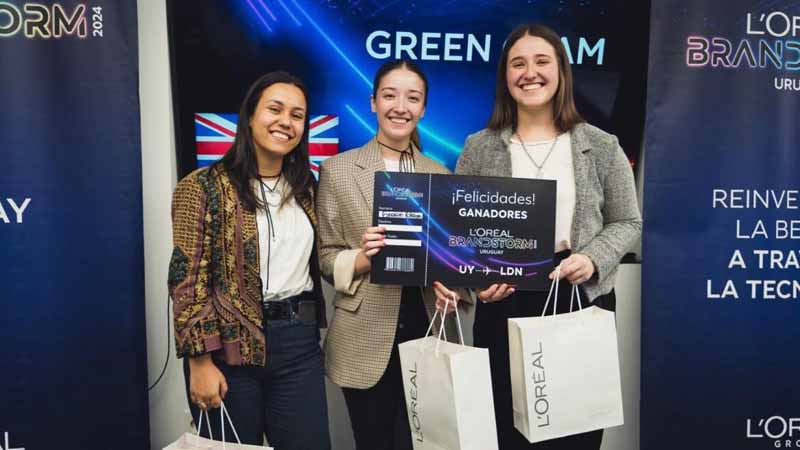
The goal was to reinvent the future of professional beauty through technology, and that is how the students set out to do it using biotechnology.
In a competition featuring 11 groups of three participants, held on May 9, the entry submitted by Matilde, Fiorella, and María Eugenia was declared the winner.
How did you hear about the contest?
We found out through an email sent by the school. When Matilde read the proposal, she forwarded it to our group of friends and asked if anyone wanted to join. All three of us loved the idea.
What motivated you to sign up?
We found the contest theme very interesting, and we thought it was a good idea to bring a more biotechnology-focused perspective to a field that tends to be more oriented toward marketing or perhaps computer science. Taking that approach could set us apart from the other groups.
What was the proposal they submitted?
This year, the contest’s theme focused on beauty salons, with the slogan “Reinventing the future of professional beauty through technology.” We began looking for current issues related to the topic and came across hair loss. As advanced biotechnology students, we set out to find a solution. That’s how we discovered a microalgae, studied by the scientific community, with the ability to regenerate hair and promote hair growth. That’s how the project began, with the idea of creating a hair care line featuring this star ingredient.
What sets it apart? How does biotechnology play a role in the project?
Our idea stood out not only for its great potential but also for its commitment to the environment. Because it is formulated with algae, this product is highly biocompatible with the skin, and since it is bio-based, it has a lower environmental impact. Algae, which sequester carbon dioxide 10 times more effectively than plants and have the ability to clean wastewater, are a great ally for industry and a promising tool for the future.
Did you receive support from the Biotechnology Laboratory during the process?
From the very beginning of the project, we received support from our academic coordinator, Mariana Ferrari, who encouraged us to sign up. Another crucial person in this process was Facundo Rocha, a professor in the program, who helped us at every stage, offering advice and information about these algae. We also received unconditional support and assistance from both friends in the program and outside it, who work in the fields of advertising and marketing. Among them was Juana Gayoso, who made a significant contribution to the audiovisual aspect of the project.
Now they're heading to London. What are the other competitors like, and what's the grand prize?
From what we’ve been told, we will represent Uruguay against 60 other countries in England this June. There, we will present our idea to an international jury. The winner of this round will join the company as an intern, where the idea will be developed.
https://www.youtube.com/watch?v=MSlIAGKxfAo