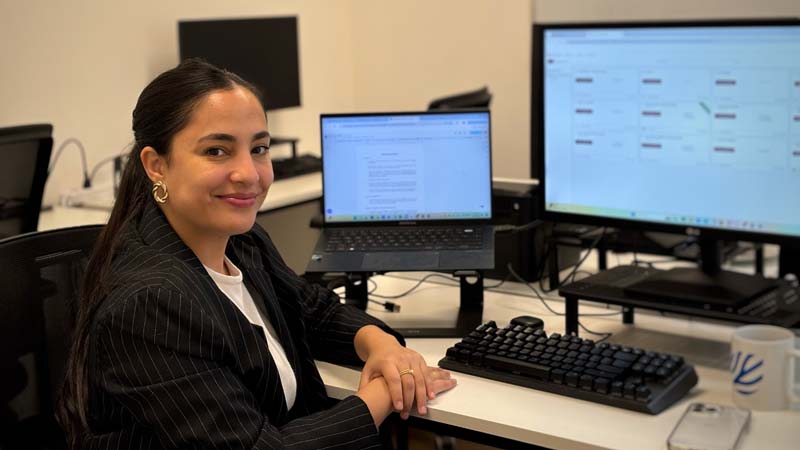
He focused his master's degree on artificial intelligence, where, using machine learning models, he developed a new way of analyzing and understanding reality.
According to Marchesano, one of the most notable aspects of the master’s program was: “Thinking about how these models could solve complex problems for humans in a simple way, by assisting with decision-making, or by giving humans more time to focus on creativity, strategies, or even rethinking and creating new challenges.”
As a chemical engineer, what motivated you to pursue a master’s degree in big data?
My main motivation for choosing to pursue a master’s degree in Big Data was that, through my work experience, I began to see and understand just how much valuable information can be gleaned from different types of data and, above all, how this information serves as an invaluable input for decision-making.
Early in my career, I started as an analyst, and analyzing data was a key part of my role in supporting day-to-day operations. As I progressed and took on other roles, I began to see the value of data analysis in a predictive or prescriptive context as well. That is, not only using it to understand a current situation, but also to make predictions, anticipate events, and, even more importantly, develop strategies that can make a difference in terms of competitive advantage.
As a chemical engineer, I spent the early years of my career at Fábricas Nacionales de Cerveza (FNC), part of AB InBev, a leading multinational in the brewing industry. I observed how the company, like many others, was stepping up its efforts in this area. This resonated with my belief in the enormous potential of data, even as I discovered the challenges and difficulties it presented. I decided that I wanted to be part of it too. I realized that data analysis was already essential in today’s landscape and that this discipline is what makes the difference. “I need to educate myself, acquire tools, and learn how to use them,” I thought.
On the other hand, I was torn between wondering if the only way to break into the world of data was to dive into it myself, because at the same time I didn’t want to lose ground or stall my career in leadership roles in other fields, where I didn’t have 100% of my time available for it. In the end, I concluded that the two didn’t have to be mutually exclusive and that if I wanted to lead teams that based their decisions on data, I could only do so—and convey that approach—if I also used data myself and understood what was happening.
What challenges did you face when switching from one field to another?
I think I’ve always been known for my curiosity—about anything and everything—but in order to apply what I learn, share it with others, or truly feel that it’s enriching me, I try to get to the root of what I’m learning. This meant I had to sit down and read, ask questions, and build networks, and that was the most challenging part for me, but also the most rewarding.
In the master's program, most of the courses involve programming, and although I had some idea of what to expect from a few college courses and out of curiosity, it was a whole new world for me.
One of the most rewarding aspects of the Master’s in Big Data at ORT is that it’s designed for a wide range of backgrounds, so the professors are there to support you, and at the same time, you’ll meet classmates with very diverse backgrounds, which makes for a very interesting experience.
For example, when it came to solving problems or situations where we had to decide how to use the available data, how to model it, or how to make the most of it, three people with the same technical skills could approach it from different angles. Certainly, someone from the IT department or a programmer could contribute a great deal when it came to creating and deeply understanding certain aspects at the code level; a business administration graduate provided an incredible business perspective; and I probably contributed an interesting perspective or understanding of the process.
I believe that everything can be applied to everything else; it’s just a matter of being flexible enough to adapt your knowledge to different fields and being willing to exchange ideas and seek help from those whose strengths differ from your own. For me, that’s always the key to success.
What was your final project about, and what results did you achieve?
My final thesis is titled “Explainable Artificial Intelligence: Technology and Transparency for Industry 4.0.” What my thesis partner, Lua Iusim, and I did was, first and foremost, develop machine learning models to predict whether a given industrial machine would fail or not.
In this way, a company or industrial plant could perform machine maintenance only when necessary, thereby minimizing unscheduled maintenance costs and maximizing the service life of the machine’s components. In addition, we complement this by addressing the topic of Explainable Artificial Intelligence (XAI), which aims to provide transparency, interpretability, and fairness to the results generated by machine learning models, so that they can be easily understood by humans.
The models we developed outperformed the existing literature in terms of performance and explanatory power for one of the cases in which we worked with tabular data; furthermore, they set a precedent for explainability using complex models for time-series data.
I found it fascinating to be able to work on our final project on a topic that is very familiar to me, given my background in chemical engineering. Furthermore, incorporating and using explainable artificial intelligence—a suggestion made by our instructor, Sergio Yovine—was a fantastic addition.
The interpretability of models is crucial for demonstrating and discussing their value. Those who ultimately make investment decisions in this area are generally not the ones with the deepest technical understanding of the subject. Therefore, having tools that help convey the true value to the business and demystify the perception of models as “black boxes” for some seemed to me to be a very enriching and interesting conclusion.
What aspects of the Master's in Big Data did you find most interesting and relevant to your career?
I focused my master’s degree on artificial intelligence, which allowed me to begin exploring and applying machine learning models, understanding how they work in theory, and putting them into practice. I gained a new way of analyzing and understanding the world. Thinking about how those models could solve complex problems for humans in a simple way—by assisting with decision-making or giving humans more time to focus on creativity, strategies, or even rethinking and generating new challenges. For me, it was mind-blowing.
I enrolled in the master’s program with the sole intention of gaining skills to apply to my current job, and I discovered a whole world of possibilities, ideas, and applications that I hadn’t known existed.
All of this was, without a doubt, what I found most interesting. Today, I’m fortunate to work at Pento, a company specializing in AI and focused on creating products and solutions for businesses.
How do you view the importance of pursuing a master’s degree in big data these days?
I think it can make a real difference in a professional career. One of the aspects I find most interesting about it is its versatility.
Being able to lead or contribute to strategic initiatives based on data and artificial intelligence undoubtedly makes you an even more valuable professional, one who can directly contribute to an organization’s success and innovation today.
The knowledge gained in the master's program is applicable across various sectors and industries, as well as in different areas and roles within the same organization.
How did it benefit you professionally?
Professionally, the master's program provided me with a solid foundation in today's key data analysis processes: statistical techniques, the lifecycle of big data analytics within an organization, knowledge of storage and processing infrastructure, and artificial intelligence techniques focused on predictive and prescriptive analytics.
It also marked a shift in my mindset. I learned to assess and view challenges from a new perspective, it spurred my creativity when it came to developing strategies, and I acquired new skills and tools to make decisions more objectively.