
They know you. They see you. They read you. They follow you. And they remember everything about you. But they aren’t spies. Nor is it an international conspiracy. It’s simply everything that surrounds you in your daily life. Your phone, your computer, your medical records, online stores, credit cards. Every day, all your routine activities are turned into digital data, and getting the most out of them is one of the great battles of our time. This is what’s known as Big Data.
Starting this year, the School of Engineering at Universidad ORT Uruguay a Specialization Diploma in Big Data Analytics, designed to equip university-educated professionals with the technical skills needed to solve complex problems in a world of big data. This postgraduate program provides them with the tools to quickly adapt to technological changes in their professional field.
While this may seem like a trendy topic, the numbers provide undeniable proof: more than 2.5 trillion bytes (yes, a number with 18 zeros) of data are generated every day. And this is just the beginning: experts predict that this figure will grow even faster in the coming years.
But what exactly are we talking about when we refer to these daily data volumes?
- 300 billion emails.
- More than 250 million tweets.
- About 800 million posts on Facebook.
- More than 432,000 hours of video are uploaded to the Web.
- Two billion searches are conducted on Google.
- 9.5 billion credit card transactions are processed in the United States alone.
 All these everyday activities generate data, which is added to other activities such as checking in for a flight, paying household bills on your phone, shopping at the supermarket, downloading an app, joining a club, buying movie tickets online, looking up an address on Google Maps, going to the doctor, or staying at a hotel.
All these traces left behind by our actions are stored digitally, and nowadays they are also analyzed. Experts say that this is where the true wealth of our times lies: in the information available and the ability to study and use it for a specific purpose.
Milestone by milestone
As is often the case with social change, Big Data is neither a new nor an isolated phenomenon; rather, it is part of a long chain of events and developments related to the collection and use of data.
A lot has happened since the first libraries in Babylon more than 5,000 years ago up until the 20th century, when the need arose to manage the vast amounts of information that were beginning to be produced on a massive scale. Among these developments were systems designed to automate tasks, predict the weather, and store data—all of which led to the situation we see today.
“In recent years, the catalyst has been access to technology capable of processing and analyzing the vast amounts of data being generated. We can store more and more data, and computers are becoming increasingly powerful in their ability to analyze it,” explained Sergio Yovine, who holds a Ph.D. in Computer Science from the Institut National Polytechnique de Grenoble, is a professor in the School of Engineering, and serves as the academic coordinator of the university’s Specialization Diploma in Big Data Analytics.
Big Data as a “Big Brother”
Today, big data can be applied to a wide variety of fields, although perhaps one of the most popular areas is the analysis of information shared on social media. Its use, in turn, can be applied to politics, social studies, economics, and business.
 It can also be used in the medical field—for example, by analyzing medical records from various hospitals to determine the most appropriate treatment for a disease—as well as in scientific research, fraud detection, organizational decision-making, the creation of advertising campaigns based on more accurate data, investment decisions, and human resources management within a company, to name just a few examples.
In fact, big data played a central role in the recent U.S. presidential election.
“Analyzing the geopolitical distribution of the electorate—as well as understanding what they buy, whether they have mortgages, and their level of education—is useful for setting campaign goals and determining which message resonates best,” Yovine explained.
“One of the most effective aspects of Donald Trump’s campaign was his ability to immediately identify which messages were working and which weren’t, and then eliminate the latter,” he added.
Three parts of a cycle
“When working with big data, there are three main areas to consider,” Yovine explained. The first involves data capture—that is, the process of collecting, cleaning, and preparing the data for analysis. “It’s one of the most time-consuming tasks,” he noted.
The second step is, in fact, analysis. This is where a relatively new role comes into play: that of the data scientist, described as “the sexiest job of the 21st century” by Tom Davenport, a visiting professor at Harvard Business School, and D.J. Patil of Greylock Partners, in a supplement on Big Data published by the Harvard Business Review.
Earlier, in 2011, areport by the consulting firm McKinsey & Company noted that by 2018, the United States would face a shortage of between 140,000 and 190,000 data scientists—professionals capable of leveraging the vast amount of available data. It also revealed that there would be a shortage of 1.5 million managers capable of making decisions based on the data obtained.
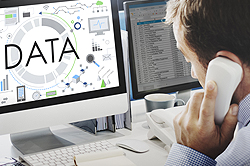 Basically, explains Yovine, a data scientist is someone who selects a machine learning algorithm—one that learns from data—to generate the most accurate prediction regarding the question someone has asked. Generally, the person asking the question is the one who will ultimately use that data; it could be a company manager, a doctor, or the director of a political campaign.
“It’s the most interdisciplinary field, because you have to know a lot about mathematics, probability, statistics, and algorithms in order to know what to look for and how to do it most efficiently,” Yovine said.
Finally, the cycle concludes with the presentation and display of the results. Generally, this stage involves those who make decisions based on the data obtained, so the information provided to them must be presented in an accessible manner.
Big Data in Higher Education
The graduate program, which began in March of this year at Universidad ORT Uruguay on the second stage of the Big Data process, although it covers the entire cycle, Yovine explained.
In terms of the curriculum, this diploma program consists of both theoretical and practical components. The faculty—professionals selected for their expertise and experience in the field—teach six core courses and three practical workshops in the areas of Data Analysis, Systems, and Information Management.
As Yovine explained, the program is inspired by offerings from universities in Argentina, Spain, and the United States, particularly the Master of Information and Data Science program at the University of California, Berkeley.
Currently, 28 professionals are enrolled in this graduate program; two-thirds of them are systems engineers, and one-third come from the field of economics, with backgrounds in econometrics and statistics or working at companies that specialize in business intelligence, Yovine said.
“In today’s market, the ability to handle big data is a required and essential skill,” he said. In fact, the graduate program was created in part due to interest from companies that approached the university seeking a program focused on big data, as well as the growing number of undergraduate theses at the school whose topics are related to big data.
On the academic front, Yovine added that those who complete the diploma program can continue their studies to earn a Master’s degree in Engineering (research track) at the university.