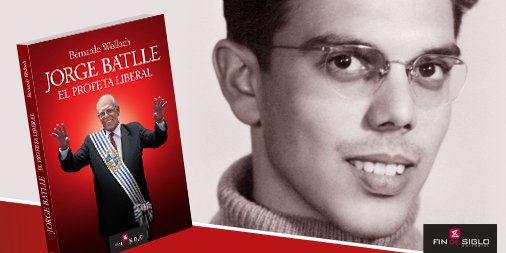
“The steps to baking a good liberal cake are: grease the pan with a trip to London at age 19 or 20, no older; dust with a career in media—both spoken and written—where freedom of expression is a non-negotiable principle; simultaneously add a degree in Law and Social Sciences, early exposure to a conservative uncle, and a mother with a passion for nature that extends to the country’s means of production. Then beat until dry and add to taste Ludwig von Mises and Friedrich Hayek. It is possible to substitute any of the above with Milton Friedman. Pour in a generous amount of Juan Bautista Alberdi and a pinch of Heinrich Ahrens. Finally, let it rest for a few years in a political household where there is a president or a party leader. The result is a complete liberal, a tireless generator of ideas of freedom and liberalism.”
This is how Wolloch himself describes the book he has just published: *Jorge Batlle, the Liberal Prophet*. As noted on the Fin de Siglo publishing house’s website, the book’s style is described as “serious yet daring.”
Wolloch, born in 1991 anda graduate in Journalism since 2016, explained how the opportunity arose to write the biography of the former Colorado Party president, who passed away in October of last year.
When you approached Fin de Siglo, did you do so solely with your thesis in mind, or did you have another project in mind as well?
Once I finished my thesis and had it approved, I sent it to Editorial Fin de Siglo. It’s a report on the conflict between sea lions and small-scale fishermen along the Uruguayan coast. The subject matter didn’t quite fit the publisher’s usual focus, but they were interested in the way it was written.
After Jorge Batlle’s death, I expressed interest in writing about him in the hope that they would consider me for the project. They reviewed my proposal and felt that Jorge Batlle was a politician who deserved a biography unlike any other—one that was relaxed and free from ideological constraints. Although it doesn’t take place on the beach, the biography unfolds in the political arena but in a style that feels most natural to me.
Where did your interest in Batlle come from?
Jorge Batlle left a lasting impression on me when I was a child. He was the one who sparked my interest in politics. His statements on Bloomberg TV (2002) made him the first politician I became interested in during my childhood. In addition to his famous quotes, his administration had a significant impact on Uruguayans in one way or another. In my case, my family’s financial situation suffered, and a close childhood friend of mine emigrated.
What was your goal in writing the book?
The book is written in a completely unrestrained style.
The only one under scrutiny is Jorge Batlle. That is, perhaps, what makes him the right choice.
Why political journalism? What do you find most interesting about it?
There’s no doubt that interest in political journalism has grown since this publication; I’d love to continue working in this field. However, I find any kind of investigative journalism appealing: I enjoy getting out into the field, seeking out sources, conducting interviews, and consulting the press and academic literature.
How long did it take you to complete, and how did you organize yourself?
Time was of the essence. The research, compilation, and writing were all completed in three months. Then came the editing, which took another month. Of course, I had help: first and foremost, the interviewees. Without them, the material would be worthless, because it is through their accounts that the past—which would otherwise be in black and white—is reconstructed. They provide essential details for shaping the characters and events.
The approach emerged from the material I gathered. Jorge Batlle’s political career was extensive. I identified three distinct phases based on how he viewed the world: the first phase spans the time his father was alive; the second, from when he took the helm of Lista 15 until the end of the dictatorship; and the third, from the return of democracy until his death.
I conducted about 30 interviews and reviewed more than 150 documents. What sets Batlle apart is that he has influenced every Uruguayan, for better or for worse. There isn’t a single person who doesn’t have a story to tell about him. In every circle I moved in, I always mentioned the project I was working on, hoping to catch someone’s attention and find a source or a lead.
Did you end up interviewing Batlle?
Unfortunately, I didn't have the chance to interview him, but after reviewing so much material—video, audio, and written—I ended up having conversations with him in my dreams.
What did you find in the unpublished documents?
The book contains correspondence between Jorge Batlle and his family. The most notable letters are those exchanged with Luis Batlle Berres, his father. Some are handwritten, others typed. In them, readers get a glimpse of the private side of Jorge Batlle, as he harshly criticizes his father or teases him. At age 23, he was put in charge of Radio Ariel, the newspaper Acción, the construction of a family home, and his great-aunt, who was ill, while his entire family traveled to Europe. It was during this period that the most letters were exchanged, and it was already possible, even then, to discern the intellectual framework of the future president of the Republic.
How did you approach this job at such a young age?
The challenge I faced as a young person—or rather, due to my lack of experience—was researching in detail events that took place before I was born. Also, when interviewing people with such distinguished political or academic careers, I often had to prepare for the interviews well in advance. I think one of Uruguay’s strengths is that, as long as you show respect, you can approach anyone, regardless of your age.
What is the significance of the book you just published?
The book offers readers an in-depth look at Jorge Batlle—the man who is hard to read, who makes decisions without hesitation in the most difficult moments, and who wavered during the 2002 crisis; the Batlle of the "pingos," the man who betrayed his trust, and the man who lived in bankruptcy after the dictatorship. Furthermore, delving deeply into Jorge Batlle’s life offers a glimpse into the political inner workings of the country over more than half a century, revealing both its highlights and its dark moments.
Jorge Batlle: The Liberal Poet, published by Editorial Fin de Siglo, will be presented on Thursday, April 20, at 7:00 p.m. at the Fucac Foundation (corner of 18 de Julio and Pablo de María).
https://www.youtube.com/watch?v=CnMTRwq8Vhs