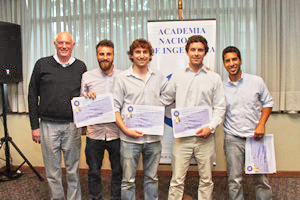
 The awards ceremony took place on December 2, 2014, and was attended by the entire team and their mentor, who supported them throughout the process and encouraged them to participate.
Graduates Diego Cáceres, Rafael Clement, Federico Sendra, and Juan Manuel Sobral received support from their advisor, Gastón Mousques, the academic coordinator of Software Factory, in carrying out the project.
It was also their tutor who encouraged them to enter the contest despite their reservations.
BioMotion is a virtual simulator of a laminar flow cabinet that uses natural user interfaces.
The simulator allows biotechnology students to practice using laminar flow cabinets in a safe environment.
Students can practice, assess, or review the techniques before performing them in the actual booth.
In addition, it improves the efficiency of operations, reduces execution time, and minimizes errors and costs resulting from improper use of the cabin.
In this interview, Federico Sendra talks about the project, its future, and what it will take to establish it in the market.
How did the idea to enter the contest come about?
As we were nearing the completion of our senior project, our advisor, Gastón Mousques, told us about the competition and encouraged us to enter. At first, we weren’t familiar with the competition and weren’t sure if our project was good enough to submit. But after our final presentation and receiving positive feedback from both the judges and the professors who had guided us throughout the project, we decided to enter.
What stage is the project at? Are you focused on continuing to improve it, or are you continuing with your regular work?
The project is functionally complete and tailored to the needs of biotechnology students and faculty at Universidad ORT Uruguay. Some details still need to be refined to make it more visually appealing. We developed everything ourselves, including the 3D models used in the virtual lab, so at the time we dedicated full-time effort to ensuring that first version was properly finalized. However, since we are currently focused on our regular work, we have not been able to continue its development.
What is the focus of the project? Where would you like to position it?
Our focus and the objective of the project is to educate and train students, and in turn, produce qualified professionals. Our goal is to see it implemented in university and corporate laboratories nationwide and across the region. Our initial plan is to use it in the university’s biotechnology laboratories to gather feedback, identify potential improvements, and then evolve the product to meet the needs of various users and clients.
What funding or other resources does the project need to move forward?
Today, the project is a fully functional product developed in collaboration with teachers and students. Throughout the development process, the project underwent several rounds of testing by both students and teachers, but it still requires some further refinements. To this end, we need funding to polish these details and make the necessary improvements to the software.
Are you planning to form partnerships or pitch to investors?
Any help that moves the project forward is welcome.