How did your interest in biotechnology come about?
My interest began in my senior year of high school while taking biology; during one of the lessons, the topic of genetic engineering was introduced, and from that moment on, I decided I wanted to pursue my studies in that field. After I finished high school, I researched the various degree programs related to that field in Uruguay, and the most comprehensive option was the Biotechnology Engineering program at Universidad ORT Uruguay.
What did you learn during your studies?
Biotechnology is a very broad field that encompasses many fascinating areas. Furthermore, it is a discipline that is constantly developing and evolving, which is appealing because innovation is a constant feature.
After gaining experience in the Uruguayan industry and working at Laboratorio Microsules and ATGen, you decided to pursue a master’s degree in Biomedical Research at Pompeu Fabra University. What prompted that decision?
I had always wanted to pursue a master’s degree, as well as experience living abroad. The idea of pursuing a graduate degree in a new and highly developed environment was very appealing to me, as it would allow me to learn about different ways of thinking and working.
What was it like to get into such a prestigious university?
Enrolling at Pompeu Fabra University was a wonderful experience. Taking classes with professors who had worked at top research institutions was inspiring. It’s worth noting that, compared to my classmates, my theoretical knowledge was quite strong.
In addition, I was able to see for myself that the level of hands-on training provided in the faculty’s laboratory is much higher than at other institutions around the world.
What was the research you conducted during your master's program about?
The study focused on the movement of a non-structural protein (NS5) of the Zika virus within nervous tissue. This virus poses a threat to public health because infection with it causes congenital microcephaly.
My study focused on the NS5 protein of the Zika virus and its interaction with Rootletin, a fibrillar protein, at the base of the cilia (a structure found in some cells). In addition to their interaction, the study found that disrupting this interaction prevented the transport of the NS5 protein to the base of the cilium, thereby reversing the phenotype caused by NS5 (the acceleration of neuronal differentiation).
This project shed light on new mechanisms by which NS5 interferes with the molecular machinery involved in cilia formation, as well as new potential targets for preventing fetal malformations caused by the Zika virus.
You are currently at the Weizmann Institute of Science, one of the world’s leading multidisciplinary research institutions. What is your role at the Institute?
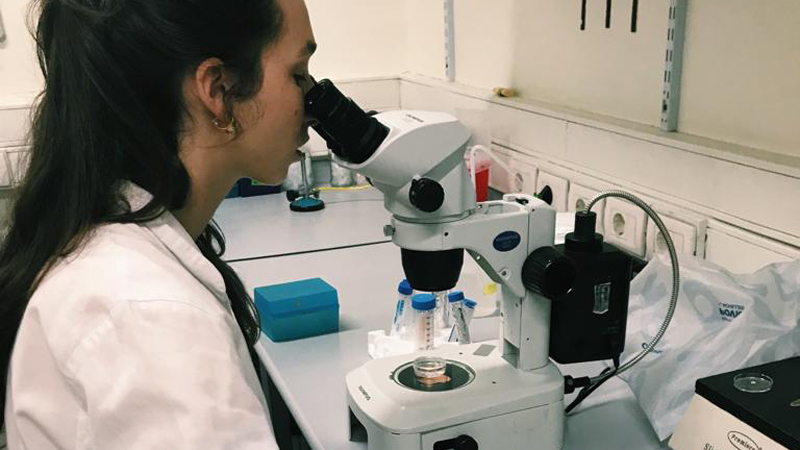
I currently work at the Weizmann Institute in Israel, in Ravid Straussman’s laboratory. There, we study the microenvironment of various tumors, their microbiome, and resistance to cancer therapies. When I refer to the tumor microenvironment, I am talking about the area surrounding the tumor—the ecosystem around it, which may include immune cells, the extracellular matrix, and other cells, such as fibroblasts. Tumors manage to modify their environment to their “advantage,” for example, by suppressing the immune system around them so that it does not recognize the tumor as an abnormal entity that needs to be corrected or eliminated.
At the institute, I was hired as a research staff member, and I am also part of a company founded by Ravid Straussman called Baccine. This company aims to sensitize tumors resistant to immunotherapy by introducing modified bacteria.
My work involves modifying different bacteria with various proteins so that they activate the immune system within the tumor microenvironment, which typically suppresses the immune system.
Do you feel that college gave you the tools to succeed in such prestigious places?
Without a doubt, my university education prepared me both theoretically and practically to work and succeed in every place I’ve worked—not only in academic settings, but also in the private sector.