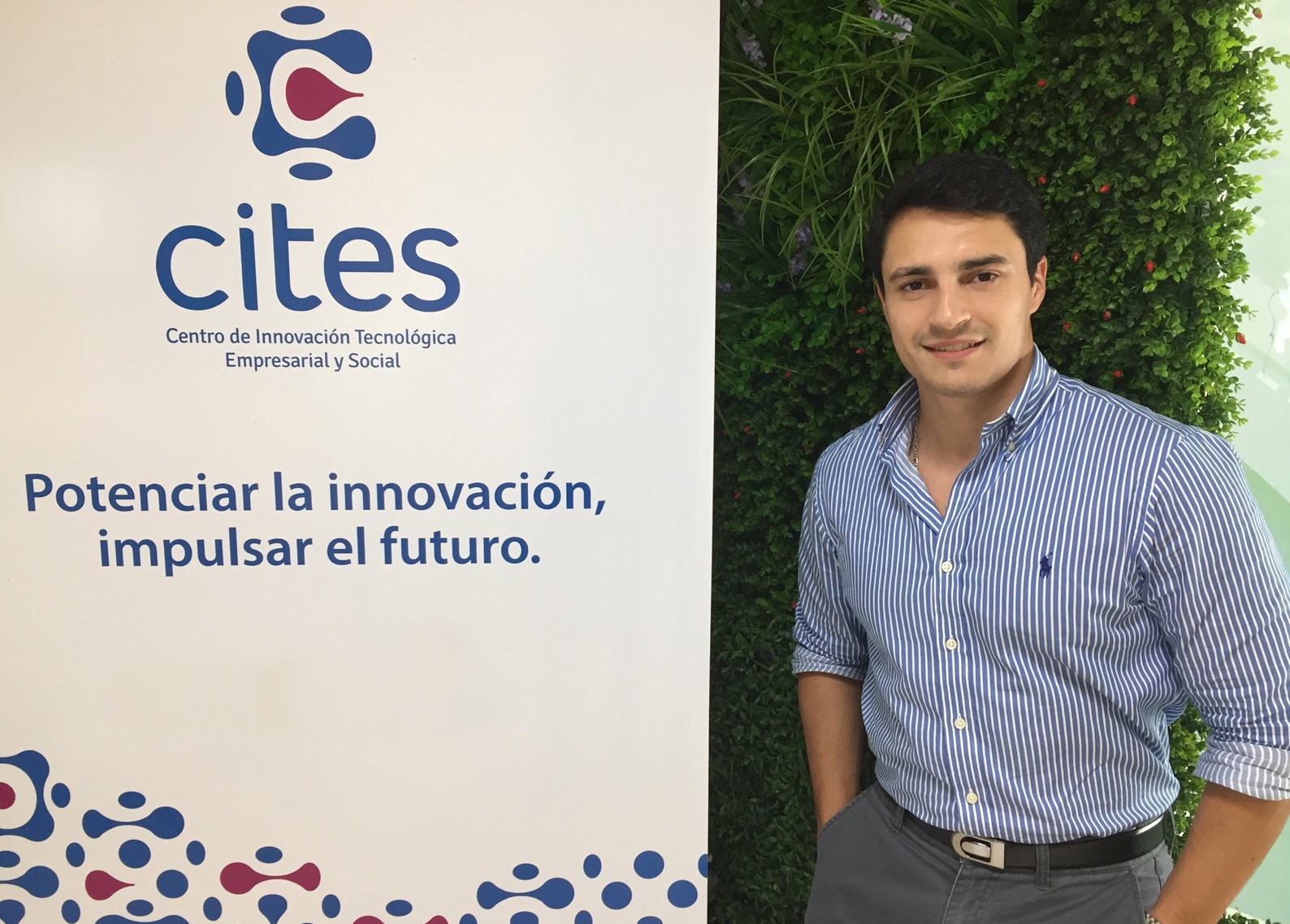
Last year, Pía Garat, an engineer, took on the role of CEO at Eolo Pharma, a startup dedicated to the rational design of new compounds for metabolic and cardiovascular diseases. This year, it was the turn of Nicolás Tambucho, a biotechnology engineer, who in September became the CEO of RADBIO, a biotechnology startup focused on developing biopharmaceuticals and biomarkers for complex chronic diseases with a significant impact on health.
According to Tambucho, the offer came through Carlos Sanguinetti, M.A., the coordinator of the biotechnology programs. Although he was working at the time and the position required him to move to Sunchales in Santa Fe, Argentina—where the incubator is based—he was interested in the opportunity and applied. “It was a unique opportunity for professional growth,” he says.
After being selected for the position of CEO, he began the process of relocating to Argentina. He knew the decision entailed a major challenge and a great deal of responsibility, but he had always enjoyed working in the business world.
In your previous job, you also had a sales-oriented role. Was that something you were looking for?
At Genia (a molecular biology laboratory), I started working as a laboratory technician in 2014, and in 2015, when I had to write my thesis for my degree in Biotechnology Engineering, I proposed focusing it on developing a molecular study within the company. This involved a technical evaluation as well as an economic and commercial analysis of its feasibility. Fortunately, they gave me the opportunity, and that’s how I began to develop my career in the commercial sector.
How much of it was a personal choice to pursue that field, and how much did the degree program offer you?
I’ve always been aware of the business side of things, and in my opinion, studying biotechnology in itself meant embarking on a path of innovation and entrepreneurship. I remember that shortly after starting my degree, we attended a talk about the Center for Innovation and Entrepreneurship (CIE), and at that moment I felt that I was in the right place, where I would find the tools and infrastructure to develop my skills in what I loved. Throughout the program and in various courses, we had to develop small projects based on the theoretical concepts we were taught, and that makes a huge difference because it gave us a different perspective on the potential applications of the concepts we learned.
At RADBIO, we are focused on developing biopharmaceuticals that may have therapeutic applications for diseases for which there is currently no clear solution.
We are focused on developing new biologic drugs and biomarkers for diseases such as cancer, liver fibrosis, autoimmune diseases, and others. These diseases share certain biological responses, such as inflammation or dedifferentiation. There is a protein called “TGF-beta receptor II” that is involved in the mechanisms through which these processes occur in cells. RADBIO discovered and patented a new soluble variant of TGF-beta receptor II, which is naturally produced by human cells and serves as an innovative therapeutic and diagnostic tool.
There are already biologics available that treat conditions such as rheumatoid arthritis and are highly effective. What makes this biologic you are developing different or innovative?
While biologics already exist for certain conditions, the key difference in our development is that it involves a protein naturally produced by human cells. In this way, we aim to more precisely regulate the signaling cascade mediated by the target protein of our discovery, TGF-beta. It is known that TGF-beta is commonly overproduced in diseases such as cancer, fibrosis, and inflammatory processes, and this excessive overproduction drives disease progression by modulating cell growth, migration, and cell phenotype. This is why one of the competitive advantages over other biologic drugs is that it is designed to reduce the action of TGF-β without completely inhibiting its agonist effects.
What are the benefits of biologics compared to conventional drugs?
Biopharmaceuticals are biological rather than chemical in nature and are generally produced by living organisms. As a result, they are identical to or very similar to human proteins, which can make them more effective and associated with fewer side effects. These medications are geared toward personalized medicine.
What is the team's composition?
The company is comprised of a multidisciplinary team and has support and collaboration of teams from the Chascomús Institute of Technology (INTECH) and the CER Medical Institute. It is a highly experienced team that has dedicated many years specifically to the development of this project. The founders are Dr. Ricardo A. Dewey, Ph.D., scientific advisor and specialist in genetic engineering, gene therapy, and regenerative medicine; Dr. Jorge Velasco Zamora, clinical advisor and specialist in internal medicine and rheumatology; Mónica Coronel, financial advisor specializing in business administration; the director of technology is Dr. Ana Romo, Ph.D., a biochemist specializing in biotechnology, industry, and business; and laboratory tasks are overseen by Pamela Velázquez, a technician.