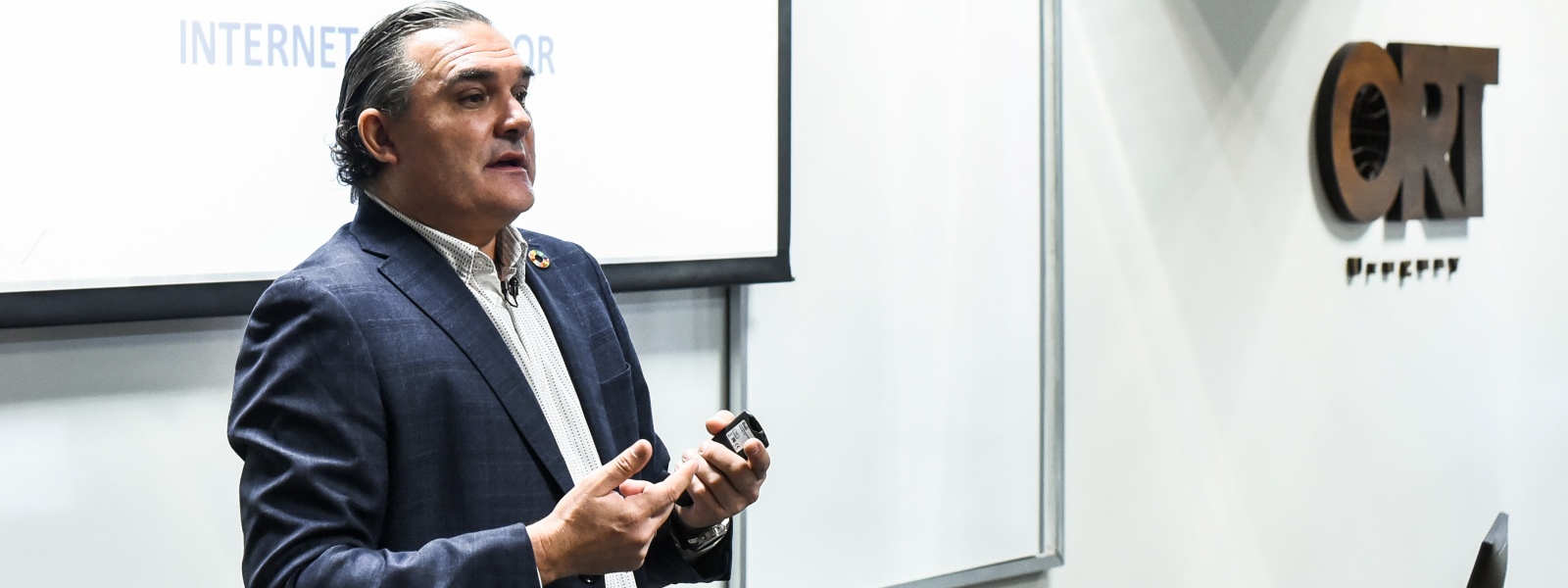
“Blockchain is the new internet of value. The first was the internet of communication, of spreading ideas. The second was the internet of social media, where there was not only static communication but also interaction and dialogue. Now, interaction is not only between people but also with value,” said Pablo Coirolo, MBA—CEO of Americas Aeternity and founding CEO of Light 47—during the conference “The New Internet of Value in Business Models.”
The event took place on Wednesday, September 4, at the Pocitos Campus of Universidad ORT Uruguay. The conference was part of the Management and Business Lecture Series organized by the Graduate School. Coirolo attended as part of the agreement between the Center for Innovation and Entrepreneurship (CIE) and Aeternity, which led to the creation of the Aeternity Blockchain Innovation Center at ORT.
Blockchain and the Shift in the Business Model
In recent years, there has been a complete shift in business models. A shift that was unimaginable in the 1990s but is now a reality. The expert gave the following examples: “Uber, the world’s largest transportation company, doesn’t own a single taxi. Airbnb, the world’s largest lodging company, doesn’t own a single property. Facebook, the world’s largest content-production company, doesn’t create any content.”
Coirolo defined blockchain as a distributed database system in which all nodes (computers with a copy of the network) are synchronized to keep a record of information transfers. Each node has exact has of the distributed database.
The speaker noted that changes occur more quickly in blockchain than in traditional formats and mentioned some of the companies currently using it: Société Générale, Santander, Visa, Barclays, and ABN AMRO.
A new security system
Coirolo quoted John Chambers, former executive chairman and CEO of Cisco Systems: “There are two types of companies: those that have been hacked and those that don’t know they’ve been hacked yet.” He cited as examples the massive 2019 hack affecting millions of people that took place in Bulgaria and the hack of former First Lady Michelle Obama’s passport.
“Throughout history, there isn’t a single castle that hasn’t been attacked, no matter how large it was. We must learn from history: everything will eventually be breached; it’s only a matter of time, ”Coirolo said.
Blockchain offers a new approach to security. The fact that it is a decentralized system makes it more secure. Because it consists of nodes that are perfectly synchronized regardless of their location, hacking them is more difficult than hacking a centralized system.
The expert explained: “Throughout history, history has been written by the victors, so it can be altered. However, blockchain is an immutable ledger.” Since each node has identical copy of the shared ledger, no one can modify it.
Just as there was confusion between email and the internet in the late 1990s, Coirolo pointed out that people now confuse blockchain with bitcoin: “Bitcoin is the first successful application on the blockchain network. This does not mean that every blockchain works with bitcoin.” Bitcoin is an example of a token. A token is a unit of value similar to a coin and “the new digital asset.”
In 2008, Satoshi Nakamoto (a pseudonym for one or more people whose identities are unknown) invented Bitcoin. Following the emergence of Bitcoin, Ethereum, a smart contract platform, was created. These types of platforms provide the assurance that the contract was executed under the established conditions. “This revolutionized all businesses,” Coirolo noted, since “by being on a blockchain, the information is independently verifiable by all parties.”
“We are moving toward a tokenized economy, in which every aspect of life will be represented by tokens. At the same time, new legal and regulatory frameworks are being developed to enable the cross-border transfer of tokens,” said Coirolo.
The evolution of the digital market involves the “tokenization” of assets, that is: capturing the value of real-world objects and converting it into tokens, as well as the creation of tokenized investment funds and regulated exchanges for tokens. Among the benefits of living in a tokenized economy, Coirolo highlighted the ability to prevent securities fraud thanks to blockchain records, greater efficiency, transparency, and lower transfer costs.
Full lecture:
Image gallery:
