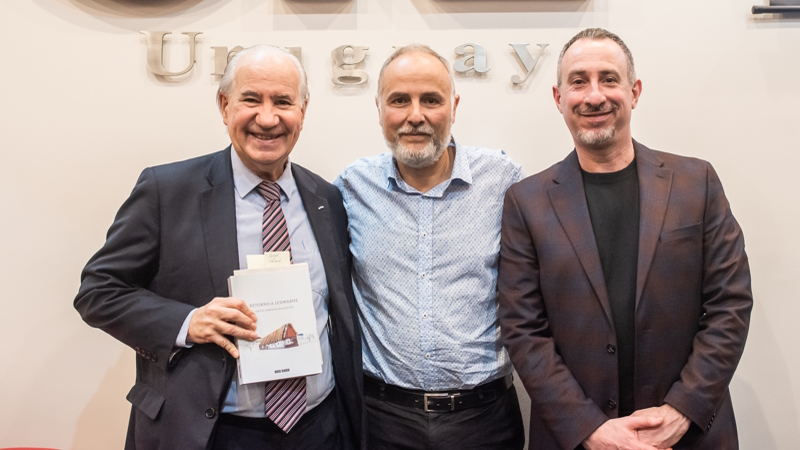
The event took place on July 25 in the Pocitos Campus Auditorium and took the form of a discussion between the author and the engineer.
Ruperto Long, president of LATU and author of the book The Girl Who Watched the Trains Leave, and was moderated by Andrés Bancalari, academic coordinator of the Bachelor’s Degree in International Studies at Universidad ORT Uruguay.
The three participants explained that the idea to hold the book launch for *Return to Jedwabne* on the university campus arose in early 2024 at the initiative of Prof. Charlotte de Grünberg, president of Universidad ORT Uruguay, who passed away in February 2024.
Professor de Grünberg fought tirelessly against anti-Semitism and promoted the study and remembrance of the Holocaust, the systematic extermination of 6,000,000 Jews carried out by the Nazis.
People used to assume that these acts were carried out by Nazis or similar groups, but in this case, it was the neighbors themselves—people who were not part of the Nazi organization.
He also described Serrano as a "multifaceted intellectual," praised him for "piecing together a complex puzzle down to the smallest detail," and highlighted the research and narrative quality of the Spanish philologist's work.
Serrano recounted an act of heroism by the town’s Catholic residents. Upon seeing two badly injured and half-naked Jewish women, two elderly residents of Jedwabne stood in front of them to defend them, but to no avail, as they were killed by their fellow townspeople.
"Anti-Semitism is a much more widespread phenomenon than one might have thought," he concluded, noting that this became evident following Hamas's terrorist attack against the Israeli population on October 7, 2023.
Long emphasized that good literature "allows us to relive events," and that this story "sheds light beyond the tragedy."
The Nazis' entry into Poland sparked extreme violence among the region's inhabitants. In Jedwabne, where the events recounted in this book took place, there were about 3,000 residents, with roughly equal numbers of Catholic and Jewish residents.
On July 10, 1941, nearly all of the Jewish residents were murdered by their Catholic neighbors. Seven survived. Many years later, some of these survivors took on the task of recounting what happened on that fateful day and seeking justice.
The author invites readers to follow the journey of each survivor through a harrowing yet profoundly beautiful work of nonfiction that reads much like a novel, told in the present tense as events unfold.
Interview with Dr. David Serrano Blanquer by journalist Daniel Castro
https://www.youtube.com/watch?v=zqFvknnyrCw
Dr. Serrano interviewed witnesses, survivors, family members, journalists, historians, and high-ranking officials (both political and judicial) around the world, and conducted research in archives in Poland, Germany, the United States, Israel, Mexico, Argentina, and Uruguay.
In short, the book tells the story of a village lost in the vastness of rural Poland and offers an in-depth look at the West, from the second half of the 20th century to the present day.
Full video of the event
https://youtu.be/IvSWUYdYO08