https://www.youtube.com/watch?v=7GWYg0ulngc
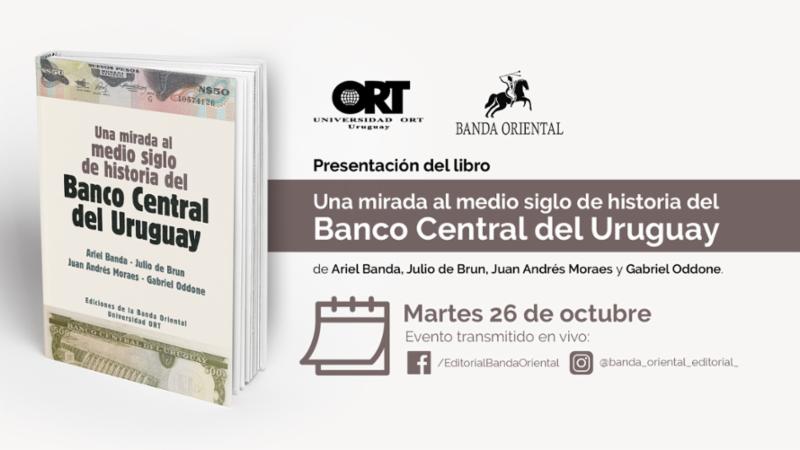
The BCU has played an important role in our country’s monetary policy since 1967. In the book, published by Banda Oriental and Universidad ORT Uruguay, authors Ariel Banda, Julio de Brun, Juan Andrés Moraes, and Gabriel Oddone summarized its origins, development, and current status.
The presentation was attended by Salvador Ferrer, Esq.—President of the Banco de la República Oriental del Uruguay (BROU)—, Dr. Gaston J. Labadie—Dean of the ORT School of Business and Social Sciences—, Diego Labat, Esq. Diego Labat—current president of the Central Bank of Uruguay—, Enrique Iglesias—first president of the Central Bank of Uruguay and former president of the Inter-American Development Bank (IDB)—, and Dr. Gabriel Oddone—book coordinator and ORT professor—.
The Foundations of Prestige
“The book makes an important contribution to our understanding of how the Central Bank of Uruguay came to enjoy the prestige it has today, both within and beyond its borders,” Ferrer noted.
“Thanks to the drive of several of its presidents and directors, but also as a result of the lessons learned from each crisis the BCU has had to face over the years, a prestigious institution that is respected by political leadershas been established, ”he added.
He recommended the book as a reference for future generations and also for “those of us who have lived through much of this history.”
A contribution to economic history
Dr. Gaston J. Labadie praised the initiative to “preserve institutional memory.”
“The book is not only a very interesting analysis and well-written account of the Central Bank of Uruguay, but it also constitutes a contribution to the economic history and current political economy of Uruguay,” added the dean of ORT’s School of Administration and Social Sciences.
“As dean, I share with you my personal and institutional satisfaction with what this book represents in terms of our contribution from the faculty and the Department of Economics toward a better understanding of Uruguayan society.”
The professor congratulated the research group, which included, among others, Julio de Brun, “a founding professor of the Economics program at Universidad ORT Uruguay.”
A contribution to society
“This is a story whose dissemination will benefit society as a whole, as well as the field of economic thought. It is an excellent piece of work, and we have a duty to do our best to ensure it is shared as widely as possible,” said Diego Labat, an economist.
The economist noted that the book offers a comprehensive and in-depth analysis of the creation of an institution that serves as a model in terms of its governance, its working methods, and its professionalism.
This book “takes you on a journey through the development of the strong institution we have today ” and enables us to “learn, make corrections as we move forward, take what is useful, and continue to improve,” as well as to “avoid complacency, think about how to reinvent ourselves, and consider how we can contribute more to society.”
The memories of the protagonists
Enrique Iglesias stated: “The book is, in a way, a memoir of the people who were there during the events described in it. So it’s been a very good initiative.”
He also highlightedthree key pillars of the BCU’s role. First, it established “an institution that is respected both domestically and internationally.” Second, its presidents were known for fostering human capital. Third, the BCU improved “the supervision of the banking system, which today helps us manage complex situations.”
A more stable country, a stronger state
“The book offers a glimpse behind the scenes of the country’s economy and politics . That, at least for me as a Uruguayan and as a member of my generation, makes me feel quite proud—despite the successes and the mistakes,” said Dr. Gabriel Oddone.
“It’s an institution that coexists, interacts, and engages in politics under different administrations, and while that may seem perfectly natural to us, I can assure you that when I speak with many people from abroad, I realize that it isn’t. From the outside, it’s something truly admirable.”
“As I was saying, of course mistakes were made—some of which the book highlights—and of course some things could have been done better, but there are certainly a great many successes, ”the expert said, concluding: “The vast majority of the figures featured in the book helped make this country more stable and the government we have today a stronger one.”