
The project, created by Nausícaa Palomeque, a graduate and instructor at Universidad ORT Uruguay in Universidad ORT Uruguay, also involved the creation of audio stories.
“I created a project that reflects who I am,” Palomeque replies when asked what motivated her to launch an inclusive cultural project focused on Latin American literature.
8 that she has written draw on her past experience as a literature professor and a graduate of ORT’s Bachelor’s program in Communication with a concentration in Journalism, as well as her current role as a professor at the School of Communication at the same university.
“I’m interested in literature, social issues in general—such as education, inequality, and inclusion—and literature, of course,” she says.
About the initiative
The project, which includes eight contemporary short stories by eight different Uruguayan writers, consists of two parts.
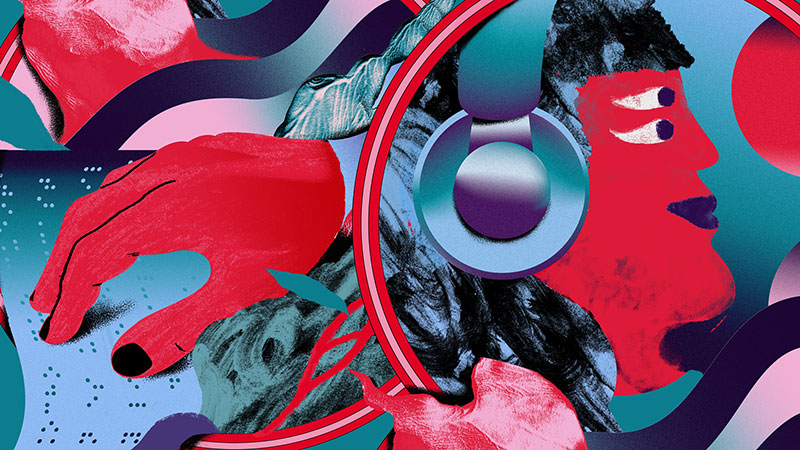
On the one hand, it involves the production of physical books that will be published in Braille and large print (with a larger-than-usual font size) so that people who are blind or have low vision can enjoy not only the stories but also the physical book itself.
“Although Secundaria produces content for young people who are blind or have low vision (…), physical books published in Braille and large print are a valuable and scarce resource,” explains the journalist.
The books, which are not for sale and will begin to be distributed free of charge this year to Uruguayan high schools attended by students with visual impairments, are unique in that, in addition to being printed in Braille and large print, they also feature a handcrafted cover.
According to Palomeque, at the Resource Center for Students with Visual Impairments (CeR), the covers are designed by hand using materials such as cardstock and foam rubber, so that the covers have textures that allow the students to recognize them by touch.
Stories also available in audio format
In addition, " 8 que cuentan " includes a series of audio stories, which are now available on Spotify and YouTube and were narrated by actors Gabriela Pérez and Gustavo Saffores.
Not only is this a way to ensure that these stories reach people who are blind or have low vision and cannot access the book, but it is also a commitment to promoting Uruguayan literature —at least in this initial phase—to other parts of the world, such as Argentina, Brazil, Colombia, the United States, Australia, New Zealand, and Germany, where it is already gaining traction.
“It has to do with the fact that there is a community of Latin Americans living all over the world who are eager to hear stories in their own language, ”says the ORT graduate and instructor.
View this post on Instagram
Selection of short stories
In this first season, Palomeque “started close to home” and chose to feature contemporary short stories by eight Uruguayan writers: Fernanda Trías, Inés Bortagaray, Carolina Bello, Rosario Lázaro, Martín Bentancor, Martín Lasalt, Horacio Cavallo, and Pedro Peña.
The stories were selected based on aesthetic, generational, and gender-equity criteria. In addition, the journalist sought out material that would allow her to showcase Uruguay’s diverse soundscapes in the podcast—from the city, beaches, and countryside to the sounds of animals and music in small towns.
And so, together with composer and sound designer Daniel Yafalian, they created audio stories featuring music and sounds from Yafalian’s archive, as well as others recorded specifically for this project.
“In Rosario Lázaro’s story, for example—a story that has an erotic element and, at the same time, a horror aesthetic—there are sounds of mussels rubbing together that were created using boiling rice. That was recorded in Daniel’s kitchen,” he says.
View this post on Instagram
Launch
On Friday, March 22, at 7:00 p.m., the second part of the presentation of Palomeque’s project will take place at the Morosoli Library (Plaza Seregni – Martín C. Martínez and Eduardo Víctor Haedo), an event that will bring together Palomeque, the writer Bortagaray, the actress Pérez, and the teacher Luz Álvez.
This sixth-grade teacher used the audio story based on Bortagaray’s “Bravo, Blanca” to introduce the topic of sexuality in the classroom.
He took his students out to the playground, blindfolded them, and had them listen to the story at full volume among the trees.
“It was incredibly moving for me, for Inés, and for Gabriela, because we never imagined it would have such a beautiful outcome,” she says.
“Based on that audio story, the students—both girls and boys— explored sexuality by sharing their experiences, drawing pictures, and discussing the story, ”she adds.
The actors' rehearsals and part of the recording of the audio stories took place at the ORT School of Communication.
Will there be a second season?
Palomeque admits that he can't reveal anything yet, but everything seems to indicate that there will be news in the future.