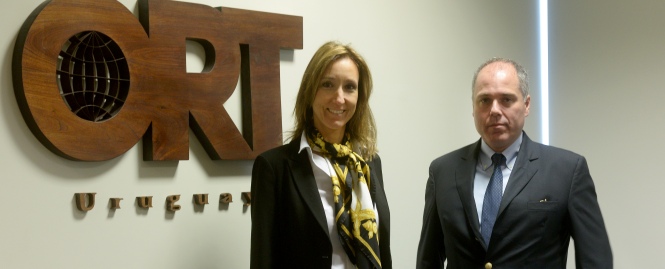
“The experts were wrong once again,” said Bárbara Mainzer, an economist, during the lecture she gave alongside Pablo Sitjar, a certified public accountant. At the event titled “Brexit: Its Impact on Investment Portfolios,” which took place on Wednesday, July 20, 2016, as part of the Management and Business Series, both speakers analyzed the impact of Brexit on the financial system.
Bárbara Mainzer is a Chartered Financial Analyst (CFA) certified by the CFA Institute and the director of Criteria. A graduate of Harvard Business School, she previously served as vice president and sales manager for the Southern Cone at Merrill Lynch.
Pablo Sitjar, who holds a master’s degree in international finance from the MIT Sloan School of Management, is the president of the Montevideo Stock Exchange; he also worked as an emerging markets debt trader at Goldman Sachs and served as deputy general manager of Banco Surinvest.
Brexit: Immediate Effects
“The experts were wrong once again,” said Bárbara Mainzer, pointing out that analysts’ predictions about the outcome of Brexit were far off the mark. In just a few days, Britain faced the resignation of its prime minister, sharp declines in the stock market and the value of the pound, and threats from multinational companies to relocate all their workers, among other setbacks.
The impact of the British people’s vote was felt throughout the Western world. Mainzer said that while the stock market in the United States fell by 4%, declines in some European countries exceeded 12%, and bond yields hit record lows. German bonds reached negative yields, as did Swiss and Japanese bonds.
In addition, the United Kingdom lost its AAA rating from Standard & Poor’s, and sales of luxury properties in London plummeted by as much as 50%. Interestingly, the day after the vote, many Britons expressed concern about what they had chosen and, in many cases, admitted to their lack of knowledge about the European Union and the implications of a future exit.
The situation gave rise to the neologism “Bregret,” a combination of “Britain” and “regret,” which became a trending topic on social media. Mainzer noted that one of the most frequently searched terms by Britons on Google after the election was “What is the European Union?”
No roadmap
Mainzer foresees a long “period of great uncertainty,” with years of negotiations ahead. He said that the UK will experience “slower growth and higher inflation” and noted that international markets quickly returned to normal after the initial shock: in some countries, such as the United States, they even reached record highs.
The speaker argued that Latin America was not directly affected by Brexit because “its own dynamics prevail,” independent of the United Kingdom. The fact that Brazil and Argentina share these dynamics meant that Uruguay, too, did not feel the impact that European economies did. She further clarified that our country took advantage of the opportunity to “issue debt at historic lows.”
The current calm in Uruguay does not mean there are no risks ahead. Mainzer highlighted several, such as the possibility of slower growth and increased protectionism, a strengthening of the dollar, and rising raw material costs, as well as slow-moving negotiations with the European Union.
Geopolitical considerations
Pablo Sitjar recalled the ties between Uruguay and England dating back to the period of the British invasions and said that, just as happened in the 1930s, experts today recommend doing business with Germany.
According to Sitjar, British citizens prioritized their safety over the well-being of the economy, and he cited fears about immigration as a key factor in the decision to leave the European Union.
Sitjar said that in the Western world there is widespread “distrust in governance” and asserted that “leaders have been drifting away from the people.” Today, Europeans view the European Union’s bureaucracy, centered in Brussels, with suspicion. “People are tired of the rationalists who are always telling them the same thing,” he declared.
The European public's distrust has been clearly evident in polls on approval of the European Union. According to Sitjar, distrust of political leaders is not unique to Europeans.
Volatility and Caution
Mainzer said that the United Kingdom's exit from the European Union increases geopolitical risk. Its exit is causing volatility and concern about the state of the financial system.
In times of instability and uncertainty, he recommended waiting, avoiding hasty decisions, and always relying on a carefully designed investment plan. Each portfolio should be built around specific goals, and there is nothing wrong with being “more conservative” when selecting investments.
He said that investors should brace themselves for a period of lower returns. “We won’t see the returns we’ve had in recent years again,” he stated.
Photo gallery:

Video of the conference:
https://youtu.be/Gl9MPaE90Ss