As part of the program of activities for the "Project 5" course in the Architecture program at ORT’s School of Architecture, the second lecture in the series Building from the Site featured Brazilian architect Gustavo Utrabo, founder of Estúdio Gustavo Utrabo, based in São Paulo.
The activity offered a reflection on situated architecture, attentive to the territory, material culture, and forms of collaboration and the social, climatic, and cultural conditions of each site. Throughout the conference, Architect Gustavo Utrabo shared a series of projects developed in different contexts across Brazil and linked them to a central idea: building from the site; in addition to responding to a physical site, it also involves reading memories, materials, techniques, scales of use, and ways of life that are already present before the project begins.
Throughout the discussion, the conversation kept returning to certain central themes that run through his work: the relationship between nature and culture, the importance of shade, and the value of local construction knowledge, the tension between system and exception and the need to avoid generic responses.
Situated architecture: thinking about place beyond the site
One of the most significant insights from the conference was that Utrabo did not reduce the concept of place to a mere geographical fact. In his presentation, place also emerged as a conceptual, perceptual, and cultural construction: something formed from matter, memory, environmental conditions, and the way architecture relates to what already exists.
From this perspective, the project does not impose itself on a blank slate, but rather is developed through a careful analysis of what makes each context unique. This approach aligns with the event’s guiding principle, which proposed thinking about architecture through local resources, construction know-how , and appropriate technologies. Architect Utrabo’s talk demonstrated that this approach was not abstract: in his examples, every material, structural, or spatial decision was linked to a specific condition of the site.
- You might also be interested in the article: “Building from the Site I: Collaborative Architecture and Situated Technologies, with Architect Ceballos Ugarte and Architect López Isabellas”
From the Museum to the Landscape: Nature, Journey, and Perception
Among the first examples presented by the Brazilian architect was a project at the Oscar Niemeyer Museum (MON) in Curitiba, designed around an existing tree, the garden, and the relationship between architecture, nature, and the visitor’s path.
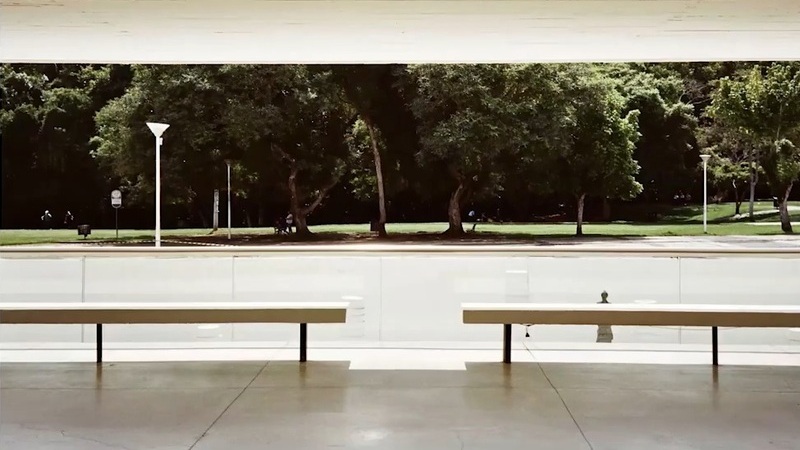
In that section, Utrabo demonstrated how a lightweight, tensioned structure could create a new way of viewing the surroundings: getting close to the treetops, traversing them with one’s body, and seeing the museum again from a different perspective. He also insisted that drawing and photography are not separate parts of the project, but rather tools for better conceptualizing the site.
In that first part of the talk, several ideas had already emerged that would later be repeated: the desire to not to think of nature merely as a backdrop to architecture, the importance of bodily perception in the experience of space, and a structural exploration where vibration, lightness, and controlled instability cease to be a problem and become part of the project’s meaning.
- You might also be interested in reading: “Landscape Project Roundtable: How Landscape Architects Are Trained and How ORT Approaches Landscape Design”
Matter, Memory, and Atmosphere
Another project presented was a house in Bahía, in direct dialogue with the vegetation, glass, ceramics, and craftsmanship. At the conference, Utrabo explained that what interested him there was not only building with local materials and knowledge, but also creating a new layer of perception: a different way of looking at nature, of moving the body, and of inhabiting the relationship between interior and exterior. In this regard, the model, the drawing, the photograph, and the prototypes emerged as tools for thinking, not as separate elements of the project.
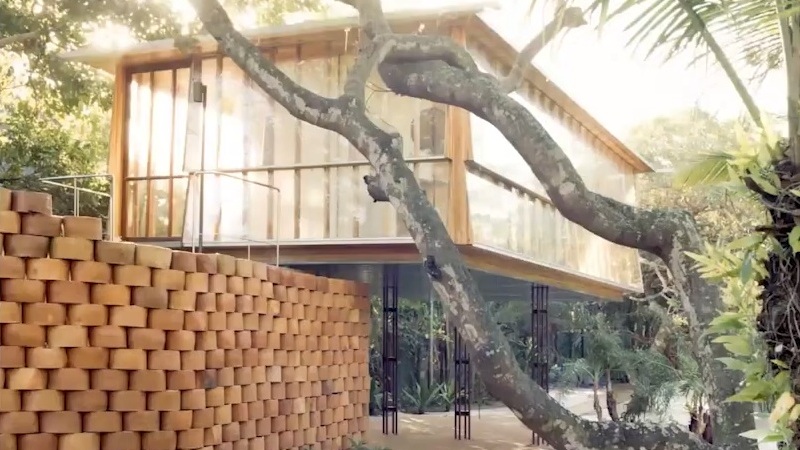
Also particularly significant was the way in which that example served to introduce two recurring themes in his work. On the one hand, the idea that technique and materials are not chosen in a neutral manner, but rather in relation to the memory of the place and specific ways of working. On the other hand, the conviction that part of the value generated by the construction should remain within the community that makes it possible. In the talk, this point was linked to manual labor, to pieces made one by one, and to the local circulation of construction knowledge.
- You might also be interested in reading: “Architecture and Mental Health: How the Design of Spaces Impacts Our Psychology”
Shade, scale, and local knowledge
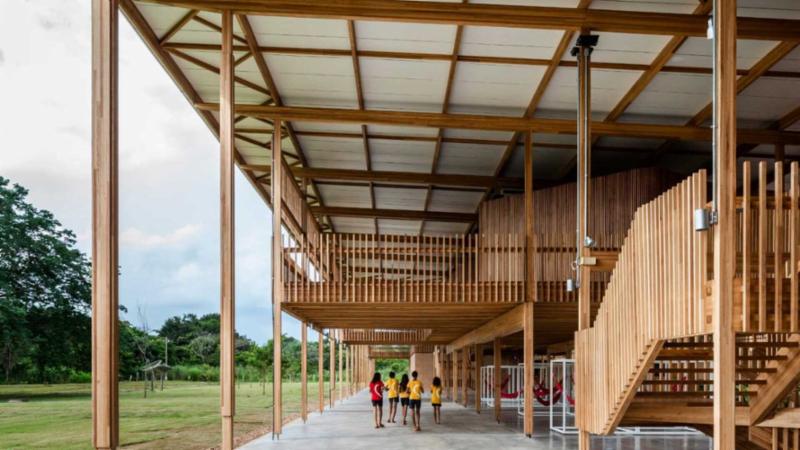
Another of the most compelling segments of the conference focused on a boarding school for 540 children in central Brazil, affiliated with the Bradesco Foundation. In that segment, Utrabo revisited several central issues in his practice: how to design in a remote context, how to work with the scale of its users, and how to transform an educational facility into a place of belonging.
The lecture showed that, for the architect, understanding a place—rather than simply studying the site—means spending time there, looking at people’s homes, observing how they live, and recognizing what kind of space makes sense for those who inhabit it.
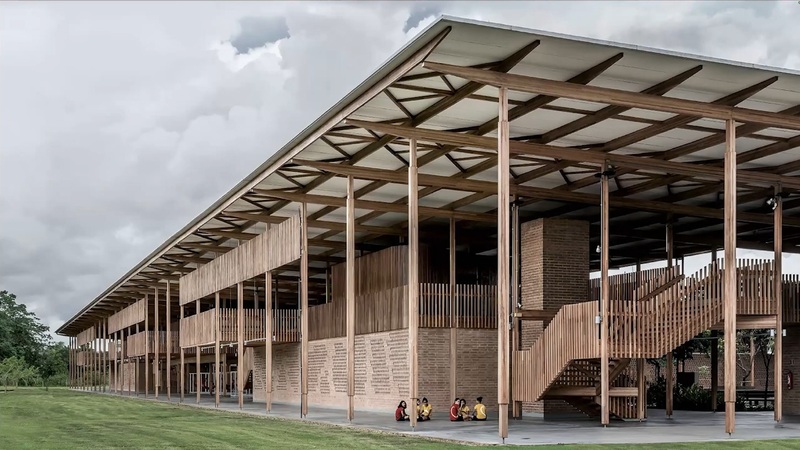
That’s where one of the most powerful points of the entire talk came up: in a tropical country, creating shade can be one of the most fundamental acts of architecture. In that project, this idea translates into verandas, patios, sheltered common areas, and an explicit priority for shaded areas for collective use.
Utrabo also explained that his interest in vernacular architecture does not stem from a romantic or nostalgic perspective, but rather from a practical understanding of how to build best in each specific location. That is why, in this case, the earth, the wood, the scale of the courtyards, and the organization of the spaces do not appear as picturesque gestures, but as decisions tied to the climate, the use, and daily life.
The conference also highlighted another key point: architecture can leave behind more than just a finished building. In this example, Utrabo emphasized the importance of ensuring that the knowledge and part of the economic value generated by the project remain within the community. This perspective broadens the concept of sustainability, shifting its focus from the building’s physical performance to a dimension that is also social, productive, and territorial.
- You might also find it helpful to read: “Bernard Rudofsky, the multifaceted architect of ‘architecture without architects’”
São Paulo: System, Contradiction, and Interstitial Spaces
Another segment of the talk was devoted to a project for WPP in São Paulo, where the discussion shifted toward the system, prefabrication, contradiction, and intermediate spaces. There, Utrabo explained that he was interested in thinking of the site as a field of tensions between nature and progress, between pragmatism and strangeness, between industry and manual labor. In this context, the project is organized around courtyards, pathways, cores, and spatial sequences where interior and exterior cease to appear as clear opposites.
In that section, the lecture was particularly clear on one point: accepting a system does not mean blindly obeying it. Utrabo demonstrated how, even in a large-scale project with a strong constructive logic, architecture can introduce deviations, textures, veils, curves, and moments of ambiguity that make the experience of the place more complex. For this reason, rather than separating a “pragmatic” part from a “beautiful” one, he was interested in work with that contradiction within the project itself.
- You might also be interested in the article: “Antoni Gaudí: Master of Catalan Modernism and Architect of Nature”
Xingu: Building Without Imitating
The closing session of the conference brought the discussion to a particularly sensitive issue: how to design in an indigenous context without turning architecture into a superficial copy of the place. In that session, Utrabo focused on a project developed in the Xingu Indigenous Park, in partnership with the Socio-Environmental Institute, where the central issue was not to reproduce familiar forms, but to engage with a specific culture through respect, observation, and an appreciation of difference.
That point became particularly clear when he explained that creating something too similar to the goose would have been disrespectful. Instead, the project was conceived as a new piece capable of engaging with that world through proportion, shadow, light, the flexibility of the system, and the potential for collective use. In that sense, building from the site did not mean copying a given form, but rather recognizing its spatial logic, its conditions of use, and its cultural depth in order to respond with a precise and site-specific architecture.
With that example, the conference concluded by addressing an issue that runs through much of contemporary architecture: how to work with specific memories, techniques, and cultures without turning them into folklore, without romanticizing them, and without absorbing them into an abstract, universal solution. In Utrabo’s presentation, building from the site meant, therefore, carefully reading the conditions of each location and responding to them with architecture capable of being critical, materially conscious, and open to forms of collaboration.
- You might also be interested in reading: “Contemporary Architecture: Exploring 21st-Century Architectural Design and Its Characteristics”
Watch the full conference:
https://www.youtube.com/watch?v=gpLKj-sPiiM