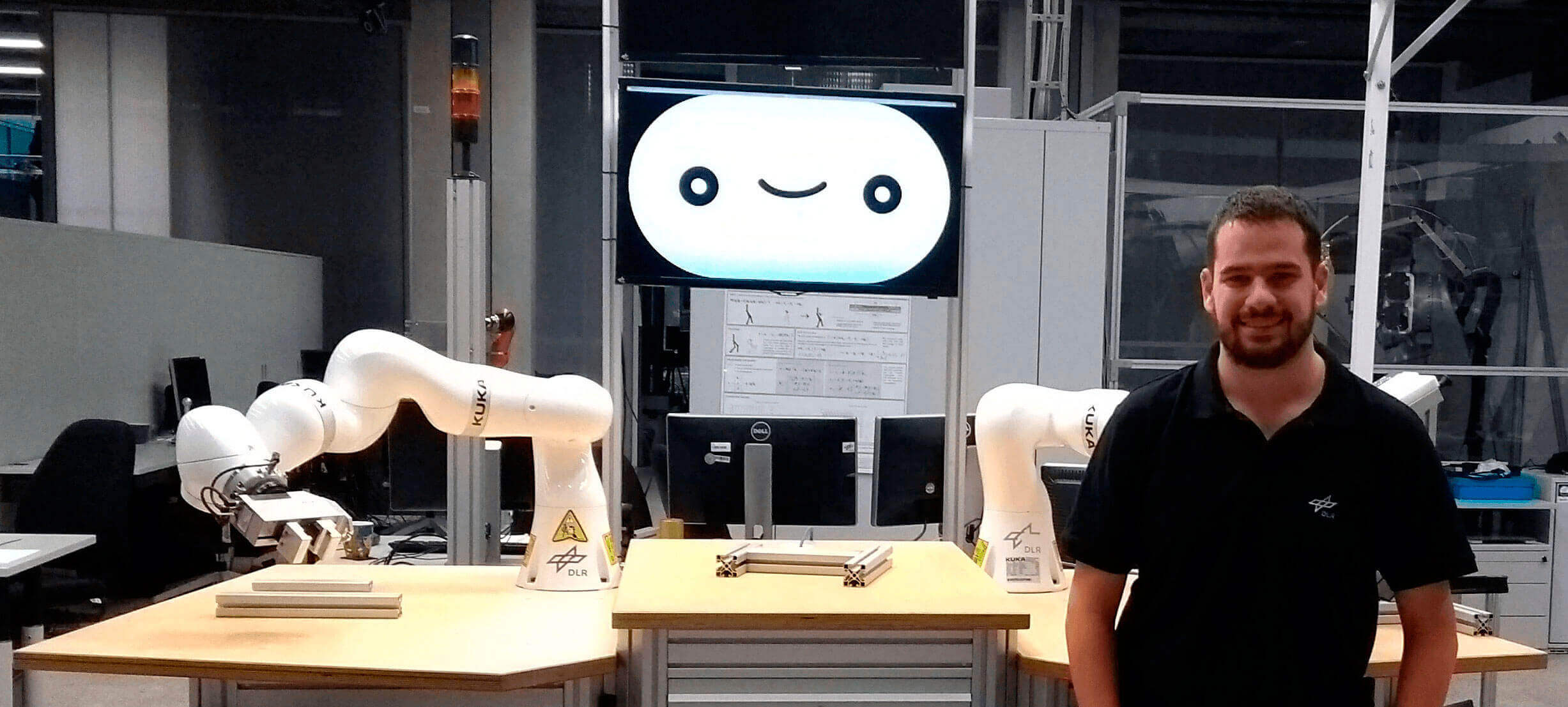
Until a few years ago, Ismael was a professor in the School of Engineering, a research assistant in the Applied Mathematics for Telecommunications (MATE) group, and an engineer at TCC, but the prospect of pursuing a Ph.D. abroad began to appeal to him, so he started looking for opportunities.
A friend suggested he consider pursuing a Ph.D. at the German Aerospace Center (which conducts research in aviation and spaceflight), and even though he didn’t speak the language and had no contacts, he sent emails to various professors, attaching his résumé and a letter of recommendation written by the coordinators of the MATE group.
“I sent my resume to the email addresses listed on the Center’s website until a professor liked my resume and offered me a spot on his team. To help cover my living expenses, the German Academic Exchange Service awarded me a scholarship,” says Ismael.
He holds a Ph.D. in robotics, and the project he joined is called “Automatic Planning for Applications in Industry 4.0.” “My specific area of focus is automated assembly for factories of the future. Basically, I’m developing a system that, given the product to be assembled, automatically generates the commands for robots to perform the assembly,” he explains.
Despite the changes and being far from his family, Ismael is enjoying himself: “It’s like Disneyland, but for robots. There’s a huge variety of projects and lots of highly skilled people who are also very approachable and willing to help.”
He lives alone in Germering, a town 25 kilometers from downtown Munich, close to his workplace. There are some cultural differences he’s still getting used to, such as the Germans’ candor: “They’re very direct when it comes to criticism, and at first that’s a bit of a shock, but after a while you get used to it and realize they mean well.”
Another challenge is the language; he admits that the phrase he uses most often is still “Sprechen Sie Englisch?” (“Do you speak English?”). “I’m taking an intensive course to improve my skills; for now, I communicate in English at work.”
On weekends, he goes out with friends and tries to travel, though he admits that between work and his German class, he hasn’t had much time. “I’ve traveled a bit, but not as often as I’d hoped; still, I’ve visited several German cities, as well as Switzerland, Ireland, and Great Britain.”
She’ll be working on her PhD until September 2019 and has the option to stay for another year, so the idea of returning hasn’t even crossed her mind yet. “It was a really tough decision for me to come to Germany to do my PhD, so for now I’m not even thinking about what I’ll be doing in three years,” she says.