
7,500 cases of skin cancer were recorded between 2010 and 2014, which amounts to 1,500 per year. According to data from the National Cancer Registry, four new cases are diagnosed every day. It is the most common type of cancer in the country.
With the aim of launching a prevention campaign, the Uruguayan Society of Dermatology reached out to the Academic Coordination Office of theBachelor’s Program in Multimedia Design at Universidad ORT Uruguay.
Students in the courses “Graphics for Film and TV” (taught by Magdalena Álvarez) and “Digital Design 6” (taught by Juan González) were divided into seven groups of approximately three people. The assignment was to create three audiovisual pieces to be submitted as a required component of the courses and for an internal competition.
Leandro Méndez, Paula Pérez, and Marcelo Macadar—third-year multimedia students—were the winners, and their videos will be shared on social media.
About the Awards
On Monday, December 18, 2017, Méndez, Pérez, and Macadar were honored at the launch of the 2017–2018 Skin Cancer Prevention Campaign, which aims to promote the adoption and implementation of concrete measures for the prevention of skin cancer.
The event was organized by the Uruguayan Society of Dermatology, the Society of the Interior, and the Department of Dermatology, represented by Dr. Alejandra Larre Borges and Dr. Sofía Nicoletti.
The audiovisual presentations were shown in the auditorium of the Honorary Commission for the Fight Against Cancer in the presence of officials including Health Minister Jorge Basso and Minister of Education and Culture María Julia Muñoz. Also in attendance were Álvaro Luongo—president of the Honorary Commission for the Fight Against Cancer—and Fernando Tomasina—dean of the Faculty of Medicine at the University of the Republic—among others.
The winning proposal
The concept that the third-year multimedia students sought to convey is that skin is as fragile as a child.
“We got together in the group our teachers assigned us and came up with an original idea—one that wasn’t sensationalist but would make an impact,” said Méndez. They decided to focus on children at the beach and in the park—in other words, the places where they’re most likely to be found.
The filming took them two days. They invited family and friends to appear in the video. They edited it in less than 24 hours. On Friday, December 15, they submitted their entry, and on Sunday, December 17—the day before the campaign launch—they found out they had won. Right up until the moment they received their award, they were making adjustments and improvements to their video.
https://youtu.be/-2fxfEhZDs0?si=x0lPokzwRTqzIaEB
The Refund and Its Implications
“We decided to use an innovative approach: we invited the students to hold an internal competition among themselves,” said Dr. Alejandra Larre Borges, a dermatology specialist, who thanked the winners for their “quick and efficient” work.
He added that “they got the message,” which was “to focus on children,” given the fragility of their skin and the cumulative effects of sun exposure, since that is where the impact is greatest. Finally, he thanked Alejandro Erramún, academic coordinator of the Bachelor’s Degree in Multimedia Design, for his support throughout the process.
Minister Muñoz congratulated the students on their “excellent work in record time” and emphasized the importance of preventing this disease from an early age.
Luongo, in turn, stated that “audiovisuals are a different way to reach people.” “It’s a new and interesting approach that we need to take advantage of,” emphasized the president of the Honorary Commission for the Fight Against Cancer. Tomasina, dean of the School of Medicine, noted that the students’ campaign conveys a message that is “clear, simple, and impactful”—something that is not easy to achieve.
“Prevention is better than cure,” Minister Basso emphasized, adding, “Prevention is a collective effort; you can be happy while minimizing risk.” Avoiding sun exposure, wearing sunglasses with UV protection, and using sunscreen are some of the key points he highlighted for skin care. Sunbathing until you turn red—for children, teenagers, and adults alike—has a “harmful effect that must be kept in mind.”
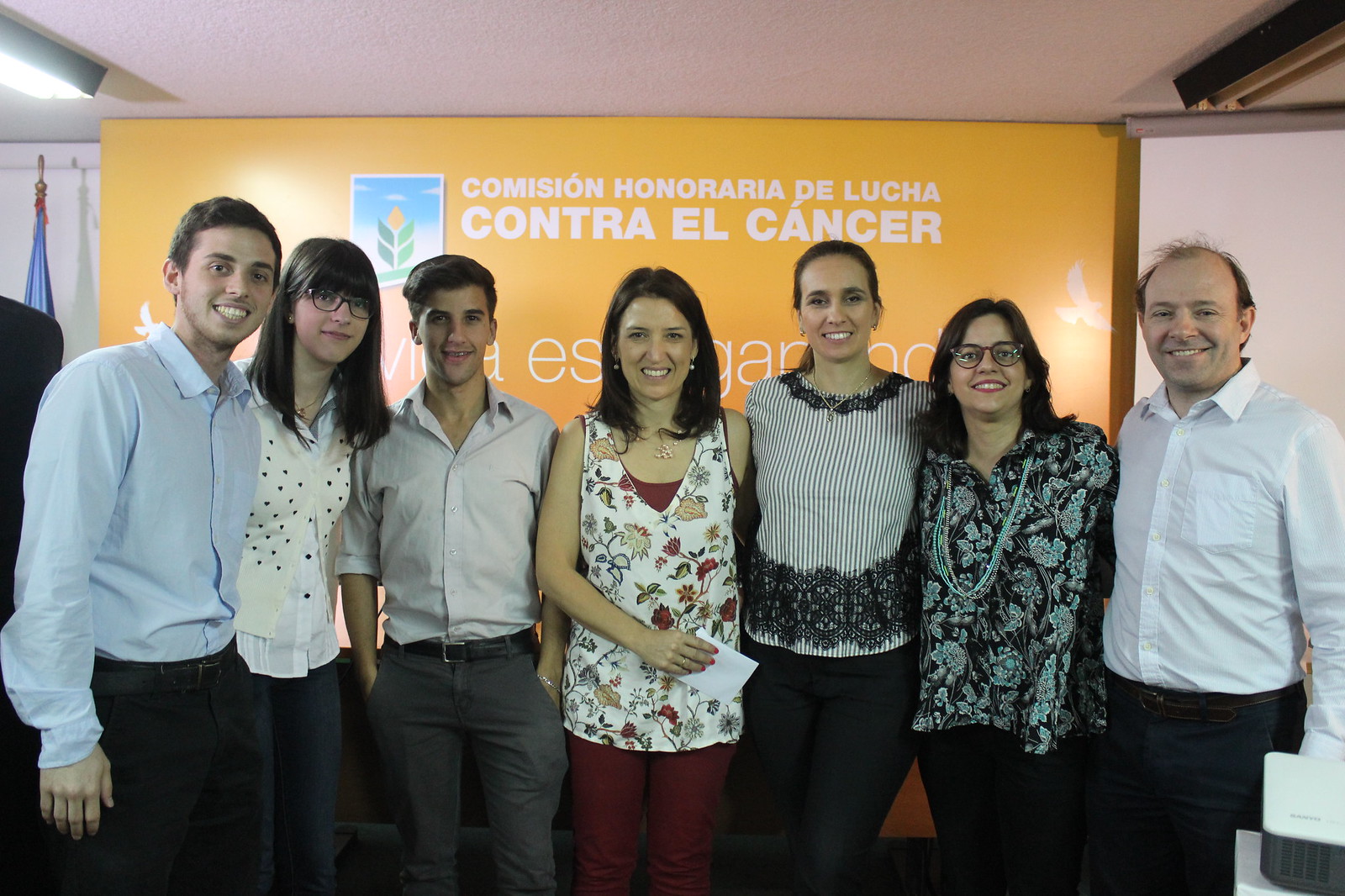
From left to right in the photo: Marcelo Macadar, Paula Pérez, Leandro Méndez, Dr. Alejandra Larre Borges, Dr. Maria Sofía Nicoletti, Magdalena Álvarez, and Alejandro Erramún.