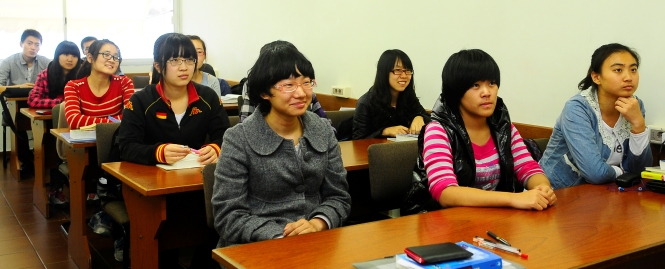
The 42 Chinese students—33 women and nine men—who arrived at Universidad ORT Uruguay on an exchange program are visiting their home country for the first time; for most, this is even their first time leaving their province. They are pursuing a Bachelor’s degree in Spanish Language at Harbin Normal University, a degree program with high employment rates that trains translators, teachers, and future businesspeople for trade with Spanish-speaking countries. “It’s likely that many of them will be buying and selling products with us within 10 years, ” said María del Carmen Azpiroz, the exchange coordinator.
They are all natives of northeastern China, from Heilongjiang Province—which means “Black Dragon River”—with a population of 38 million and an area of 460,000 square kilometers, more than two and a half times the size of Uruguay. Its capital is Harbin, with a population of 10 million, a city that in the last century was under Russian and Japanese rule and, since 1946, Chinese rule. It is known for its extreme temperatures, ranging from -40 degrees in winter to 40 degrees in summer.
They are the first cohort of their program at the university, one of the most prestigious institutions in their province for teacher education. They came to Uruguay as part of their program, which requires them to spend the third of its four years in a Spanish-speaking country. Thanks to an agreement between their university and ORT, this international experience will be available again in the coming years.
Back home, they live on campus and have classes from 8 a.m. to 6 p.m., with a break at noon for lunch. Even on weekends, they go to bed before midnight so they can get up early again. “We have so much homework that, otherwise, we wouldn’t have enough time, ” said Zhang Long Hao, also known as Santiago, because all students in the program are given a Spanish name.
But the biggest challenge for Chinese students isn’t college itself, but rather an entrance exam called the Gaokao—considered the most difficult in the world—which tests all the knowledge they’ve acquired in high school. Cheng Xiao Yu, whose name in English is Lluvia, says that during their preparation, they get up before 6 a.m. and study almost nonstop until well past midnight.
They say it’s stressful. The fact is, the Gaokao results determine what major a student can pursue, whether they can attend college, and which one. You can only take it twice. It takes place over three days, and some parents rent hotel rooms for their children so they can be more relaxed. It’s a national event broadcast on television. The pressure is so intense that the number of suicides rises around the time of the exam, says Azpiroz, who lived in China for four years and taught in Harbin to the generation that entered university.
And studying in Uruguay isn't easy for them either. They have to really concentrate to understand what the teachers are saying, which might be too fast for someone who first encountered the language less than three years ago. Santiago and Lluvia think that women are easier to understand when they speak.
Andrés Bancalari, Assistant Coordinator of the Bachelor’s Degree Program in International Studies and instructor of the course “Fundamentals of International Trade”—which two Chinese students are auditing—said that they do not participate in class unless the instructor asks them a question.
They are very polite; to them, the teacher is a figure of authority. However, because the curriculum is so demanding, it is common for students to fall asleep in class, which is not seen as disrespectful, adds Bancalari. To them, the teacher’s role goes beyond what happens in the classroom; the teacher serves as a role model, which is why they seek to maintain a personal connection, notes Azpiroz.
They are cheerful, smiling young men, generally slim and not very tall. They’re struck by how few people are on the streets of Montevideo and by certain customs, such as demonstrations. Santiago says that in Uruguay he sometimes gets up at noon, especially after a night out, but others can’t sleep that late. One day at seven in the morning, in winter, Azpiroz was driving along the promenade and ran into one of the Chinese students who had gone out for a walk. “I can’t stay in bed any longer, ” he explained.
“They’re really friendly and such great people,” said Juan Michellini, a student at the university and mentor to Alicia, Esperanza, Diana, and Julia. “There’s a significant cultural barrier, but that makes it even more interesting.” Michellini also mentioned that, at the welcome party, they exchanged traditional songs and dances.
At the university, students follow a curriculum designed in collaboration with their home institution, but some—those with stronger language skills—also take courses in the Bachelor’s Program in International Studies and the School of Communication. Bancalari has observed a high level of integration, better than expected. “Communities aren’t forming, but there is mutual interest. There is undoubtedly a sense of enrichment taking place.”
They say they liked the barbecue, though they politely point out that the food in Uruguay is a bit monotonous. In any case, they eat much more than Uruguayan students, says Paola Barreto, from the cafeteria at the School of Business and Social Sciences. Many even have lunch twice. They like milanesas and alfajores, foods they discovered in Uruguay, but also pasta and hot dogs, and they generally drink milk, but never with coffee. They speak just enough, says Barreto; they’re very polite and always, after eating, take their dishes to the counter.
Uruguayan students have a different relationship with their parents than Chinese students do, Lluvia notes. In China, the relationship is closer; in fact, parents often continue to support their children financially even after they move out on their own. They are also very close to their grandparents, who generally play an important role in raising the children.
They’re all living in a five-story student dorm in Pocitos. Santiago and Lluvia say that strangers sometimes greet them on the street, and they like that. Santiago wants to travel around South America working as a translator. Lluvia wants to be a teacher and stay to live in Uruguay. “They say I’m prettier here than in China, ” she jokes. Rather than going to dances, she prefers karaoke, which is more common in China than in Uruguay.
They usually wear shirts, jeans, and sneakers. “They like to watch movies on their computers, use their cell phones, or hang out on Renren, a social network similar to Facebook, ” says Azpiroz. “They’re a hedonistic generation, something that until recently wasn’t common in China.”
They spend a lot of time at the university, in the cafeteria, or studying in the library. Everything is very different for them. Their university has about 32,000 students, and the campus is so large that they have an internal shuttle bus with stops; and to get a spot in the library, they have to get up at 6 a.m., even when it’s -40 degrees. Plus, the power and internet are cut off at 10 p.m.
They will spend nine months in Uruguay. Upon their return, most of them will have to retake the Spanish IV exam, a national test in China for Spanish language programs with a pass rate of between 16 and 20 percent, and they want to use their time in Uruguay to prepare for it. Passing the exam isn’t a requirement for graduation, but many companies require one year of study abroad and a passing grade on the Spanish IV exam.
It’s interesting to see them walking around Pocitos and on campus, switching between Mandarin and Spanish, mingling with Uruguayan students, exchanging cultures, and sharing their ways of life.