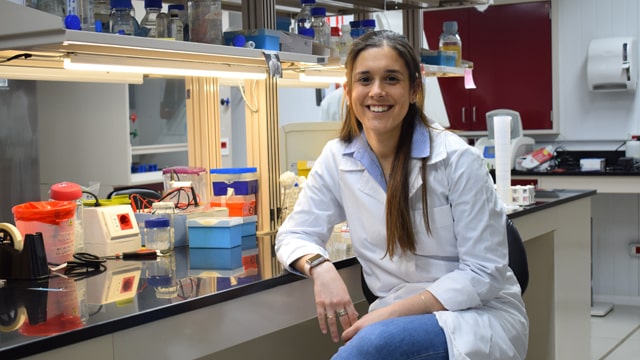
Every year, the Massachusetts Institute of Technology (MIT) magazine honors 35 innovative young Latin Americans under the age of 35 in the following categories: Inventors, Visionaries, Humanitarians, and Pioneers.
It was in this last category that Campot stood out for her startup, Enteria, of which she is a co-founder. It is a biotechnology company dedicated to studying the gut microbiota as a tool for preventing and diagnosing diseases.
How did Enteria come about?
The company was founded in 2018 in response to a need in the local market for services that incorporate the wealth of scientific knowledge linking gut microbiota to health.
In response to this need, and after a year of extensive research, we secured funding from the National Agency for Research and Innovation (ANII) to validate the business idea.
Once we understood the market’s needs, we applied for a new grant—also from ANII—which enabled us to develop an initial prototype of the service we planned to offer. In 2020, we received investment from GridX (a biotech business accelerator), and we are currently working on expanding our services and growing internationally.
What is it like to break into a company that offers biotechnology solutions?
Starting a biotechnology business is a major challenge. Although it is a long-established field that is constantly present in our lives, there are few companies in this sector in Uruguay. Furthermore, the development of biotechnology products and processes typically requires significant investment.
However, biotechnology has the potential to significantly impact our lives, which is why I believe it is important to encourage the development of this type of venture.
Are you part of the CIE-BIO incubator? What kind of support do you receive from this incubator?
It offers us various types of support: first, it provides us with lab space, which is essential for ventures like ours. It also supports us with project planning and presentation, and by offering courses and talks tailored to entrepreneurs.
You were named one of the 35 most innovative young people in Latin America, according to MIT, and you’re also the only person from Uruguay. What does that recognition mean to you?
Honestly, it came as a surprise, but it was a very nice honor. I share this with my partners, who are just as much a part of the project as I am. Although I’m very proud to be the only Uruguayan, I would have liked to see more of my compatriots receive awards. I know there are great projects and initiatives in Uruguay that deserve to be recognized.
In an interview, you said that you are a scientist by vocation and by profession. What is it like to work in science in Uruguay, and what do you like most about this profession?
What I like most about being a scientist is the constant challenge of finding explanations for things and seeking new ways to solve problems. Uruguay is home to many great scientists working on extremely important and interesting research projects. However, we face the challenge of being a small country with limited resources dedicated to this field, where it is harder to make a name for oneself than in other places.
Do you feel that your degree gave you the tools you need to start a business?
The degree program gave me the push I needed to embark on my entrepreneurial journey. On the one hand, it allowed me to understand all the possible applications of biotechnology and learn about what was being done around the world.
It also gave me insight into science-related businesses and how to run a company of this kind. I believe it is essential to introduce students to the different career paths available to scientists: research and entrepreneurship. These are two necessary roles that complement each other.