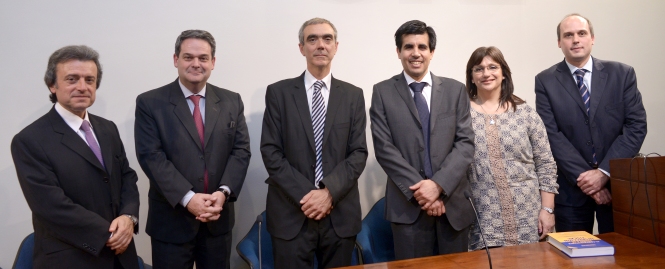
On Thursday, November 13, 2014, the fourth edition of the book *The Taxpayer Facing a Tax Audit* was presented in the auditorium of the School of Business and Social Sciences.
In this book, first published in 2007, the authors—tax law specialists Alberto Varela Rellán and Gianni Gutiérrez Prieto—address difficult questions in the field:
- What powers do inspectors have?
- What rights do taxpayers have to object to requests from tax inspectors?
- What are the tax liabilities of the company's managers and directors?
- What actions can the General Tax Directorate (DGI) take while the debt is being discussed?
- What are the consequences of misconduct during an inspection, among other things?
In this fourth edition, the book has been updated to reflect the latest developments in tax law. The commentary on the work was provided by Dr. Alejandro Altamirano, professor of tax law at the Universidad Austral in Argentina, and Dr. Andrés Blanco, professor of financial law at the Universidad de la República.
Before opening the floor for comments, the book’s authors agreed in a brief presentation that the relationship between taxpayers and the tax authorities in Uruguay is “out of balance,” because taxpayers lack effective legal safeguards in litigation.
Varela Rellán stated that while the DGI has become more professional and streamlined, Uruguay has yet to take any steps to strengthen taxpayers' rights.
A moral signal
Argentine expert Alejandro Altamirano noted that the book provides an analysis of the general principles of tax law with a very concrete practical foundation, offering guidelines for developing a more sound line of reasoning to defend taxpayers.
Altamirano argued that in all legal systems across the region there is a “problem in the relationship between the tax authorities and taxpayers,” since the efforts of law-abiding taxpayers are not commensurate with the “final use” that governments make of public funds.
According to Altamirano, this situation leads taxpayers to have a “natural inclination” to want to reduce their tax burden, which causes tax authorities to “step up their pressure” on taxpayers.
According to Altamirano, the government’s new expenditures “come from a common pool that is facing increasing tax pressure.” The expert argued that “it’s always the same people who foot the bill.” He added that “citizens need to see a moral response from the government—a sign that it is being responsible with the resources provided by taxpayers.”
A new legal system
For his part, attorney Andrés Blanco stated that the number of tax cases filed with the Administrative Court (TCA) is small compared to the number of administrative proceedings initiated by the DGI.
Blanco stated that a very small percentage of these administrative decisions are challenged in court. Of the cases that reach the courts, seven out of ten are lost by the DGI, which, according to Blanco, shows that the tax administration is not doing things quite right, as there are deviations from the legal framework.
The reason there are so few lawsuits filed with the TCA over improperly collected taxes is that taxpayers face “a host of obstacles” when it comes to taking legal action, he noted.
Blanco argued that the administrative litigation system provided for in the Uruguayan Constitution is designed to protect the government, not the taxpayer.
The expert added, “It is time for the Uruguayan court system to have courts of first and second instance below the TCA,” and proposed creating courts with jurisdiction over tax matters. He also argued that it is necessary to establish the position of taxpayer advocate.
https://youtu.be/t25QdDYkj_I