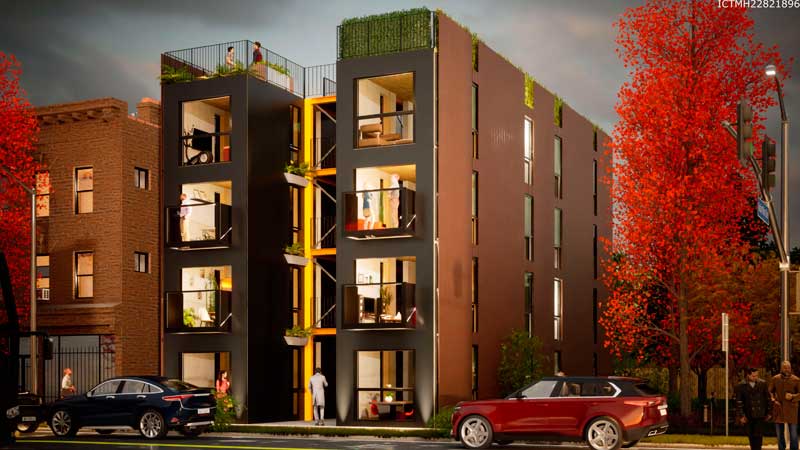
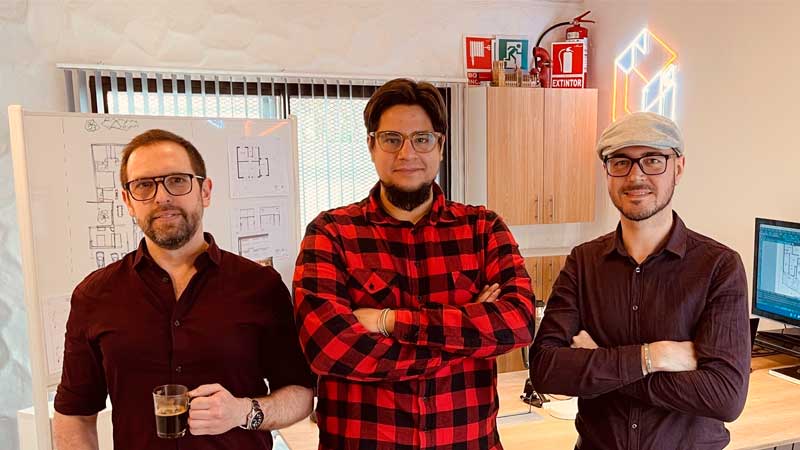
Citrino Arquitectos is an architecture firm that began its professional practice in 2020, founded by architects Luis Isain, Mauricio Capo, and Fernando Da Silva, all graduates of the architecture program at Universidad ORT Uruguay. In 2022, these young professionals decided to enter their first international design competition, which was open to students and young architects.
“The competition was organized by Impact Design Competitions, and more than 100 countries participated; we were the only team from Uruguay to be named among the top 50.”
Based on the competition brief to design a minimalist dwelling in a community of their choice, the team of architects decided to address one of the greatest needs in their local context: student housing.
What was your goal in entering an international competition?
We wanted to test ourselves against the world as a professional team. Furthermore, one of the contest’s requirements was to design a minimalist dwelling within a context that reflects the needs of a community selected by the participants. With that in mind, we were able to address an existing need in Uruguay: student housing.
What motivated you to work within the local context and focus on housing for such a specific segment of the population as students?
As cities grow, lots begin to take on different shapes. This results in increasingly smaller urban spaces for housing. Consequently, designing a student housing complex from scratch in the heart of a city is becoming increasingly challenging.
This is how the idea of three blocks, each measuring 10.89 m², came about; together, they form a 32.67 m² housing unit. Each block is designed for one or more household functions and can be arranged in various ways to facilitate its placement on the lot and minimize the area required for circulation. In this way, the complex can be subdivided into smaller lots, adapting to each specific situation.
How did the choice of construction method come about?
Thanks to technological advances and growing concern for the planet, we decided to use CLT (Cross-Laminated Timber) as the load-bearing structure, capable of supporting the number of floors needed to house 100 people. At the same time, we sought to create user-friendly spaces, not only because of their natural aesthetic but also because of their sustainability.