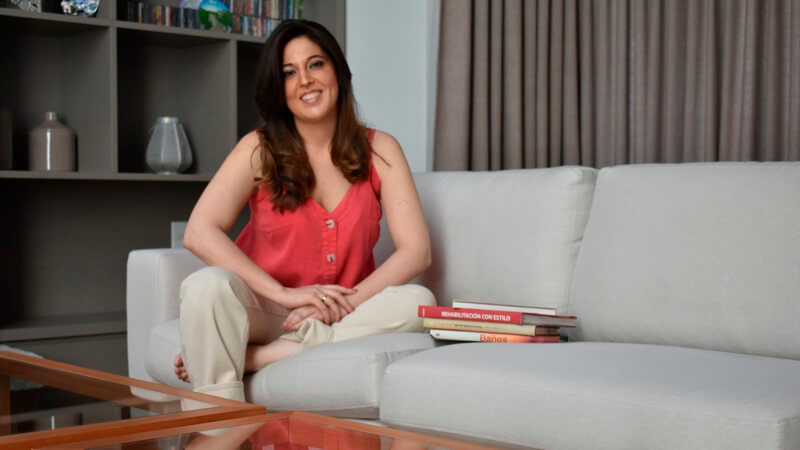
How can you turn a problem into an opportunity? Nicole Sosenke, a graduate of the Bachelor’s Degree in Interior Design from Universidad ORT Uruguay, is well-qualified to speak on the subject.
For her, as for so many others, the onset of the pandemic triggered a severe employment crisis. However, far from becoming discouraged, Sosenke saw this new reality as an opportunity to pursue a personal project she had put on hold for various reasons: a venture that combines interior design with coaching.
In this interview, Sosenke explains how the two areas are integrated.
How would you describe your current job?
My current work is part of a personal venture. What I do is apply self-awareness techniques to the interior design process.
Before this phase, I spent a long time working as an employee, and this is the first time I’ve taken the plunge to work on my own, in a different setting. My goal is to approach interior design from a personal perspective, helping people discover what they truly want and what their style is.
In this context, interior design becomes a tool to help people live better and be happier. That is the goal of incorporatingcoachingtechniques into the design process.
During your career, you’ve worked at companies such as Divino and Walmer. What was it like working at those firms?
My work experience at both companies was exceptional, because I grew and learned a great deal at both of them.
Walmer was my first formal job. There, I interacted with clients, learned to approach projects from their perspective, gained an understanding of the business side of things, and developed my skills significantly. It was the first step toward moving to Divino, where I took on the role of Product Manager—a major challenge that gave me the opportunity to travel and learn more about the industry.
Although they were different experiences, both were extremely rewarding, and I am very grateful to have been part of these companies.
What was the transition to private practice like?
The shift to self-employment was prompted by the onset of the pandemic. At first, I had to stay home, and later I signed up for unemployment insurance. Personally, I didn’t view that time as a period of uncertainty—quite the opposite. I was grateful to have that time to reflect on myself and on how I wanted to continue growing professionally.
At the time, my son was a year and a half old, and I was already questioning a lot of things about motherhood; that’s also why I took the opportunity to create something for myself—something different.
That’s how the idea came about, thanks to Nicole Sosenke, an interior design coach. Later, I was selected by the Organization of Women Entrepreneurs of Uruguay (OMEU) for the Más Emprendedoras program. There, they helped me turn my idea into a business model. Now, little by little, I’m starting to build my business.
"People are becoming more involved in design and placing greater importance on it—not just in terms of functionality, but also in terms of sentiment."
How do you remember deciding to pursue a Bachelor's degree in Interior Design at ORT?
In that regard, it’s worth noting that I had previously studied psychomotor therapy. At some point, I realized it wasn’t for me and that I needed to study something where I could see myself growing.
I’ve always loved crafts and painting—in fact, my mother is a visual artist—so that whole creative side was always very much a part of me. That’s how I learned about the Bachelor’s Degree in Interior Design through an interview with Graziella Blengio (academic secretary at ORT’s School of Architecture), and I loved the program. It fascinated me from the very beginning, and pursuing this degree is a decision I don’t regret at all.
What skills did you acquire during your studies, and how do you apply them in your day-to-day work?
I think I picked up all the necessary skills during my studies. And I use them all the time in my work. In fact, I don’t even realize I’m using them when I’m doing so. So, really, everything I learned at ORT is the foundation of who I am professionally today.
 What would you say to people who are thinking about starting their degree program?
It’s a wonderful degree program—very demanding, but also very rewarding. My advice is that if you love design, architecture, and working with people, don’t hesitate to pursue a Bachelor’s degree in Interior Design, because it’s incredibly rewarding, both academically and personally.
What do you think of interior design in Uruguay?
I think it has grown tremendously. From when I first started studying until now, the change has been enormous. More and more importance is being placed on everything related to design in general, not just interior design. In addition, people are becoming more involved in it and placing greater emphasis not only on the functional aspects but also on the emotional aspects of design.
Today, the Bachelor's degree in Interior Design and professionals in the field are much more widely recognized than they were a few years ago. That's something we should take advantage of.
What are your next professional goals?
My project isn't just focused oncoachingprograms and interior design projects; it also includes teaching. The idea is to give people the tools they need to tackle their own projects, so the next step will be to offer courses through my website for those who want to design their own spaces.