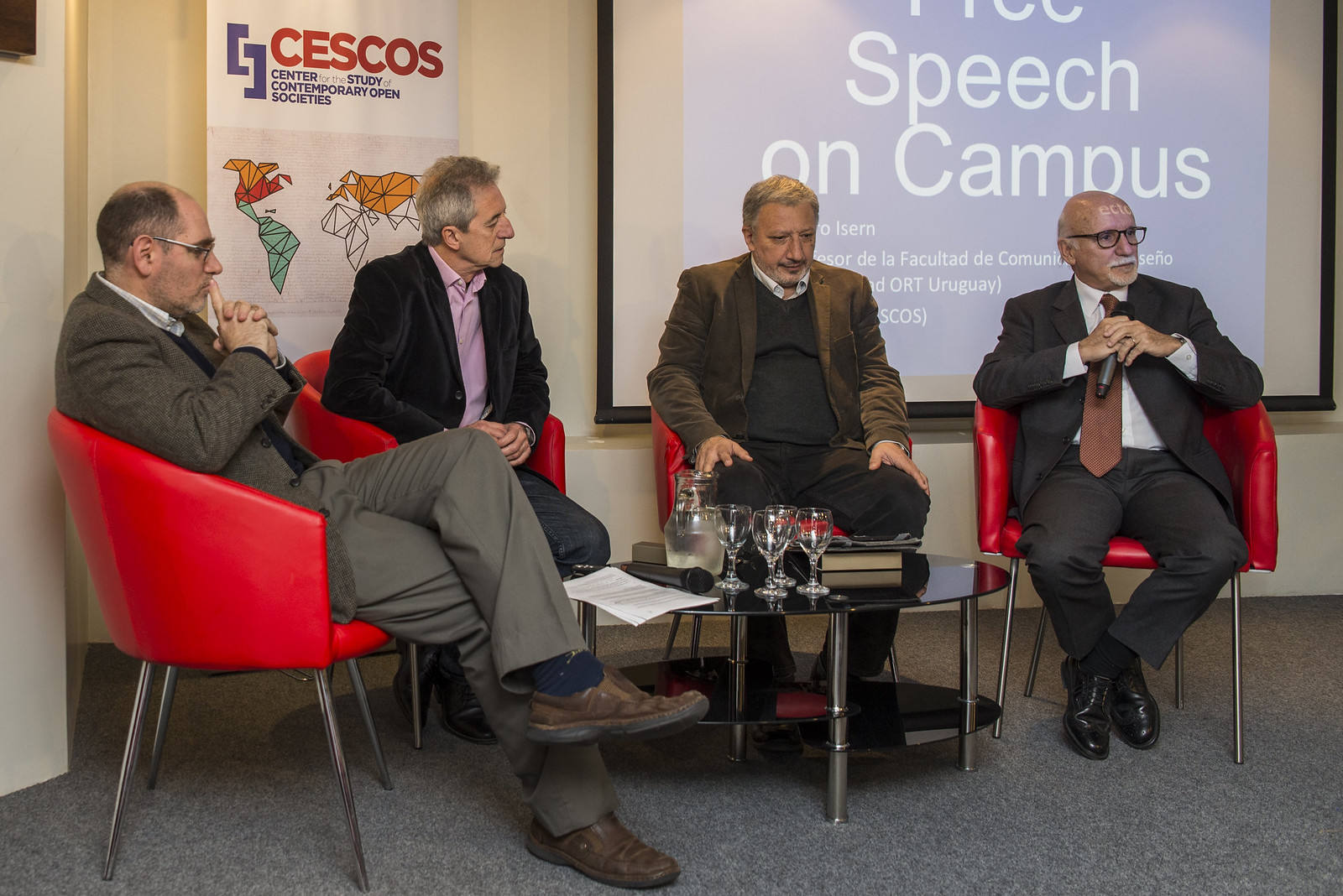
“Freedom of expression is essential to defending freedom and reason,” said Ambassador Guillermo Valles, president of CESCOS (Center for the Study of Contemporary Open Societies). “That is the ultimate foundation of CESCOS.”
Valles moderated the discussion titled “The Open Society in Its Labyrinth,” featuring presentations by Pedro Isern, Daniel Mazzone, and Gerardo Sotelo. “In the field of communication, you don’t just have a career,” the ambassador told the students, “in communication, you have a role as citizens—both of Uruguay and of the world. Communication plays a fundamental role as a mechanism for defending freedom.”
Professor Pedro Isern—who holds a Master of Science degree and a master’s degree in economics and political science—argued that “freedom of speech must be balanced against other rights.”
“For several years now, unease and frustration have been spreading throughout much of the West,” he noted. “In a place as central and as significant to open societies as the United States of America, one manifestation of that unease has been evident in universities.”
We have the opportunity to address the issue, to create spaces where we feel safe, and to begin to thrive in our diversity.
Pedro Isern
He lamented that “the most important thing at the university” had ceased to be the pursuit of truth and had instead become “a culture of victimhood.” He pointed out that nuance is essential at the university.
Meanwhile, the academic coordinator of the Bachelor’s Degree in Communication with a concentration in Journalism, Daniel Mazzone, M.A., said that “truth is a crucial issue in open societies.” He commented on one of the problems journalism is currently facing: “Journalism is timid, on the defensive, trying to say ‘it wasn’t me’ regarding this issue of so-called fake news. Who would ever think that journalism could invent fake news?”
We live in a society with many flaws, but in an open society, we have the right to appeal. Freedom is diminished without participation; that is what defines the quality of our freedom. Truth does not exist without you; it does not exist without each and every one of us; there is no truth without participation.
Daniel Mazzone
Journalist Gerardo Sotelo spoke about freedom of expression in the age of post-truth and post-censorship: “Freedom of expression includes the possibility that someone might take offense at what we say; post-censorship is to post-truth what a wall is to the castle where the faithful take refuge from the infidels.”
https://youtu.be/w1u931Kc0Wo?si=KfrekNTnPlecf6Fv
On the Importance of "Free Speech on Campus"
Why reflect on “Free Speech on Campus”? Because other people’s opinions are always important, but at university they are essential.
“The concept of Free Speech on Campus stems from the fact that, in the United States, we are beginning to see outbreaks—or rather, explosions—of intolerance from groups that do not want to let others speak,” Mazzone explained. “This concerns CESCOS (Center for the Study of Contemporary Open Societies), so they are beginning to organize events and debates, especially among young people, to raise awareness of the importance of listening to others. Not just tolerating, but respecting what the other person is saying.”
"Today," Mazzone continued, "this is a concern shared by 'people from the political sphere, who are joining forces with people from the world of journalism.'"
“These days, there is a lot of talk on American college campuses about freedom of expression and the values of free inquiry,” says the article cited by Prof. Pedro Isern to illustrate how this concept came to the fore at the University of Pennsylvania.
Isern adds: “The learning process involves gradually setting aside one’s own ideas, beliefs, and prejudices in order to incorporate and make use of the ideas and knowledge of others.” We learn, he says, “because others teach us something we didn’t know.” He adds that for this process to be genuine and virtuous, it is necessary to respect the freedom of others. “Listening to an argument different from one’s own is not only a matter of respect but also a great opportunity to learn.”