- How does a bank innovate using data?
- How much do communication profiles contribute to the analysis?
- Is data analysis a cross-functional skill that should be part of every profession?
- What skills will communicators of the future need?
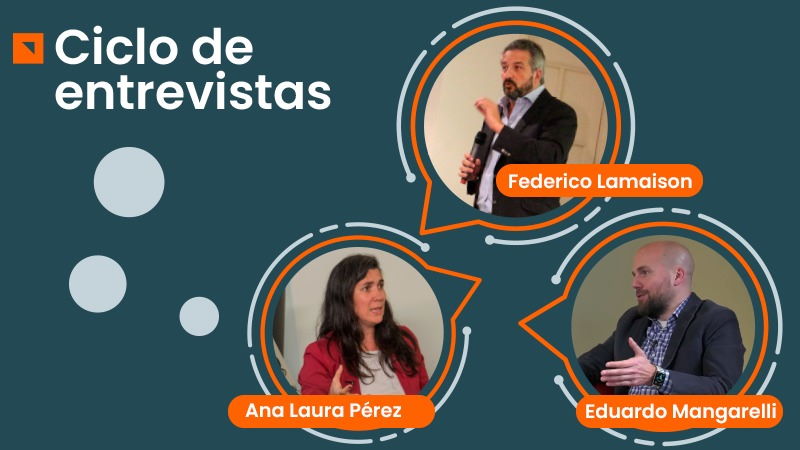
Those were some of the questions answered by Federico Lamaison, Manager of Marketing and Corporate Communications at Banco Santander Uruguay, and Eduardo Mangarelli, Dean of the School of Engineering at Universidad ORT Uruguay. Both were interviewed by journalist Ana Laura Pérez, who has MBA and serves as digital product manager at the newspaperEl País, as well as academic coordinator for the Bachelor’s Degree in Communication with a focus on Data Analytics and Innovationand, additionally, for the Journalism track.
“Data is like an oracle”
In the banking sector, data is used to make decisions; decisions that give rise to innovation and insights. In other sectors—from government to the pharmaceutical industry (a clear example being everything related to COVID-19)—data is central to everything.
Federico Lamaison has been head of Communications and Marketing at Banco Santander since April 2019. He says that, in addition to analyzing all the data to inform decision-making, they devote significant effort to cybersecurity to protect both customer and market data.
We all have data. Big Data is defined as the data that comes into a company every day, in whatever form. For those of us who work in marketing and communications, data is like an oracle: in the past, we had to seek it out through market research, which took weeks and required focus groups to interpret.
“Data teams, generally speaking, especially those focused on data analysis, tend to be made up of people with backgrounds in economics or engineering,” said Ana Laura Pérez. “How important is it to have communications professionals who can engage with those teams and make sense of that data?” Lamaison is emphatic: “When people hear ‘Big Data,’ they think of Excel spreadsheets, data, and numbers, and it can be intimidating. You might think, ‘What does this have to do with communication and marketing?’ It has a lot to do with it—and it has to do with everything.”
Communication professionals are needed to interpret consumer insights that aren’t always reflected in hard statistics or numerical data. “For example, there’s a lot of talk these days about the human factor behind Big Data.”
In fact, he noted that some studies suggest that many companies that invest in data often fail to effectively manage and utilize that information. “Communication is essential for predicting behavior, understanding why things are happening the way they are, and correcting mistakes.”
Interpreting data to challenge conventional wisdom
Is analytics a cross-disciplinary skill that should be part of every profession? “If I may expand on that, I’d say it involves numbers and data,” replies engineer Eduardo Mangarelli, who took office as dean of the School of Engineering at Universidad ORT Uruguay February 2020. “The digitization of all tasks, in some cases, simply involves storing a large amount of data on various things—sales, purchases, customers who call us, how many people visit us, who accessed the website, and at what times. That data we generate all the time is ripe for analysis from a commercial perspective, from a medical-clinical perspective, and even for optimizing a city based on traffic measurements.”
Today, Mangarelli asserts that in any field, the ability to interpret and analyze data—as well as to derive insights from that data—is an essential skill.
Data analysis is one of the key skills of the future. I believe it serves as a common language that allows us to communicate effectively and enables organizations to unlock the full potential of their data.
Mangarelli acknowledges that it is true that organizations have been developing teams focused on data analysis, processing data, and sharing those findings with the rest of the organization. Another very important development is that stakeholders from all areas “are able to understand and even develop a common language to interact with these data experts.”
In addition to technical skills, it is essential to have a common language. “Learning to live with ambiguity, knowing how to prioritize communication within teams, adapting to change, and developing the ability to embrace change,” Mangarelli continued.
Another key trait is the ability to question things and break away from conventional thinking. Often, those who possess this ability are the ones with less structured thinking—the more creative and innovative ones; someone who feels uncomfortable, who is restless, who questions reality and the limits of what can be done.
It is clear that managing, understanding, and making data-driven decisions has become a top priority. ORT’s Bachelor’s Degree in Communication —the most comprehensive and up-to-date program in the country—recently introduced a specialization in Data Analytics and Innovation, which provides the analytical rigor needed to interpret audience behavior, enhance communication strategies, and accelerate innovation processes as well as new business models.