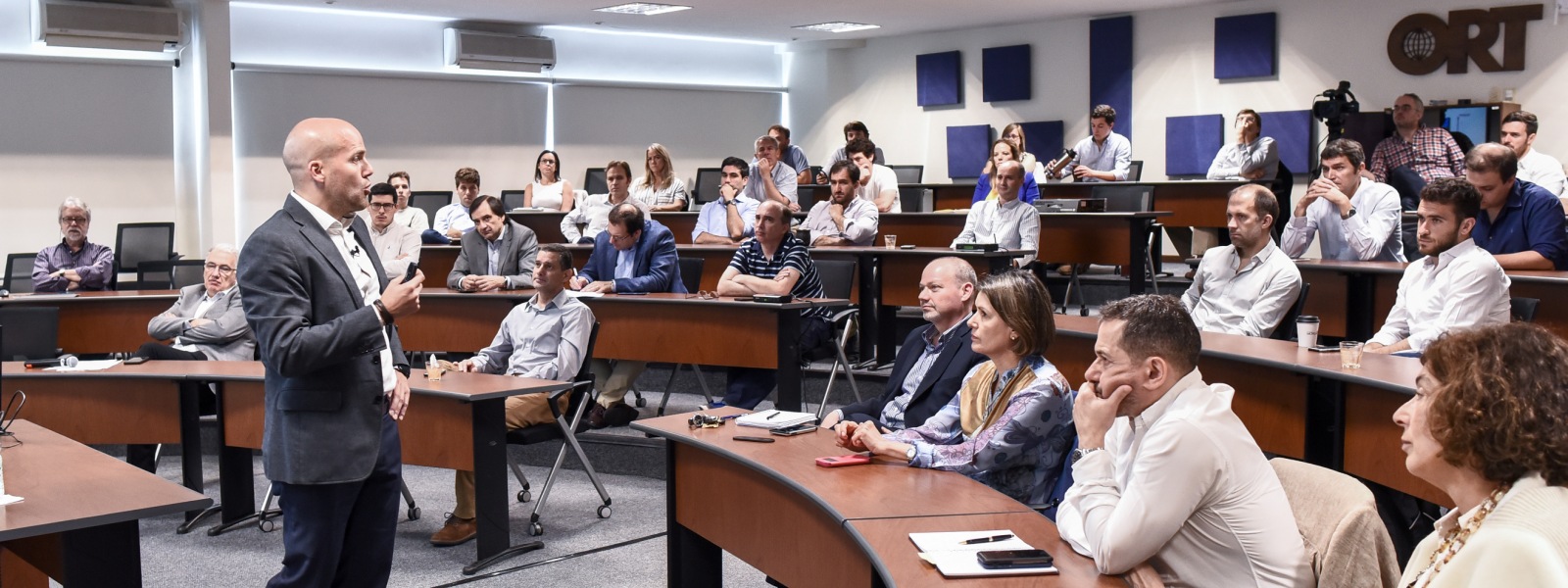
“When digitizing a company, it is important to clearly identify the problems you want to solve and the customer’s needs,” said Francis Cepero, M.A.—Director of Solutions at Mercado Vertical—during the conference “Leading the Digital Transformation: Success Stories.”
The event took place on Thursday, November 14, 2019, at the Pocitos Campus of Universidad ORT Uruguay. It was organized by the Graduate School of Business and was part of the Management and Business Lecture Series.
Alongside Cepero, the panel featured Eduardo Mangarelli, an engineer—associate dean of the university’s School of Engineering, board member of Endeavor Uruguay, and former chief technology officer at Microsoft Latin America—with Mauricio Oppenheimer, an economist and general manager of Punta Carretas Shopping, serving as moderator.
Is data the new oil?
Not all products or services can be digitized, but four related areas—customers, employees, assets, and suppliers—can be digitally transformed.
Cepero defined an organization’s digital transformation as the process of gaining sustainable competitive advantages through the use of data and technology. While a business strategy does not necessarily have to be digital, it must be supported by digital technologies.
Today, it’s no longer just about producing and selling; you also need to understand data analytics (big data) andmachine learning. A business leader doesn’t necessarily need to possess these skills. In that case, the expert added, it’s important to work with a partner who can help promote them within the company.
“It’s important to anticipate and meet customers’ needs,” Cepero explained. For example, Airbnb addresses a need that no one else had been willing to address: “Staying at someone else’s home.”
“Is data the new oil? If I give a company 500 TB of data, it doesn’t become any richer. If data were the new oil, companies would automatically become richer simply by having data. Data itself has no value. What has value is analyzing it. We must treat data as an asset, responsibly,” Cepero said.
The value of data
“Every company relies on technology as a source of differentiation, opportunities, and competitive advantages, as well as a means of creating new customer experiences,” Mangarelli said.
Digital transformation occurs along two main lines: one brings about significant or disruptive improvements in operations; the other changes the value proposition of products.
The expert discussed the case of Monzo Bank, a UK-based startup. It is a digital bank that specializes in payroll accounts and makes recommendations based on the collective data it collects from its users.
“It went from being just a digital bank to becoming a financial advisor. This is a good example of how competition can come from unexpected places. This isn’t just happening in the financial industry—it’s happening across all industries,” said Mangarelli.
“All companies tend to focus on our major competitors, who have branches right next door, until someone from outside comes along and sees the business in a different light, with a different approach and a different value proposition.”
To achieve successful digital transformation, “the company must have a vision for how to improve customer engagement.”
Mangarelli identified five key pillars for digital transformation: understanding market trends; specific business knowledge; the potential of technology; the ability to execute; and fostering a cultural shift.
“There is a challenge that all companies face when undertaking digital transformation projects: should they adopt existing solutions or build their own?” said the expert, noting the importance of companies developing their own intellectual property for those areas that are critical to creating product value.
Mangerelli cited the example of Uber, which went from using Google Maps to creating its own maps. “You have to identify the situations where you need to develop something yourself versus those where it makes sense to rely on someone who’s extremely good at doing that.”
Video of the conference:
Image gallery:
