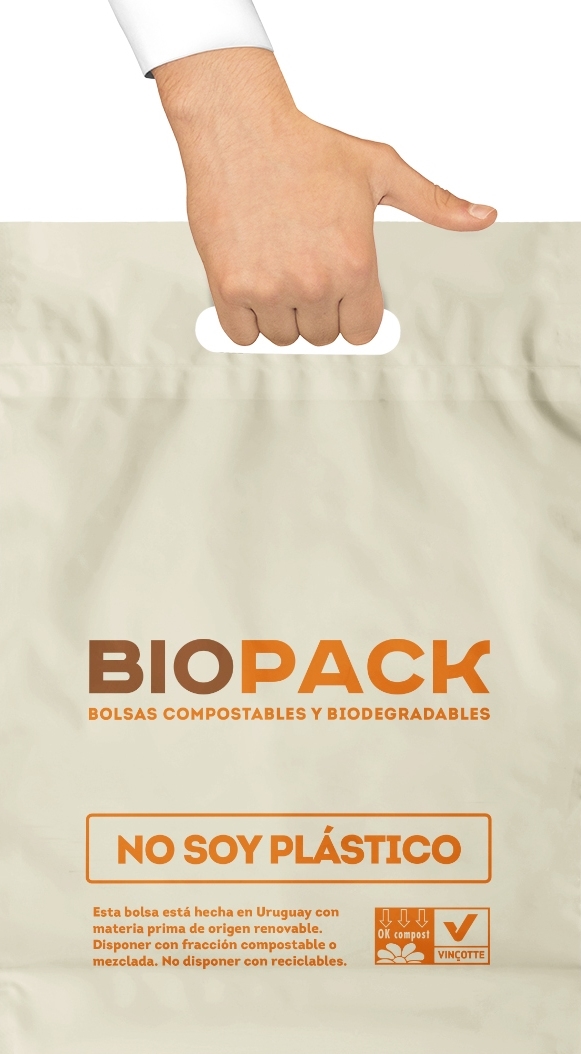
No matter how small the purchase, Uruguayans are used to receiving at least one plastic bag a day. They can be seen littering the streets and floating in the water. It is estimated that some 1.2 billion plastic bags are in circulation in Uruguay each year—nearly 400 per person. Globally, an estimated 250,000 tons float in the world’s oceans.
For this reason, and in line with international concerns about environmental protection, discouraging the use of traditional polyethylene bags and other petroleum-based products is the main objective of the law recently enacted by the Executive Branch, which mandates that retailers charge for bags and requires the use of more sustainable products.
A number of products are gaining ground in the market and are being promoted as alternatives to these bags. At the same time, experts say there is a great deal of confusion when it comes to distinguishing between the types of bags that are permitted and which ones are the most environmentally friendly.
In fact, Ignacio Gajer, a biotechnology engineering student at Universidad ORT Uruguay, and Inés Tiscornia, M.A., a professor in the program, set out a few months ago to introduce a 100% plant-based Italian raw material into the country and raise awareness about it.
“There is a great deal of ignorance in the market about these products,” Gajer said, encouraging people to educate themselves on what types of bags to use and why.
The law prohibits the “manufacture, import, distribution, sale, and delivery, in any capacity, of plastic bags that are not compostable or biodegradable.” Hence the importance of the definitions.
“Biodegradation” is a process in which a material breaks down through the action of microorganisms, producing carbon dioxide, water, and biomass, which are then reincorporated into the natural environment. While this process affects all materials, the time it takes for decomposition varies from case to case, as Gajer explained.
“All decomposition is biological in nature, and everything will eventually decompose,” he said. While traditional polyethylene bags take more than 150 years to degrade, materials such as plant-based biopolymers take 12 weeks if they are in controlled conditions at an industrial composting facility, or 10 years if they end up in a landfill along with all other waste.
Materials that differ from traditional plastic—which is derived from petroleum—because they are made from renewable raw materials are commonly referred to as “bioplastics.”
This also leads to confusion because, on the one hand, there are materials derived from renewable raw materials that are not biodegradable, while, at the same time, there are biodegradable materials made from petroleum derivatives. The following chart classifies the different materials based on their origin and their biodegradability:
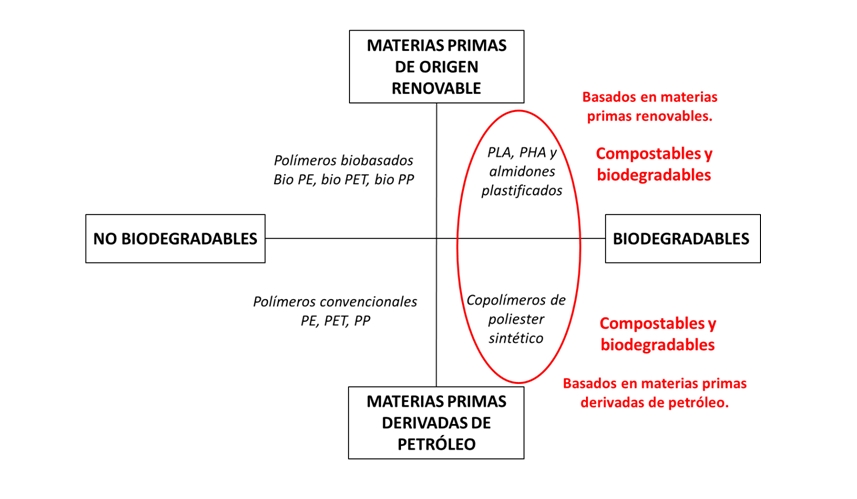
Under the new legislation, the materials permitted by law are those marked in red on the diagram. In other words, the ban on products is based on their degradation process, not on the origin of the raw material.
In this context of terminological confusion, the term that has gained ground, according to Gajer, is “composting.” This term refers to a type of biodegradation that takes place under controlled conditions (such as temperature and humidity) and results in a product (compost) that can be used as fertilizer.
There are composting facilities in Uruguay, but there is no established system for sorting household organic waste and sending it to a standard composting facility. This is why it is important to encourage so-called “home composting.” To help people learn how to compost, the Montevideo City Government recently published a vermicomposting manual.
Regarding the product that the ORT teacher and student began manufacturing, Tiscornia stated that “it meets all legal requirements and, furthermore, is made from renewable sources.”
“The project has the support of the National Agency for Research and Innovation (ANII) and the Industrial Fund of the Ministry of Industry, Energy, and Mining (MIEM), which will allow us to optimize the production process and work on promoting and educating the public about these new materials,” explained the ORT instructor.
These new bags biodegrade in the presence of oxygen within 180 days and, under industrial composting conditions, within 12 weeks. If they are disposed of in a landfill (along with other waste), they will take longer to degrade, but they will have a lower environmental impact compared to traditional bags.
“Since it’s made from cornstarch rather than petroleum, microorganisms can eat it and break it down in their metabolism without dying in the process, as happens when they consume plastic,” Gajer explained.
Most of the bags currently sold in stores as “eco-friendly” alternatives are oxo-biodegradable polyethylene bags. The problem with these bags is that an additive is added to conventional bags to accelerate their physical breakdown, but this process also generates microplastics that pollute waterways. For this reason, the global trend is to stop using this material.
“We want to tackle the problem right away,” said the entrepreneurs, who came up with this idea after meeting at a workshop on cell culture led by Tiscornia.