A DJ with a touch-screen mixer and the chance to try it out firsthand in Barcelona. That was the seed from which CreativeMornings Montevideo grew nearly five years ago.
In cities around the world, CreativeMornings—a movement that began in New York in 2008—provides a monthly gathering space for the creative community. Each month, during a two-hour gathering featuring breakfast provided by a local micro-entrepreneur, 70 people discuss a topic and have the opportunity to listen to a speaker, as well as to exchange ideas with him and the other attendees. It is a space for connection among creatives from different fields and also a window to the world.
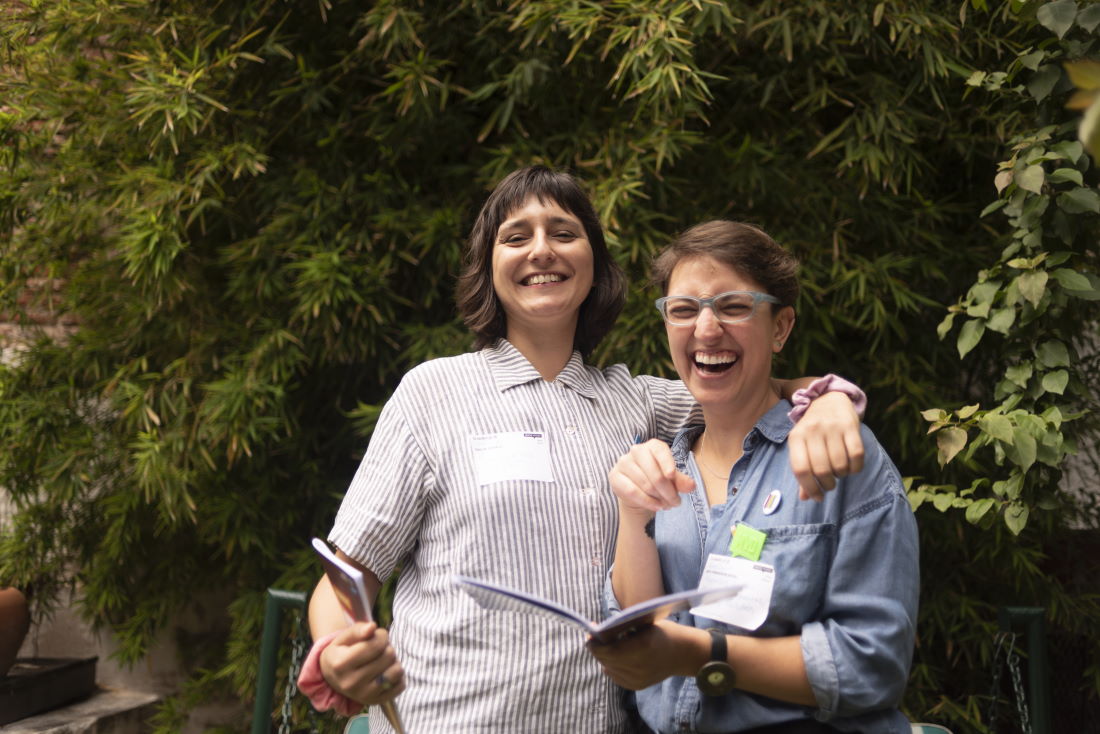
In light of World Creativity and Innovation Day, observed by the United Nations every April 21, we spoke with Valentina Piquerez, who holds a degree in Industrial Design from Universidad ORT Uruguay and is responsible for bringing CreativeMornings to the Uruguayan capital alongside her partner, Sofía Donner, who also graduated from the same program at ORT.
How would you define CreativeMornings?
It’s a series of free talks held around the world in 200 cities. It began in 2008 with Tina Roth-Eisenberg, a Swiss woman who moved to New York and created this gathering space. It began as an intimate gathering; she invited friends over for breakfast so they could get to know one another and listen to each other. What it created was a space for friends to meet and connect—friends who perhaps had nothing more in common than a certain openness and the fact that they were on the path to taking action.
We launched in Montevideo in late 2014, and today—both here and around the world—we’re a community of creative people who understand that we all have the power to take action and make a difference. It’s a diverse and open community that values differences, building bridges, connecting in the real world, and changing the world. We are dreamers, but we are people who don’t just dream—we take action—and that is what unites us.
It’s something we do entirely on a volunteer basis. Everything we have—whether it’s the venues, our partners, or the printing press—is because they believe in what we’re doing.
We’ve been at this for five years now, and it’s all been driven by people’s passion. CreativeMornings happens if the city wants it to; we all have to believe in it for it to happen.
Why did you bring CreativeMornings to Montevideo?
After studying at ORT, I went to Barcelona to pursue a graduate degree; I wanted to specialize in services and experiences—in the design of those intangible elements. At Elisava, I studied the Graduate Program in Innovation and Design Thinking. I went to get a glimpse of the future, to see how societies were evolving, what trends were emerging in other parts of the world, and what I could bring back here.
I kept an eye out for opportunities and events that looked interesting to me, because it was a way to connect with the city. That’s how I discovered CreativeMornings.
First of all, I loved knowing that the people who were opening doors for me and serving me coffee were doing so because they truly believed in that place; it really moved me.
I got to meet new people in the neighborhood, which I found incredibly enriching and full of energy. Barcelona already gave me a huge energy boost—it’s such a creative and vibrant city—but when I stepped out that morning, I felt like I could take on the world.
I wanted to create this space for openness in Montevideo because I felt there wasn’t a place like this for exchange—a place where we could tell ourselves that we can do it and show each other how others have managed to achieve such things, from a place of mutual support and admiration.
CreativeMornings, thanks to its format and the fact that no money was involved, also gave me the opportunity to create something that would have a major impact. Not only because of what it could bring to the community, but also because it put Montevideo on the global creative map, which could give visibility to the people we chose as speakers.
Sofía Donner, also a graduate of ORT’s Bachelor of Industrial Design program, was my partner throughout this entire adventure.
November will mark the fifth anniversary of the first event held in Montevideo. How would you assess the contribution CM has made to the city’s creative community?
I think that five years ago, Montevideo didn't have the same energy it has today, nor the spaces for gathering and creativity that it has now.
To become a CreativeMornings host, we had to apply and specify where the event would be held. In that search for the right venue—one that had the energy we were looking for—I met the partners at Sinergia, back when it didn’t even exist yet. CreativeMornings was the first event to be held regularly at Sinergia, and from the moment both communities were created, there was a very strong synergy. What happened in the beginning laid the foundation for everything that followed.
Today, creatives work differently; we no longer spend most of our time in studios or companies with assigned roles. Instead, we often work as freelancers, living a nomadic lifestyle and traveling the world.
I believe these spaces are essential to this new way of defining ourselves as creatives in our work.
CreativeMornings is a fantastic opportunity for people traveling the world.
We’ve served as a great platform for local creatives, allowing the world to see and get to know them. Obviously, it’s thanks to the hard work of these individuals who are striving to carve out their own path, but I think being featured on CreativeMornings—the website where talks from around the world are posted—is a great showcase.
There are many people around the world who use the platform to find talent. Here in Montevideo, we've noticed that people look through our profiles to recruit staff.
How does the CreativeMornings Montevideo team go about the process of creativity and innovation required to produce engaging events month after month?
We rely heavily on Design Thinking and co-creation methodologies. Every team member has a say, we meet once a week, and we work together to determine how best to approach the topic of the month.
We brainstorm together, group ideas into clusters, organize them, identify the main concepts, see how they connect, and then figure out who has something to say about them. The community feels very much involved and contributes its own ideas as well.
From there, we move on to developing the structure of the talk, for which we’ve also created a dedicated process to support the speaker, because we understand that it’s not an easy task and not everyone has that skill.
Once we know the direction the talk will take, we start thinking about activities we can organize alongside the breakfast. For example, with Gabriel Pasarisa—one of the many ORT teachers who served as speakers—we held a small workshop on typefaces, and participants had the chance to ink and print by hand using very old-fashioned, artisanal methods. It’s an opportunity to try something new.
We don't have the financial resources to invest, but we have all the skills needed to create something new.
Since it’s a free and open event, all you need to do to join CreativeMornings is create a profile on their website and pick up your ticket in person on the Monday before each event.
You describe yourself as a service and experience designer. Why?
I've always liked the idea of creating something new, but the actual process of making the object itself is very distracting to me. I feel like we live in a hyper-consumerist and very materialistic society, so now we're much more inclined to invest in experiences—which means investing in life, in what I experience, rather than in what I own.
Although service design has a tangible aspect, it does not focus on the object itself; rather, it generally involves designing processes, planning and organizing people and suppliers, the team, the infrastructure, and communication around a service to create something of higher quality.
It focuses primarily on the experience of the person who will use the service and on understanding that we are capable of designing that experience.
In fact, Design Thinking—which my professors introduced to me when we discussed innovation during the final years of my degree program—proposes that the person comes first: we have to find the common ground, where the variables of what is desirable, what the person needs and wants, what the company is capable of doing, and what is economically viable intersect. It is that intersection—and starting by thinking about the person—that completely shifts the focus of how we develop ideas, startups, and businesses.
I describe myself this way because this is the area I want to continue specializing in. We need to foster a culture and a body of knowledge that entrepreneurs haven't yet embraced, which is why this is so important.
Industrial design is associated with product development. How does your background as a graduate in industrial design relate to your work as a service and experience designer?
Everything related to prototyping has always been very important in every project. It’s a basic concept that’s constantly emphasized in Design Thinking—it’s the essence of design thinking and the methodology itself. It’s something I learned in college, and today it remains a fundamental principle for me: understanding that the sooner we prototype an idea and test the concepts we’ve developed—provided we’ve researched our users properly, gathered the necessary data, and created something viable—the better.
That’s what helps us figure out whether we need to go back or keep moving forward. Don’t get frustrated just because things don’t turn out perfectly the first time. The important thing is to go through the process and know that you can always start over.
Creativity is everywhere, and it is precisely how we are able to solve existing problems using existing resources—but by seeing and using them in a different way. As human beings, we are all creators, and it is at the intersection of these diverse elements that the possibility of creating new things lies.