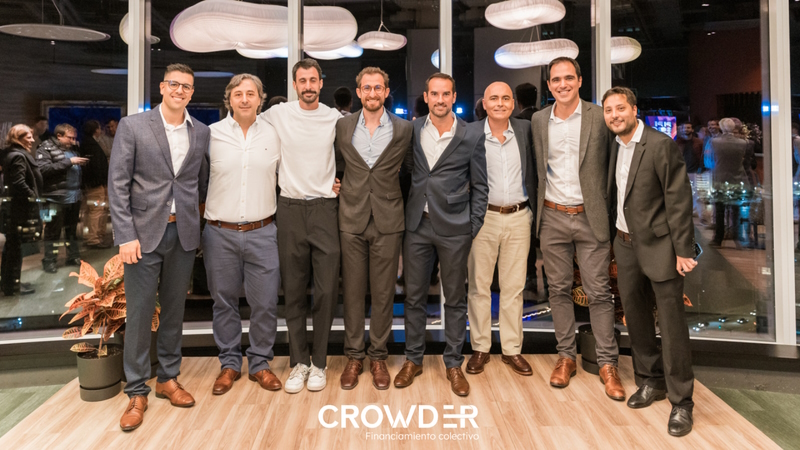
In 2020, the Central Bank of Uruguay (BCU) issued a new regulation authorizing the development of crowdfunding investment platforms (crowdfunding). A little over three years later, on January 4, 2024, a company received the first operating license to manage such a platform. The company is called Crowder, was incubated at the Center for Innovation and Entrepreneurship at Universidad ORT Uruguay and officially began operations on June 18.
Crowdfundingallows anyone to invest in a startup or small business with affordable amounts.
In other words, it serves both purposes: on the one hand, it allows the "average person" to access affordable investment opportunities by committing a small amount of money to a project they believe will be profitable within a certain timeframe; and, on the other hand, it supports the growth of small businesses by providing opportunities to generate income through small investments that, when combined, can serve as significant economic drivers.
"Crowdfunding is designed to give small investors access to investment opportunities in companies, in exchange for negotiable obligations (when the company borrows that money to repay it with principal and interest) or shares (when one buys a stake in the company and the success or failure of the investment depends on that company’s annual results),” explained Guillermo Rodríguez, co-founder of Crowder alongside Nicolás Fornasari.
The market opportunity
Rodríguez is a lawyer and has been involved in the entrepreneurial ecosystem for years: "I started advising startups and began working with incubators. That's how I came across CIE—in my opinion, the best incubator in the country—and launched SOY, followed by Crowder."
Based on their combined experience, they realized that it is difficult for a startup to secure financing.
Not all of them are suitable for venture capital (funding for startups with growth potential and a scalable business model); the spectrum is much broader, and many fall outside the scope.
Therefore, the number of small businesses that are unable to secure funding for their projects represents the market opportunity they have identified.
He added: "We later realized that this market opportunity was much larger, because there are also a lot of companies that, beyond venture capital, are seeking financing but face major obstacles in accessing it (whether due to delays, risk assessments, etc.). So those companies end up seeking financing in the private market at a very high cost." That’s where Crowder comes in, serving as an alternative for obtaining investments through crowdfunding.
"In addition, there are a lot of retail investors who have nowhere to invest their savings safely and in a regulated manner, and what Crowder does is regulated by the BCU, which oversees all our operations. But to invest in the stock market or through a broker, for example, you need a minimum of $5,000, $10,000, or $20,000. Here, people can get started with just $100," he said.
The support received and the launch
As the co-founder explained, Crowder received a pre-seed investment round from Uruguayan angel investors, and was later supported with seed capital by the National Development Agency (ANDE), and more recently by the National Research and Innovation Agency (ANII), with the CIE serving as the sponsoring institution. But he insists that it was an extremely demanding process because “it was a major hurdle,” as it was the first company authorized to operate in crowdfunding by the BCU, which involved a highly bureaucratic process.
Companies that wish to partner with Crowder are reviewed by a project evaluation committee led by industry professionals, who assess each company before deciding whether to move forward, based on its growth potential and the amount of investment it could attract.
Crowder launched on June 18, and as of today, it already has one company listed: Foxsys, which specializes in remote concierge and building security services and aims to raise one million dollars (USD 1,000,000) in investment over two months. In just one week, it has already raised nearly USD 150,000, equivalent to 14% of the goal. The minimum investment amount is USD 100.
"If the fundraising goal isn't met, there are two options: either the company takes the funds anyway and decides to invest them, or it doesn't take them and returns the money to each investor without charging a commission," Rodríguez said.
Regarding public acceptance, he said: "We understand that this doesn't happen overnight. It involves a process of education—informing people and explaining what Crowder is and how it works—a process of financial education. We get a lot of messages and questions from people, and we try to respond to everyone to provide them with information so they feel confident (about where they're investing their money)."
He concluded: "We're pleased with the start because we've already raised nearly $100,000 in three days, which is a good sign. But we understand that we have to take it one step at a time. We want this first campaign to be successful so that it can serve as a guiding light and motivate us to continue launching new campaigns."
Would you like to start a business?
Submit your idea to ORT’s Center for Innovation and Entrepreneurship