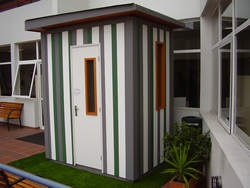
 It is the most private space in the home. Its existence is essential for human hygiene. However, in many areas facing critical socioeconomic conditions, bathrooms—and their role in preventing the spread of disease and other health issues—are often neglected. Matías Lozano, a 24-year-old eighth-semester student in the Industrial Design program, decided to complete his final thesis project in collaboration with the Ñande Project to jointly create sanitary facilities for homes in the Casavalle neighborhood.
How did you come up with the idea to design these bathrooms?
As part of the curriculum, students are encouraged to choose a topic of their own choosing that relates to the issues facing Uruguayans today.
The idea to design the bathroom came about after researching the current situation in some neighborhoods of Montevideo and small towns in the interior of the country regarding the need for decent and sanitary bathroom facilities. It essentially arose from observing the lack of sanitation and water in these places, from researching how many homes had a bathroom, and from a personal desire to tackle and engage a bit more with certain social issues and, drawing on my experience as a future professional, to contribute a possible solution to this social and environmental issue through eco-design.
Who are they intended for? Are they exclusively for people living in areas without sanitation?
They are designed for a segment of the population living in extremely deprived areas that lack basic services such as sanitation.
The reality I faced was very harsh. I found homes without bathrooms, forcing people to resort to unthinkable solutions to make up for this lack. These solutions do not meet even the most basic health and safety standards; on the contrary, they pose a threat to people’s health and the environment.
It is worth noting that the Ñande´ Project, the organization with which I am conducting my thesis, enhanced the research on the social and cultural aspects of the neighborhood (Casavalle), as it helped me explore and delve deeper into key issues. Understanding the characteristics and needs of the population, developing and incorporating new technologies in wood construction into the project, and gathering information on the types of bathrooms and methods of organic waste management used by the population helped me integrate social and communication-related aspects into the project that assist users in promoting health education.
I began to consider a solution from a design perspective, conceptualizing a product that would address this need while taking into account the lack of sanitation, the location where the product would be installed, the users, their socioeconomic status, and numerous other variables.
This product is not intended solely for people living in areas without sanitation infrastructure. The design I propose offers other options for future connection to the sanitation network. In fact, the strength of the design lies in separating waste into liquids and solids; the liquids pass through a stone filter and then seep into the ground or are collected in a tank. Meanwhile, the solids go into a compost bin where the waste is treated with chemical and organic agents, resulting in harmless, easily manageable compost.
To achieve this, a waste separator was designed; however, it may or may not be installed, as the user may be connected to the sewer system or a septic tank.
How does your project relate to water conservation?
The project does not currently include water conservation measures. Initially, this was one of our objectives, but as the project progressed, we determined that—for this phase—it was not essential to include it, given that there were other priorities, such as waste management and health education for users.
The liquid that is collected or seeps into the ground passes through a stone filter, ensuring that the wastewater causes less pollution in the soil.
Water savings are planned for a second phase, based on user feedback and the product's performance.
Why is saving water so important when using the bathroom? Does flushing the toilet really make that much of a difference?
Daily water consumption for an acceptable standard of living is estimated at about 250 liters per person per day. Generally speaking, it is estimated that 20 to 50 liters of drinking water per person per day are needed for cooking, drinking, and washing dishes. The rest is used for personal hygiene and household cleaning. It is very important to conserve water not only when flushing the toilet but also—for example—when using a faucet. Perhaps we do not fully appreciate the importance of this aspect when consuming water, since our country has water sources throughout the national territory.
One very important point—and one I consider a priority—is promoting health education among users, which of course includes water conservation for household use.
How does your project relate to caring for and protecting the environment?
The project aims to protect the environment, recognizing that some people today live in areas without access to sanitation. As a result, they must resort to solutions that do not meet hygiene standards. Waste is dumped into cesspools, open pits, or waterways, creating sources of contamination for the population and the soil, which severely impacts the environment. By using a compost bin and basic, natural chemical agents such as lime and sawdust, the project aims to produce safe compost that users can handle with greater safety, as it poses no risk of contamination.
What has your experience been like working on your final thesis project?
It was a unique and once-in-a-lifetime experience for me. Professionally, I’ve designed other products, but I’ll never forget the impact and personal growth that this project has given me. I want to highlight the collaboration of the teachers and colleagues at ORT and the team responsible for the Ñande Project: Marino Giudice, Sebastián Ugarte, Diego de Angelis, and all the young people who work at the organization. Honestly, for me, it’s a life lesson. It brought me into contact with incredible people who encourage, help, and guide me in bringing my project to fruition.
Is that what you liked best about the program?
The other day I was telling a colleague that this stage of my career is the one that has demanded the most physical and mental effort from me, but at the same time, I think that because of that effort, it’s the most rewarding and enjoyable. It feels like something that was maturing inside you suddenly bursts forth, and there it is—the result of all those thoughts that had been swirling around in your head.
Why did you choose a degree program in industrial design?
It’s the need to create objects and products that are useful to other people. I believe this is the best way to share the creative spirit within me with society.
How would you define industrial design? What are the goals of this branch of design?
For me, industrial design is the rational pursuit of creativity, which I then translate into the final product and bring to life. I believe it involves the strategic management of variables that come together to form a living product. As objectives of this branch of design, I can mention the following: the industrial designer should recognize the product as an expressive element that fulfills a specific function, for which its attributes, features, and communicative qualities are defined; create new products based on technological, productive, and cultural advancements—intelligent products that address users’ needs and consider their socio-environmental impact; and adhere to eco-design, always seeking interdisciplinary collaboration and research.
What do you love most about this profession?
To translate the creative work of design into the final product. To move through each stage of the project by exploring, recreating, and interacting with other professionals in the design field, such as graphic designers, or those in related disciplines, such as engineering, among others.
What is the most notable aspect of the program you're enrolled in at ORT?
The high-quality, well-rounded education provided by our faculty. They equip us with up-to-date knowledge that enables us to develop into innovative, creative, and dedicated professionals as we turn our projects into tangible products.
Do you remember any funny stories that happened to you while you were in college?
I remember many of them—some I can talk about, others I can’t—but statistically speaking, I remember that I could never sleep the night before a deadline; it’s impossible. I don’t know why, but there’s always something left to do. It’s not a matter of organization; rather, in my case, the best ideas always come to me at those moments.