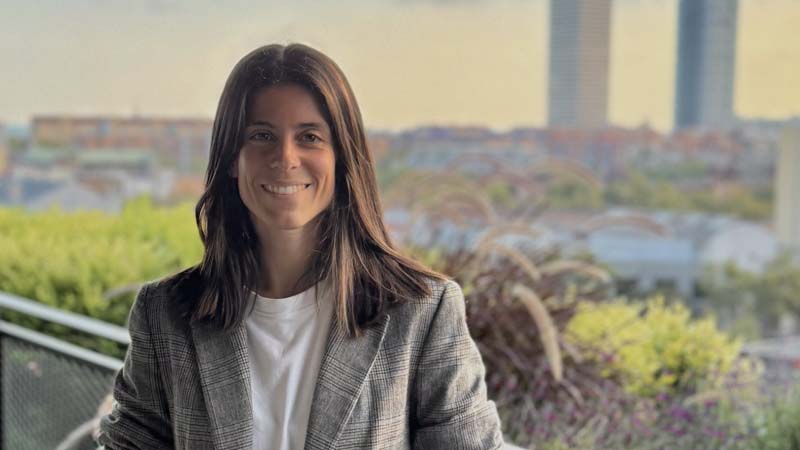
Years later, as a professional, he made it one of his key criteria when choosing job opportunities: from his early days at Rootstrap, when remote work was still virtually nonexistent, to his current role leading artificial intelligence (AI) projects in Barcelona.
“For me, that flexibility is part of the lifestyle I want to lead. It allows me to visit my family in Uruguay or my partner’s family in England without interrupting my work,” she says.
A start that left a lasting impression
One of his earliest memories from college still resonates strongly. It was during an introductory course on systems, where a professor suggested we envision the future as existing between two worlds: the physical and the virtual.
“He talked to us about parallel realities and the role we would play as creators of that digital world. It really made an impression on me. It made me want to be part of building that virtual universe, but from a positive perspective.”
That vision remains with her to this day, especially in her AI-related projects, where she recognizes the responsibility of those who develop technology for millions of users.
From ORT to Glovo, and from there to the world
After working at various agencies and consulting firms, Sol moved to Spain to join Glovo, the Spanish delivery unicorn. “I felt I was about to face a huge challenge, but I realized I was very well prepared, ”she recalls.
“The demands of the ORT program—the projects, the group work—all of that shapes you. And so does our work ethic as Uruguayans: we’re decisive, responsible, and committed.”
At Glovo, he faced the challenge of designing and scaling systems for millions of users for the first time. It was there that he also began to get involved in product development, seeking to make an impact beyond just the code.
Today: AI, Impact, and Purpose
He currentlyworks at LeadTech’s AI Lab, an in-house innovation lab where he leads projects that apply artificial intelligence to both internal processes and new product development. His role combines technical leadership with product management, allowing him to blend his two main interests: engineering and strategy.
“We focus on identifying real bottlenecks within teams—those repetitive tasks that no one wants to do—and seeing how AI can free up time and energy for what truly adds value,” he explains.“We also analyze large volumes of data to provide insight into what’s happening within the company.”
Technology with a positive environmental impact
Beyond her current projects, Sol is also exploring how technology can help mitigate climate change. She has worked with startups focused on natural solutions, circular fashion, and renewable energy, and is part of an impact hub in Barcelona.
“Everything we do in technology leaves a footprint.”
“Website design, algorithm efficiency, and the energy consumption of AI models—all of these factors have an impact. That’s why I’m interested in understanding how to reduce that footprint and use technology to solve real-world problems. It’s not about avoiding trends, but about diving right in and figuring out how to make them more sustainable.”
It is also a member of the AI for Good network, which promotes the use of artificial intelligence for the common good.
A bridge to Uruguay
Although she now lives in Barcelona, she maintains strong ties to her home country and her university. “I’d love to build a bridge between Uruguay and Barcelona. I’m not sure yet what form that will take, but it’s always on my mind. Half of my professional network is in Uruguay. If you keep your eyes open, opportunities will come your way.”
He believes that even a conversation with students, an interview like this one, or a collaborative project are valid ways to maintain that connection.“It’s part of who I am,”he says.
Showcase your work from day one
At the end of the interview, he offers a reflection that sums up everything he has learned:
Showcase your work. Every project you work on during your studies, every technology you learn—document it and share it. Make them open source, upload them to GitHub, and write about them on LinkedIn or your blog. Because no one is going to speak for you: showing what you can do is the best way to forge your own path.
That, she says, would be her advice to her 18-year-old self.
Find out more about Systems Engineering