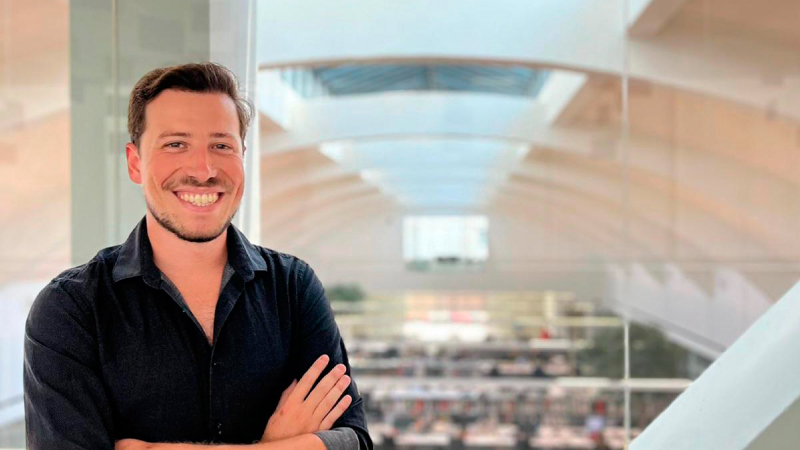
“I work at the One Works studio in Milan. I started out here designing, working on construction drawings, tenders, concept designs, and everything else that needed to be done, and now I’m also in a site supervision role,” says Imanol Perez from Milan, in the north of Italy, between the Mediterranean coast and the Alps. But his journey as an architect began many years earlier.
His first foray into what would eventually become his profession was drawing buildings in his free time in high school and experimenting with digital modeling tools. He completed the International Baccalaureate® (IB) program with a focus on architecture because he had already decided that was what he wanted to study; there, he formed a group of friends who all ended up enrolling in ORT’s School of Architecture.
It was during the Research Methodology course taught by architect Emilio Nisivoccia that Imanol came across a topic that captivated him: neuroscience and its connection to architecture, which quickly became the research topic for his final thesis project.“If there’s one thing I value about my degree program, it was the freedom I had when making decisions regarding, for example, the choice of my thesis project and the proposal for my research topic,”he says.
His focus was something of a novelty in the field of architecture, and he even had trouble choosing an advisor because there was no one with that specific expertise. In the end, the professor who took on the role was the very person who had first introduced him to the subject: Emilio Nisivoccia.
“As a teacher, what you always try to do is encourage the student, especially if you see that they have a certain enthusiasm for a topic and a foundation that gives them a competitive edge. And when he brought up the topic, he already had some background reading; he wasn’t starting from scratch,” recalls the teacher, who insists that a project is all the better if the person leading it (the student, in this case) is committed to what they’re doing. “It was a different kind of thesis, an unconventional topic that made me wonder if we’d run aground along the way because I knew little to nothing about the subject, and he was the one calling the shots. I acted more as a discussion partner, raising issues and questioning what he brought to the table,” he explains.
For Nisivoccia, teachers must be open-minded enough to encourage students to grow and take ownership of their work and their futures; they must give students the confidence and methodological tools to face challenges head-on, seek answers, and be honest in the logical process of problem-solving.“A fundamental part of a university education is understanding that knowledge is absolutely infinite and boundless, and that, in reality, what one needs are critical tools to construct one’s own challenges and arrive at one’s own answers,”he argues.
According to Imanol, neuroscience applied to architecture has many facets, and the one that interested him most was “the study of the reasons behind the decisions we make as architects when designing, from the perspective of their impact on people’s emotions, as studied and empirically verified. To effectively design (for example) a space for reflection, we are now in a new era of knowledge in which we can understand what goes through the user’s mind and design accordingly with scientific backing.”
In other words, the application of neuroscience in architecture is based on conceiving, designing, planning, and building according to how people feel in different spaces—something that was previously left to the architect’s discretion. “Now we know what emotions colors evoke, what the volumetry of a space does, how it affects stress and a person’s state of mind, and a whole host of other new factors that influence design decisions,” says Imanol.
After graduating, he took a specialized course titled “Architecture and Technology” at Torcuato Di Tella University in Buenos Aires, where he studied parametricism: how to understand the architectural object as a set of parameters, rather than simply an element shaped by the architect. However, he admits he is not a huge fan of the parametric approach to architecture, but he affirms that from the standpoint of process and functionality, it is a very interesting methodology, and that it also shares a certain connection with his previous research on neuroscience—specifically, the perspective of designing each part of a project based on empirical evidence of what the end user prefers or finds most beneficial.
In his quest to further specialize in neuroscience and architecture, Imanol secured an MAECI scholarship from the Italian government to pursue a master’s degree in the same field at the IUAV University of Venice (organizer of the famous Architecture Biennale). “A master’s program taught by professors whose work I had studied for my thesis and read avidly,” he recalls.
Although the research project for his thesis is architecturally interesting and was well received because it can be applied to improve work processes, from a scientific standpoint it wasn’t particularly relevant to the professors and faculty at the IUAV because it was essentially a historical compilation of existing information on this theory. In fact, he recalls: “The professors I was able to get to read a bit of it told me that I should now seek a scientific approach directly, start researching and experimenting, do fieldwork, and move beyond theory.”
In addition, the first thing they suggested was that he focus on the details and avoid broad, sweeping conclusions—which require more time and resources—and instead try to generate knowledge about something specific. As he recalls, even though as an architect he lacked the necessary scientific background, the master’s program and the “highly interdisciplinary and globalized group” with whom he shared it were what gave him the tools to, at the very least, “speak the same language as a neuroscientist” in order to explain himself and be understood.
Are you planning to pursue this area of architecture?
Yes, but in the long term. There’s a job market; I have friends from my master’s program who work in related fields. One of them is studying the livability of spaces for a clinic for people with psychological disorders, where neuroscientific information is essential to architectural design because it directly influences the mental well-being of a group of people. Then, other friends are part of a new research group dedicated to providing neuroscientific guidelines for all of their studio’s architectural designs. Little by little, the mental well-being of spaces and structures is becoming more important, and obviously, it’s also starting to be monetized. In the future, there will surely be many more opportunities like this all over the world.
What's your job in Milan like?
I currently hold a position as a construction manager. My experience and education have been a great help in this role, thanks to the technical knowledge I gained during my studies. At university, they teach you how to design, not how to build, and that becomes apparent when people aren’t able to make technical decisions. That was something I was quickly recognized for at this firm, and it has really helped me advance and work on various projects here.
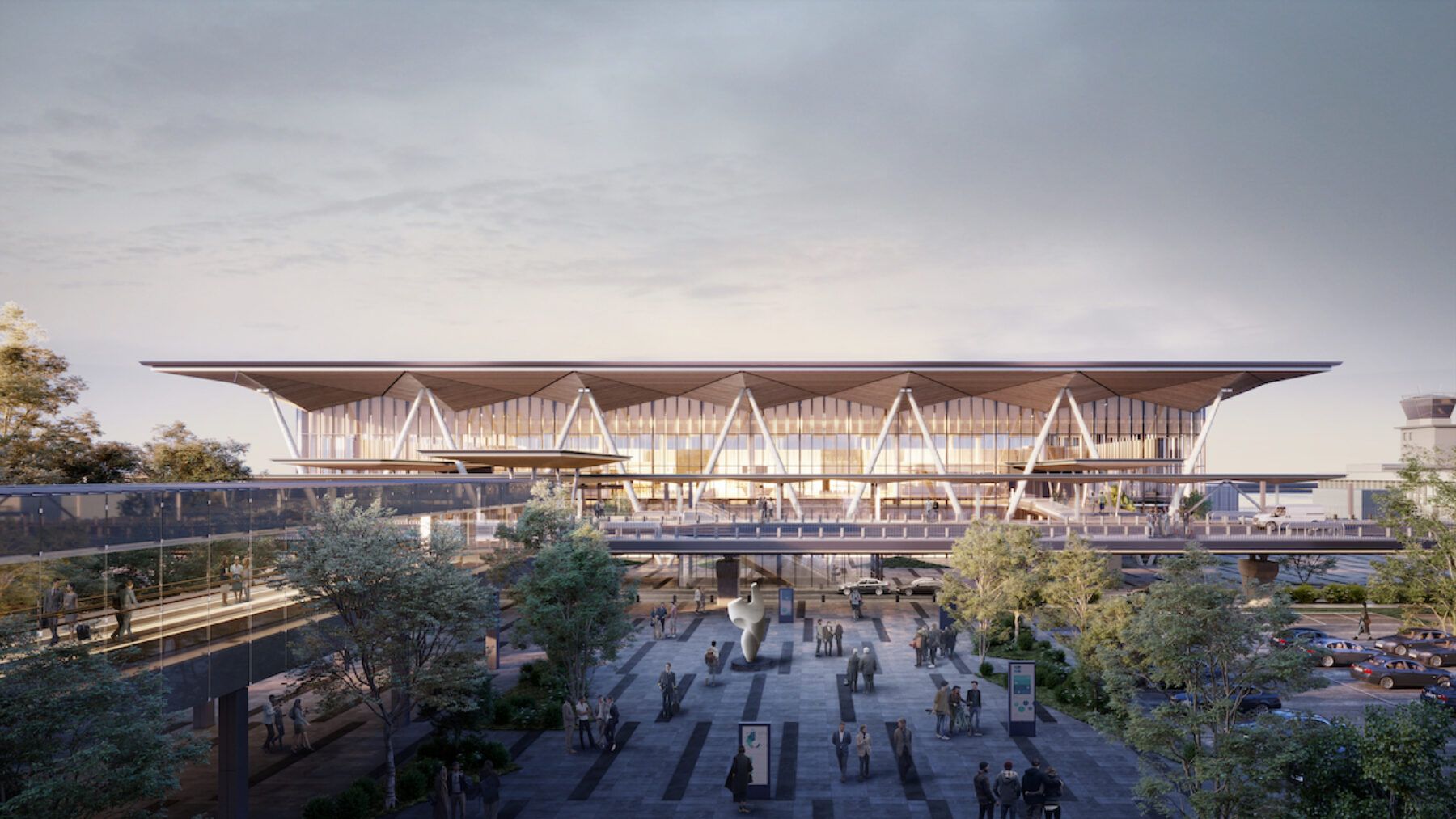 We left college knowing everything there is to know about design and construction, although obviously you refine all knowledge through practice, which always ends up being an excellent teacher. I have colleagues here who, in five or six years of college, never set foot on a construction site—they’re architects without any hands-on experience. Meanwhile, at ORT we even had a course where we built things with our own hands, and I’ll never forget it: Construction Procedures 4, taught by Ricardo Romero—a course that was motivating like no other and the favorite of almost every architect who graduated from ORT.
What's life like for you in Milan?
I came to Milan for an internship through my master's program. Venice is a nice place to visit, but it's pretty boring to live in. I moved to Milan, did the internship, got hired, and I've been here for almost two years now.
Milan is a spectacular city. It’s in a prime location in northern Italy because it’s just a two-hour drive from the beach—the blue Mar , where you can look down and see little fish swimming just 20 meters below—and also a two-hour drive from the mountains—the Alps. So, in the summer you can go to the beach, and in the winter you can go skiing, all within a couple of hours’ drive.
The vast majority of people you meet are involved in design—it’s the European capital of design. There’s an impressive number of people working in the fashion industry, design in general, and architecture. You can really breathe in and feel the city’s aesthetic standards; people on the street exude a level of elegance, care, and spectacular presentation—even when they’re just going to the supermarket. Even when my friends come to visit me, I warn them to keep in mind that everyone here is well-dressed. Sometimes it’s even overwhelming to always have that aesthetic standard—it makes you want to stress less. An hour and a half away is Turin, which is the complete opposite—Italy’s underground city.
What do you do in your free time?
I follow Inter in soccer and Pallacanestro Olimpia Milano in basketball. When I arrived, I immediately became friends with a group of Milanese people, which is kind of unusual because they’re said to be “reserved,” but they’re so fond of us—the Uruguayan and the Argentine—that I threw them a barbecue and won their hearts. Culturally, they’re very similar to us, and they took me to the stadium and showed me a whole bunch of other places too.