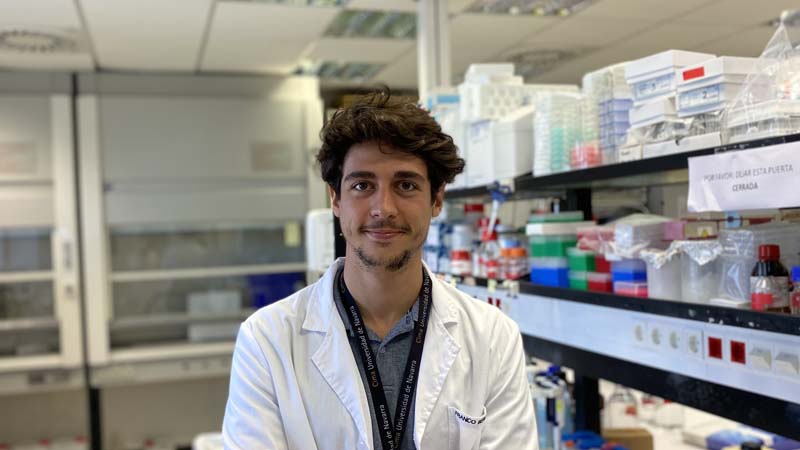
From a young age, Franco was drawn to nature and the processes that govern living organisms. Although he initially considered studying medicine, upon discovering biotechnology, he found a field that combined biological knowledge with the ability to develop solutions for health, the environment, and industry. In 2014, he decided to move to Montevideo to begin his studies at Universidad ORT Uruguay.
"I didn't hesitate when I saw the great atmosphere, the availability of resources, the comprehensive curriculum, and the excellent faculty. It was a no-brainer."
A Commitment to Human Health
Although he showed an interest in a wide range of fields, he knew from an early age that his passion lay in immunology and biotechnology applied to human health. Courses such as immunotechnology, biochemistry, and the elective in health biotechnology were instrumental in shaping his research focus.
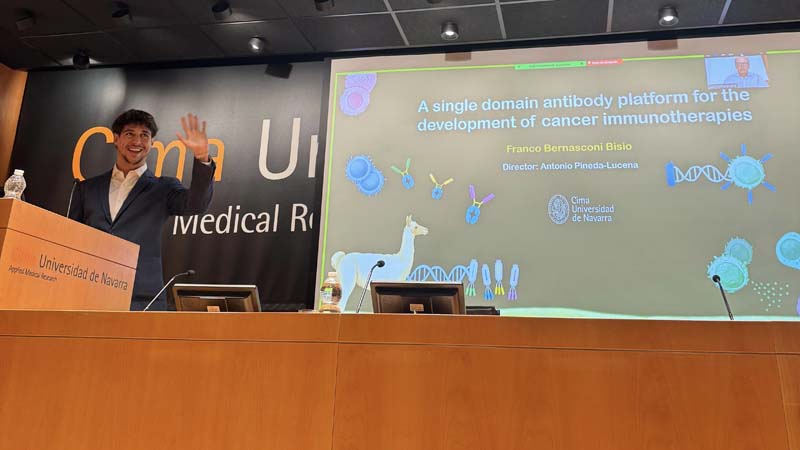
As for defining moments, my thesis was definitely one of them. The opportunity to carry out a year-long research project in a state-of-the-art laboratory, with academic support from professors and researchers, was incredibly valuable. Furthermore, the specific project I worked on—which involved developing a nanoantibody platform in collaboration with the University of Navarra— paved the way for my graduate studies.
A thesis that opened doors
Working on his undergraduate thesis was a turning point. For a year, he worked on developing a nanoantibody platform in collaboration with the University of Navarra. That project prepared him for a career in research and paved the way for him to pursue his doctoral studies.
What Sets ORT's Training Apart
For Franco, the program’s strong practical focus was key. The intensive hands-on laboratory work, along with the opportunity to make mistakes and learn from them, gave him the confidence and self-assurance he needed for his academic and professional development.
The Move to Navarra
Thanks to the academic connections she made while working on her thesis and the support of her advisor, Lucía Vanrell, she had the opportunity to continue her studies at the Center for Applied Medical Research at the University of Navarra (CIMA). There, she completed a Ph.D. in Applied Medicine and Biomedicine after being awarded a scholarship.
Challenges and Lessons Learned
Moving abroad presented him with more personal challenges than academic ones. He acknowledges that his training in Uruguay was solid and equipped him with the necessary tools to meet the demands of a doctoral program. For more than four years, he researched immunotherapies based on nanoantibodies and CAR-T cells, work that has had an impact on cancer treatments.
"I feel that college prepared me very well to tackle a PhD abroad, both professionally and personally."
"I won't deny that it takes hard work, and as a foreigner, the challenges are greater than those faced by a local, but I think I had the basic tools I needed, and I was lucky enough to find myself in a very welcoming and enriching academic environment at the University of Navarra," says Franco.
"It was more than four years of hard work, full of challenges, of falling down and getting back up. In research, you have to make friends with frustration and learn to live with it, because it’s normal for things not to turn out the way you expect, or for the results to baffle you, forcing you to mull things over and over again to find a solution."
However, all this sacrifice is worth it when you realize that even though you’re only doing your small part, all that work contributes to a scientific breakthrough that will one day change how patients with unmet clinical needs are treated.
"In my specific case, being able to identify specific nanoantibodies targeting various oncological targets, engineer them into CAR-T cells as antigen-binding motifs, and observe that they prolong survival in mouse models while exhibiting a safer safety profile—all of this made the entire effort meaningful and worthwhile."
Leading a startup
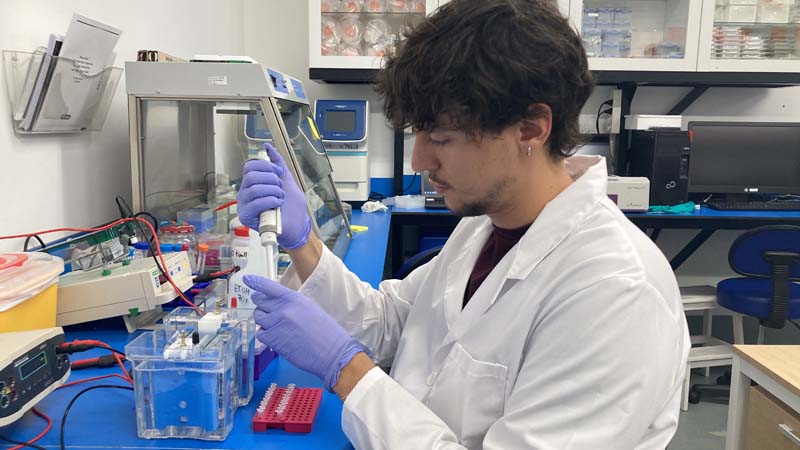
Currently, after completing his doctoral studies at CIMA, Franco works at Nanogrow Biotech, a Uruguayan startup based in Pamplona, as a laboratory manager.
The company is dedicated to developing therapies based on nanoantibodies, targeting immune system-related diseases such as autoimmune disorders, allergies, and cancer.
On a day-to-day basis, he coordinates laboratory experiments, holds meetings with the team, collaborators, and advisors, and conducts research and development with the goal of advancing the products to clinical trials.
Challenges and Opportunities
The fast-paced nature of a startup demands energy and resilience, but it also offers the opportunity for continued growth. “I really like the startup world: you have to be able to handle frustration, but above all, you need a great deal of resilience,” he notes.
Biotechnology and health: an inseparable relationship
Franco believes that biotechnology is now indispensable to medicine. From CAR-T therapies to monoclonal or fragmented antibodies, immunotherapy has evolved from an experimental approach to a cornerstone of cancer treatment. “None of this would have been possible without the biotechnology behind it, making the impossible possible,” he says.
"I see that this relationship is becoming increasingly close. There is no doubtthat biotechnology is a field that has marked a turning point in appliedmedicine, as well as in so many other areas. Just a few years ago, biologic treatments were rare and, above all, financially out of reach. Today, numerous biologic treatments have been approved, including as first- or second-line therapies."
"Today, CAR-T is a hot topic in hospitals, and in addition to monoclonal antibodies, people are talking about bispecific antibodies, antibody fragments, and ADCs. Immunotherapy has gone from being a distant prospect to a cornerstone in the treatment of cancer and other diseases. And this wouldn't have been possible without biotechnology behind it, making the impossible possible," explains Franco.
Tips for aspiring biotechnologists
He advises students just starting out to cultivate curiosity, work as a team, and never lose sight of their goals.
“What truly drives a biotechnology engineer is having a sense of purpose and understanding the impact our work can have.”
Another very positive aspect of the program is its breadth, Franco notes, as it encompasses multiple fields in which students can develop their skills: industry, agriculture, bioinformatics, healthcare, and many others. This diversity offers the opportunity to explore, discover one’s interests, and decide which area to focus on—where one feels most comfortable or sees the greatest potential for growth.
Research skills
When it comes to research, he emphasizes the importance of resilience, communication, and a constant sense of curiosity, along with the ability to define problems and develop strategies with multidisciplinary teams.
"On this journey, soft skills are essential: resilience in the face of frustration, the ability to work in a team, good communication, a constant curiosity, and a genuine desire to improve."
"Technical skills depend heavily on the field of research. In my case—biomedicine—I consider the following to be essential: having a clear understanding of the problem, identifying the need we aim to address, and determining why the chosen strategy is the most appropriate given the available resources. It is also crucial to have a thorough understanding of the state of the art and to know how to build a multidisciplinary team. And, above all, the most important thing is to never stop asking questions."
Learn about the Biotechnology Engineering program