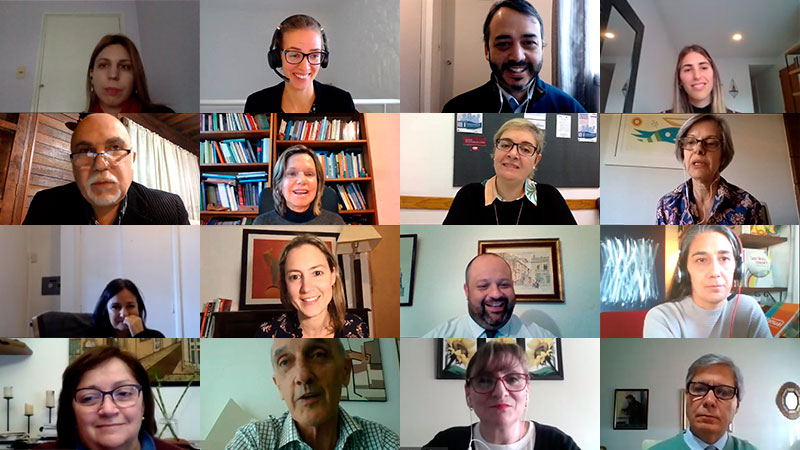
Nerves—lots of nerves. The worry that the computer might run out of battery or lose its connection. The comfort of being in the living room of their own homes. The joy of having friends and colleagues there, at least on the other side of the screen.
Having to defend a thesis virtually evoked a range of emotions among the graduates. But there is surely one thing they all have in common: it will be an experience they will never forget.
In June 2020, amid the COVID-19 pandemic, 25 students from the Master’s in Education, the Master’s in Educational Management, and the Master’s in Teacher Training successfully defended their master’s theses online. Six of them shared their insights and described their experiences during that time.
An exceptional experience
Adriana Finno tidied up her house, changed the painting she had hanging as a backdrop, and made sure it matched her clothes so that the overall look would be harmonious and not “create confusion.” In addition, the graduate of the Master’s in Education program made sure her computer wouldn’t run out of battery, that her pet wouldn’t climb on top of her every time she sat down, and hoped her internet connection wouldn’t cut out during her presentation.
Beyond those details, she didn't face any major challenges in that regard. She had prepared for that moment, regardless of the format of the defense. She was already accustomed to using digital tools for both her work and her personal life, so the virtual format wasn't a major complication for her.
However, when it came to using technology, the graduates had mixed reactions. Some said they were already using it and had no problems. For others, however, it was a challenge.
In this regard, Adriana Rodríguez, a graduate of the Master’s Program in Trainer Development, stated: “We are accustomed to feeling more confident in face-to-face settings, which may be due to our background in more traditional forms of training.”
However, he emphasized that it was a positive experience, since the master’s program “prepared them to use digital media effectively” and helped them “overcome certain barriers related to the use of technology and online learning.”
Flexibility: “one of the key skills of the 21st century”
According to Evelyn Einhorn, a graduate of the Master’s in Education program, the process of completing her thesis was complex. Her schedules and plans were disrupted: “The pandemic hit and turned everything upside down: it changed our routines, derailed or altered our plans, and confronted us with uncertainty more than ever before; and for those of us working in education, it demanded a threefold commitment to our profession.”
"It felt quite strange to me to be completing such an important program from home, on my own, and without the magic of in-person interaction, which is so central to education. Still, it’s amazing how technology has made these opportunities possible, despite the pandemic," said Evelyn Einhorn, a graduate of the Master’s in Education program.
However, as she put it, “flexibility is one of the key skills of the 21st century,” so, for her, the whole experience was a learning opportunity.
But the fact that their work required more hours than usual was not an unusual situation. Jana Blümel, a graduate of the Master’s program in Educational Management, also found it difficult to finish her thesis, given the circumstances facing the country and the world.
She currently serves as the academic director of the Goethe-Institut Montevideo. Due to the pandemic, she had to adapt to an online format, train teachers, adapt course materials, address specific situations, and ensure that students did not drop out; as a result, she was only able to devote time to her final thesis on weekends.
“However, it wasn’t impossible, and that’s because the master’s program provides a lot of support throughout the process of writing the final thesis. I see that as a very positive thing, since it really does make it possible to work and complete the master’s degree at the same time,” he emphasized.
Bridge the gap
Some people believe that presenting virtually, from their own home or office, helps them feel more at ease during the event. That was one of the advantages highlighted by Blümel, who also delivered his presentation in front of friends and colleagues from Argentina, Brazil, and Germany—who would not have been able to attend in person.
Similarly, during the thesis defenses for the Master’s in Educational Management, for example, students received feedback from Dr. Ana María de Albuquerque Moreira. The professor from the University of Brasília served as an external member of the examination committee, which fostered a much more regional exchange.
Reducing travel time was another point emphasized by Federico Riguetti, a graduate of the Master’s Program in Trainer Development: “For students from outside the city, attending a thesis defense involves long hours of travel. This has consequences that go beyond the travel itself, as it often cuts into the rest time beforehand, which can affect the outcome.” Therefore, in his view, this format ensures “more adequate emotional and physical preparation.”
“It’s very important for those of us who live in the interior of the country—in my case, 80 kilometers from Montevideo—since it saves us travel time and waiting,” said Adriana Rodríguez, a graduate of the Master’s Program in Trainer Development.
Virtual Learning: Advantages and Challenges
Better management of time and teaching resources, more support in preparing presentation materials, and the ability to help the presenter stay more focused. These were some of the advantages that graduates highlighted about virtual defenses. However, some felt that direct personal contact cannot be replaced or compared to technology.
“The only drawback I noticed is the lack of eye contact with the participants. In in-person sessions, we’re used to gauging how our message is being received by interpreting the nonverbal cues of our listeners,” Riguetti pointed out. “In video calls, when you’re sharing a presentation, that ability to read people’s body language is lost,” he added.
And, compared to in-person hearings, it can be more difficult to establish a connection with the members of the court, they explained. However, they also noted that they felt very comfortable and, in fact, highlighted the warmth of the courts.
“The personalized support provided by the tutors and coordinators at the Institute of Education was essential to successfully navigating this stage; they consistently shared their experience and professionalism,” said Rodolfo Sosa, a graduate of the Master’s program in Educational Management.
“To some extent, we were prepared for a virtual defense scenario thanks to our accumulated experience,” he concluded.
“I view this unconventional experience very positively and recognize that online learning entails new ways of working, with approaches that differ from those of in-person instruction,” said Rodolfo Sosa, a graduate of the Master’s program in Educational Management.
Going too far
“The COVID-19 pandemic has had devastating consequences worldwide, but it has not prevented the Institute from holding its scheduled master’s thesis defenses,” said Dr. Denise Vaillant, academic secretary of the Institute of Education.
In his words, digital platforms and management systems, which have been in operation for years, “became the main source of support during times of crisis.”
After the master’s thesis defenses concluded—though they noted both advantages and disadvantages—Vaillant’s assessment is overwhelmingly positive. Mag. Andrea Tejera, coordinator of the Master’s in Educational Management, agreed: “Now that the defenses are over, we can say that they were all successful, both in terms of form and the content presented.”
Having clear guidelines for conducting online defenses was essential for all graduate programs. Specifically, for the Master’s in Educational Management, the program coordinators organized a workshop to discuss this matter and encouraged students to practice the process among themselves—to ensure it wasn’t the first time they had to go through it.
They also took into account certain emotional factors that contributed to the smooth conduct of the defense. For example, they set aside time beforehand for the academic advisor to speak with the thesis student—something that usually happens informally while waiting in person to enter the defense—and in this case, they formally incorporated it into the procedure.
Although there was a risk that the presentation styles might become uniform, this did not happen. On the contrary, Tejera noted that each student presented original arguments, “based on their professional and learning styles.”
“Everything we’ve developed has taught us a great deal about how to better integrate the teaching resources we have at our disposal as educators,” he concluded.
See also:
- Interview with Evelyn Einhorn: “The pandemic demanded a threefold commitment to our craft”
- Interview with Adriana Finno: “Education is the best way to transform a country’s education system”
- Interview with Jana Blümel: A Master’s Program That Allows You to Work and Study at the Same Time
- Interview with Rodolfo Sosa: The Importance of Making Things Happen
- Interview with Adriana Rodríguez: Overcoming Adversity Through Education
- Interview with Federico Riguetti: Training as the Key to Bringing About Meaningful Change