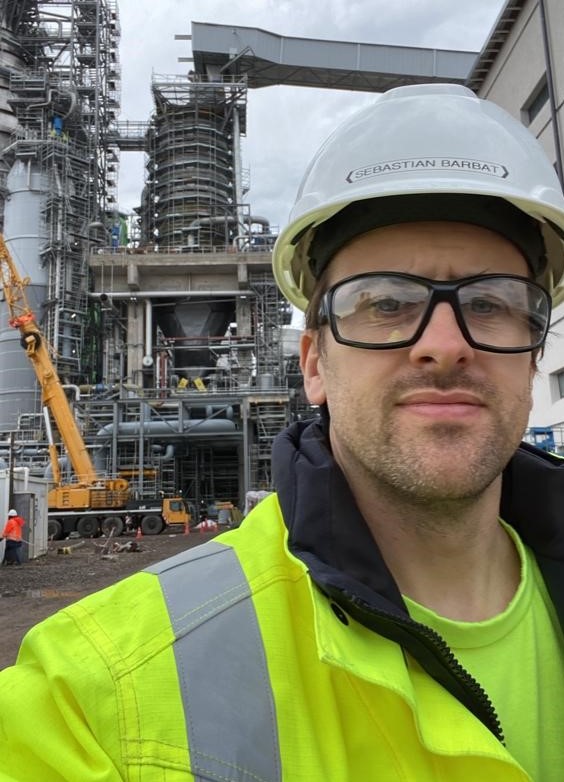
 In this interview, she looks back on her career, from her days as a student to her entry into the workforce. She discusses the challenges and opportunities she faced and how her education gave her the confidence she needed to succeed.
What is your role within the company, and what tasks do you perform?
I am responsible for coordinating and supervising the electrical team, which includes subcontractors; monitoring operations; training and assigning tasks to maintenance technicians; and ensuring compliance with safety regulations. Additionally, together with our team, we were in charge of coordinating and supervising the commissioning of all electrical equipment at the UPM2 plant. Our goal is to ensure the continuous operation of the equipment, prevent failures, and provide effective solutions to emerging problems.
What were the biggest challenges you faced when entering the business sector as an Electronics Engineer?
The transition from academia tothe business sector involves adapting to the organizational culture and work dynamics of each company. It requires integrating technical skills with business aspects, such as budgeting and project management, which may mean focusing more on management and less on technical aspects.
Professional development and continuous learning are essential in an ever-changing business environment. Tackling these challenges demands flexibility and problem-solving skills.
How has your career evolved from when you first started in the business sector until now?
My career began while I was a student, working as an engineering assistant. After graduating, I was promoted to a higher-level position. I worked on various electrical projects across the country and had the opportunity to serve as site manager during the construction of a solar thermal plant in South Africa. Later, I focused on the operation and maintenance of renewable energy systems, including the country’s wind and solar power. This experience allowed me to develop deep expertise in this rapidly growing field. Currently, I have the privilege of working at Andritz Uruguay, a leading company in the sector. I serve as an electrical supervisor and am one of the people responsible for maintaining the UPM plant in Paso de los Toros.
What non-technical skills do you consider essential for success in the business world?
First of all, I would say that communication is fundamental, since you have to communicate effectively with colleagues, clients, and teams from other disciplines. Additionally, it’s important to work as a team while respecting others’ opinions and contributions to achieve project objectives. Likewise, leadership is another skill that needs to be developed, since you often have to make effective decisions—or at least try to—while always striving to find creative solutions and maintaining a focus on results. I also think it’s important to mention negotiation: in the vast majority of cases, you have to negotiate with clients, suppliers, or other departments, always striving to reach favorable agreements.
What did your degree provide you with that you can highlight to help you enter the job market?
The degree gave me confidence, as it equipped me with the tools to tackle complex challenges and develop the technical skills needed to adapt to a changing job market.
“Upon completing an engineering degree, you’ll be prepared to tackle any task in the business world, capable of managing projects and effectively addressing business challenges.”
What do you remember about your time in college?
College was a truly special time for me. I have fond memories of that period, when I made many close friends and found valuable companions on my journey. I also gained a wealth of knowledge and skills that have been essential to my personal and professional growth. Without a doubt, we also shared unforgettable moments, facing major challenges together that brought us even closer as a group.