What was the quality of the submitted works like?
A wide range. From typefaces that are practically ready for publication and commercial release to projects that still require a significant amount of work before they reach a stage where they can be distributed.
The important thing is that, at every level, there is a growing interest in typography and in getting involved in its production.
The award aims to contribute to the growth of typography by providing an additional incentive.
With this in mind, different participation categories were planned—which is not always the case—based on the levels of development we anticipated, and this plan was carried out.
Is it possible to identify different design trends based on where the designs originated?
It is not possible to identify aesthetic trends based on geographic location.
What does happen frequently is that the most elaborate proposals come from cities that offer graduate programs in typography. This is certainly the case in Buenos Aires and Santiago.
In general, this is one of the most frequently asked questions in academic exchange programs: the perception of the geographical and cultural context regarding the origin of the typeface.
Although there is a general conceptual framework at the Latin American regional level, no national guidelines have been established.
What does exist in the professional world is a certain tendency to follow specific approaches that would make it possible to identify the creators of certain typefaces with a high degree of accuracy.
What do you think of the works presented by Uruguayan designers?
We are very pleased with the proposals from Uruguayan designers, as we see that there is some excellent material to work with moving forward.
In some cases, moreover, these promising developments come from students—that is, people who are just entering the world of design and who, therefore, have a bright future ahead of them.
With this award—and with future editions—we hope to contribute to the further development of the national typeface industry.
Participation will surely be higher next year, in part because we will be able to better tailor the award guidelines to local needs.
As evidence of this, it’s worth noting that in 2014 we were finally able to carry it out—an idea that had been on our minds for about five years.
 What were the most notable aspects of the three winners and the three honorable mentions?
There is no doubt that the selected fonts demonstrate a high level of professionalism.
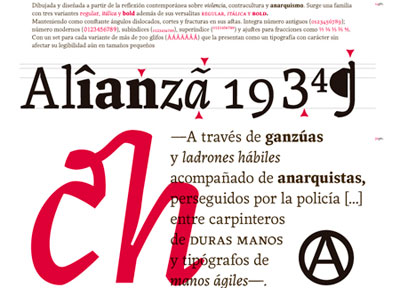
In the case of "Jauría" by Chilean artist Pablo Marchant (first-prize winner), what stands out is the breadth of the character set, which allows for extensive linguistic coverage, combined with a very bold, clean, and sharp design that, while giving the typeface a strong personality, does not interfere with the readability of the text.
This last aspect is one of the most sought-after by typographers in general. Furthermore, it incorporates a political stance into its concept, which ultimately rounds out a very strong graphic design project.
In addition, this is a typeface that TipoType will begin distributing for free in the coming days.
What was your role in the development of this award?
TipoType is responsible for the award, from conception to execution.
Beyond the business aspects that any company needs to function, we have always been committed to education and collaboration to improve the state of our field. We believe this award combines both of these aspects.
TipoType is comprised of three partners, one of whom (Martín Sommaruga) served as a local jury member (along with Manuel Corradine from Colombia and Laura Serra from Germany).
Fernando Díaz was in charge of organizing the swearing-in ceremony, and I was responsible for handling registration and assisting the applicants.
The important thing is that the competition is still ongoing, and we are developing various support initiatives for participants—both those selected and those not selected—so they can continue their typographic design process and eventually publish their work to promote and distribute it in the best possible way.
How important was the support from Universidad ORT Uruguay making this happen?
The university's support was significant in several respects.
From a practical standpoint, our partnership with the School of Design helped us make the contest more appealing in terms of the prizes.
Even more significant and important is the support that comes with appearing alongside the ORT logo at the national and international levels, which undoubtedly lends us academic credibility and allows us to align ourselves with an image of seriousness and commitment to fostering a culture of knowledge.
But even more encouraging is the prospect that this partnership will continue over time, in future editions of the award, where we will surely see more and better results from this work.