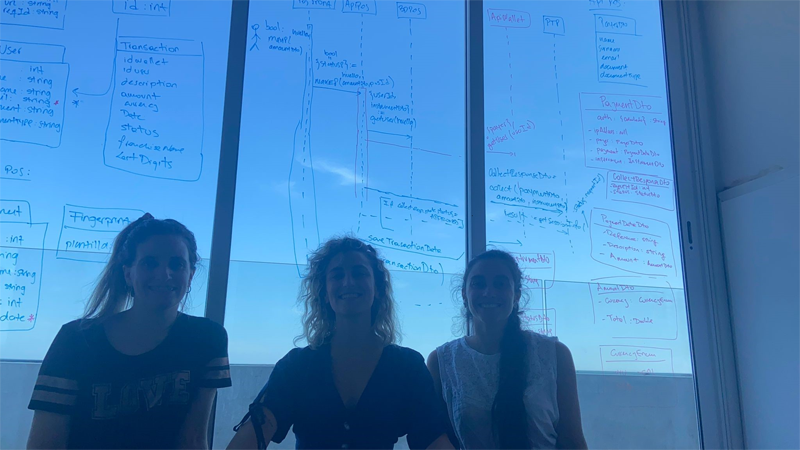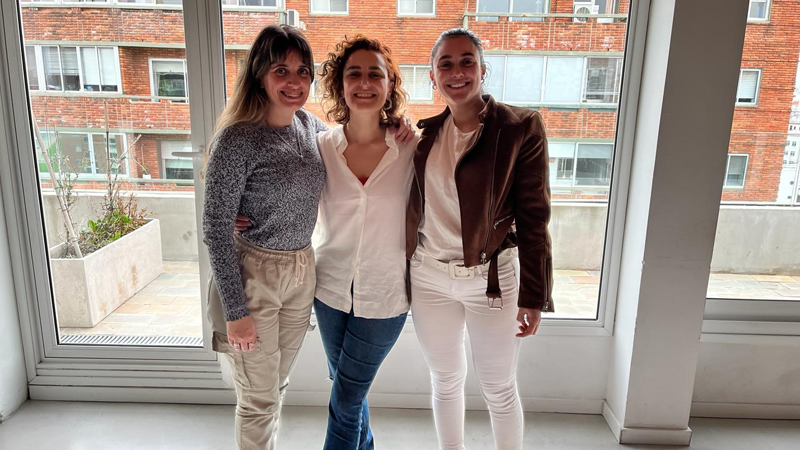
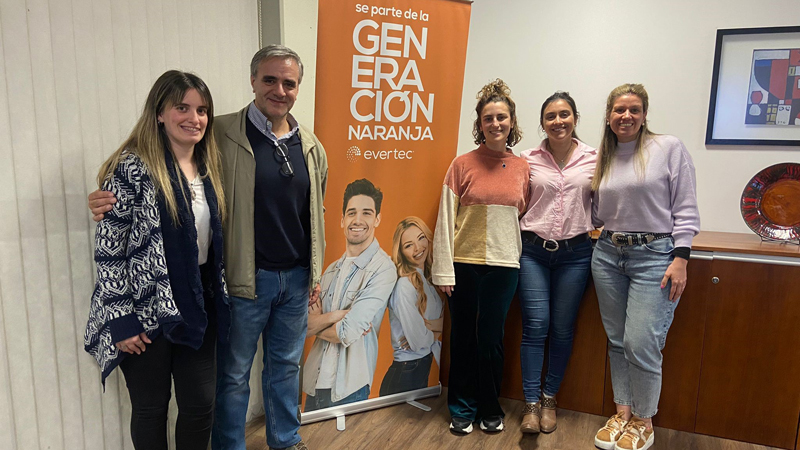
This project, developed by Sol Mendiola, Carolina Bula, and Fiorella Farinasso—all graduates of the Systems Engineering program—began as a thesis project and was carried out in collaboration with the multinational company Evertec.
In this interview, they discuss what motivated them to undertake this project, the challenges they faced, the lessons they’ve learned after a year of work, and how they envision the impact of biometric authentication on the financial industry and people’s daily lives.
What motivated you to participate in this biometric payment project? Was it your thesis project?
Yes, it was our thesis project, which we selected from the Project Fair organized by Universidad ORT Uruguay. We were motivated by the challenge of building a product from scratch, using the current technologies already available at Evertec and with the support of this multinational company. We consider this product to be original, since it does not exist in Uruguay, and we knew it would be a major challenge and a valuable experience.
We were excited to use technologies and devices capable of reading biometric data to process payment transactions. Another motivation was the opportunity to collaborate with a multinational company like Evertec, working closely with professionals from various fields, which gave us the freedom and confidence to apply everything we had learned during our studies at ORT. This experience allowed us to grow both professionally and personally.
What were the biggest technical and non-technical challenges you faced during the project?
From a technical standpoint, we can highlight our research on devices and the collection of biometric data, ultimately focusing on fingerprints and the selection of a specific reader. Challenges related to system architecture, deployment, and quality management—which, although not the primary focus of the project, were investigated and documented.
As for non-technical skills, we can highlight the following: managing a large-scale project from start to finish with a multidisciplinary team and without prior experience in software project management; and rising to the challenge of overseeing the entire process, from understanding the client’s initial idea to delivering the proof of concept.
What was your experience working with Evertec like?
Excellent! We learned a lot from every member of the project team. It was enriching to work with a multidisciplinary team from different countries, which guided us and contributed to our academic careers. Evertec was always willing to meet weekly for a year, accommodating our schedules, since in addition to the project, we were working and taking our final courses. We especially appreciate the availability of the experts in each field to hold meetings whenever necessary.
What key lessons did you learn from your participation in this project?
Project management involves planning, holding meetings, tracking tasks and the team, developing, testing, conducting demos, creating all necessary documentation, and more. It also involves trying to anticipate all the risk scenarios we identify. In our case, we left the biometrics requirement until halfway through the project without having conducted a proof of concept (POC) beforehand, even though we knew it was the project’s main risk. This led to several challenges when we began implementing this requirement (which was halfway through the project), and had we conducted one or more POCs at the start, we would have anticipated those situations. We also need to understand that project requirements can change, and we must be open to that change and adapt to new situations.
How do you see the future of biometric payments in the financial industry and in people’s daily lives?
We believe that biometric payments have a bright future and the potential to replace cash and cards in brick-and-mortar stores. It will be necessary to educate the public and raise awareness about the security of using biometric data.
Based on the survey you conducted, what other biometric methods did you consider besides fingerprints, and why did you choose this one?
We considered several methods, such as facial recognition, iris recognition, voice recognition, palm recognition, ear recognition, scent recognition, and signature recognition. Ultimately, we chose fingerprint recognition, as it provides users with a greater sense of security.
What were the main challenges in integrating biometric technology with existing payment systems?
The main challenge was to define the workflow and scope of the project. We developed two systems: a virtual wallet for users and a point-of-sale (POS) application for merchants, integrating them with an Evertec product to securely manage transactions.
How did they address the security and privacy concerns associated with the use of biometric data for payments?
For security reasons and due to the certifications required to process users' sensitive card data, we had to integrate one of Evertec's systems into our solution, which already handles sensitive card data
Since the project was a proof of concept intended to demonstrate and validate the client’s idea, user biometric security features were not included; however, this is an aspect that will be implemented if the solution is brought to market.
Did you receive any surprising or unexpected feedback during the survey on biometric authentication?
We were surprised to find that iris recognition was the third most preferred authentication method. User feedback on the final solution was very positive, indicating a high level of interest in its implementation in Uruguay.
What specific skills did you develop through your participation in this project?
We develop skills in project management, planning, task tracking, gathering requirements from the client, and translating these into user stories and assignable tasks.