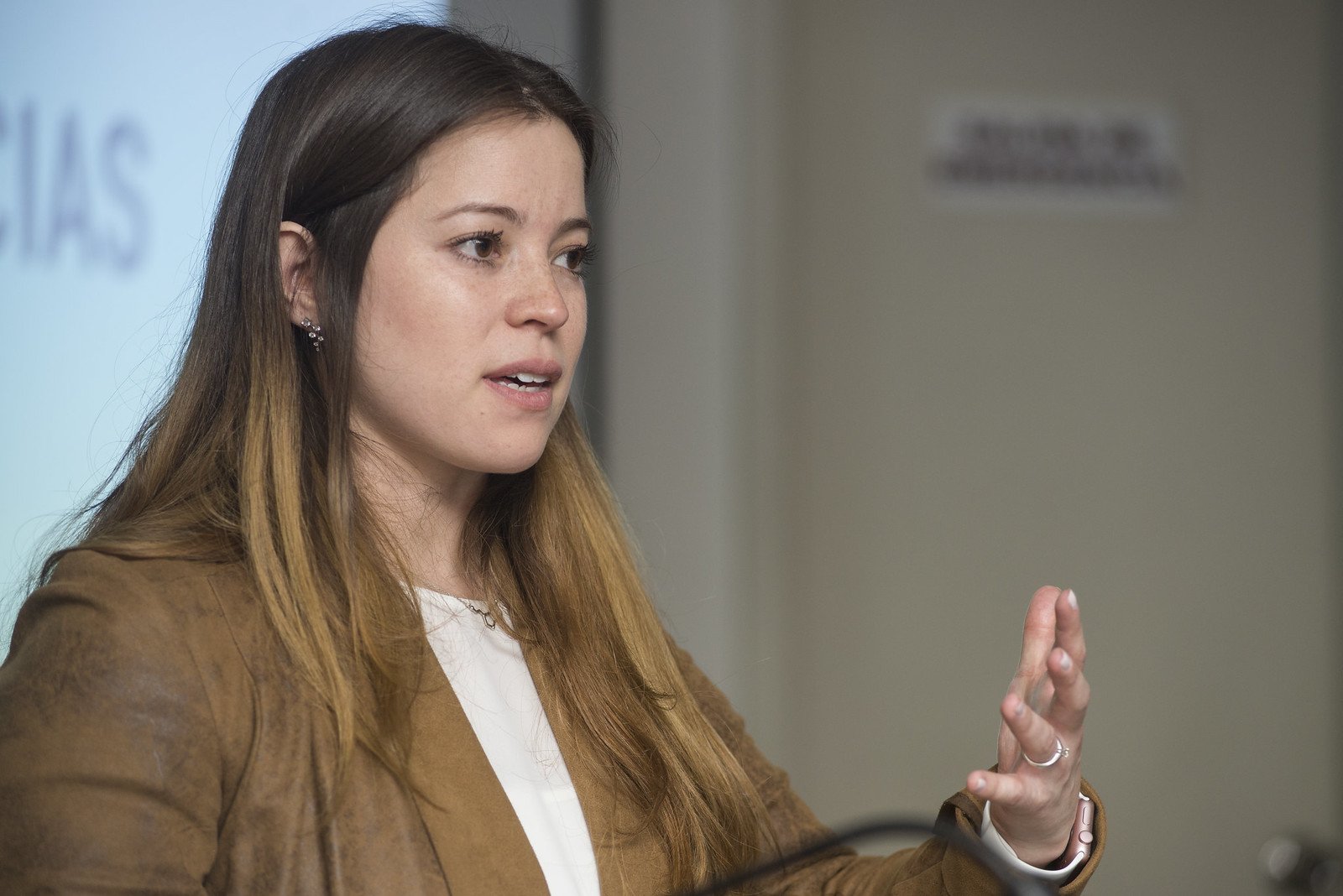
“We all have creativity. Human beings are creative by nature—not just designers. People from all disciplines are creative,” said Daniela Golby,who holds a Bachelor’s degree in Graphic Design from Universidad ORT Uruguay a Master’s degree in Design Strategy from Parsons The New School for Design in New York.
When it comes to companies that use this methodology, Golby highlighted IBM, General Electric, and Philips. He also shared his own experience working with design thinking throughOne Billion Voices. This project, presented at the United Nations (UN) headquarters in New York in 2016 and 2017, aimed to empower people with disabilities. “We needed it to make an impact, surprise people, and inspire them,” he said.
Empathy, combined with observation, allows us to understand what people want and is useful when it comes to “creating something new.” These concepts, linked to design thinking, were highlighted by Golby on Monday, November 27, 2017, during his lecture “Design Thinking: Let’s Transform Ideas” at the School of Design at Universidad ORT Uruguay.
What is design thinking?
It is a creative process used to solve complex problems. It helps generate completely new ideas that can transform a system and break with the status quo.
It is divided into five stages: the first is empathy; the second, definition; the third, ideation; the fourth, prototyping; and the fifth, testing. It is an iterative process. In other words, in some cases, you have to go back and rethink the idea or make adjustments. This can happen at any stage of the process.
What makes the work enriching is the diversity of the team members. Ideally, design thinking should be carried out in a group that is diverse, whether in terms of culture or because the members come from different disciplines.
Collaboration helps us come up with new ideas. On our own, we wouldn't achieve the same results. Together, we accomplish something we could never have done if we hadn't worked as a team.
The design thinking process is very versatile. It can be applied to business, social issues, and environmental problems.
How can it be applied in the field of design?
Since it’s so versatile, we could suddenly start offering workshops for designers and implement them in agencies. It could help improve communication between different agencies or disciplines. I think designers need to learn to work more as a team because we tend to be very individualistic.
In any case, you don't have to be a designer to apply design thinking. It's simply a matter of learning to think like a designer.
How and why is it important to consider this type of thinking in college majors?
I think it’s important for young people to be aware of what’s happening out there—the developments and ideas emerging abroad. They can think about how to apply those ideas here. Step by step, we’re building something that could suddenly bring about a significant change—a change we urgently need in our society.
On a global scale, what example of design thinking would you cite as a reference?
I love inventor Elon Musk's idea. I think he's a visionary. Thanks to the Hyperloop project he conceived, people could travel long distances in a very short amount of time—much less than it takes today.
I think that's really interesting; it's going to revolutionize the way we get around on a daily basis. Suddenly, places that used to take an hour to reach will only take a few minutes. It's going to completely change our routines and will also have a significant impact on the environment.
In Uruguay, in what situations is design thinking applied?
It’s still fairly new in Uruguay. Some companies are trying to learn about design thinking; they’re taking courses to understand it and put it into practice. Consulting firms and incubators are promoting it, giving talks to share information with the public and clarify what it is.
All of this is creating a flow of information for entrepreneurs, students, and business owners, and I find that to be both enriching and important. Uruguay has tremendous potential for growth and development. We just need to identify the sectors where we can start making that happen.