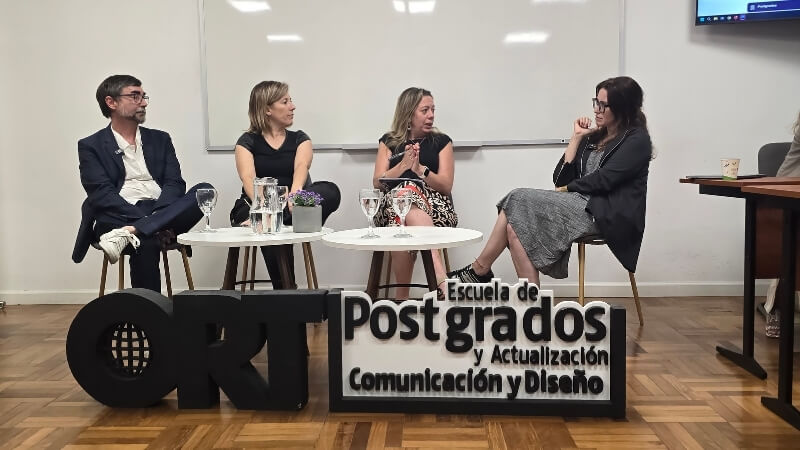
The School of Graduate and Continuing Education in Communication and Design at Universidad ORT Uruguay the academic discussion "Designing Futures with Purpose," a forum for reflection and debate that brought together students and faculty to analyze the current challenges of design, innovation, and creativity in shaping possible futures.
The activity took place as part of the course " Global Trends for Designing the Future," a course that integrates design thinking, foresight, and strategic innovation, and aims to analyze current trends to envision future scenarios with social, ethical, cultural, and environmental implications.
The goal of the discussion was to provide conceptual frameworks and analytical tools that would enable design students and professionals to anticipate trends, challenge established models, and make responsible decisions in the face of complex future scenarios.
During the opening of the event, Sabrina Bianchi, academic secretary of the School of Graduate and Continuing Education in Communication and Design, highlighted the purpose of the space and the approach behind its design, emphasizing the value of creativity understood
Not as an epiphany, not as a romantic notion, but as a force that transforms reality.
Diverse Perspectives on Trends, Design, and Innovation
The discussion brought together leading figures from the creative ecosystem with distinguished careers in trend research, art and technology, strategic design, entrepreneurship, and sustainable innovation, fostering an exchange of complementary perspectives.
Drawing on trend research and data analysis, Jimena Díaz Alarcón, CEO and co-founder of Universal, provided a strategic perspective aimed at facilitating informed decision-making.
With over 20 years of experience, he has worked with leading Latin American brands on projects involving market segmentation, audience research, UX, brand strategy, and innovation.
The intersection of art, technology, and speculative imagination was explored through the perspective of Fabián Barros, a professor in the Master’s Program in Creativity, Innovation, and Communication and academic coordinator of the Bachelor’s Program in Design, Art, and Technology. He discussed the potential of design as a driving force for pushing the boundaries of what is possible.
https://www.youtube.com/watch?v=0psTXQn2-fQ
Through her strategic and sustainable design approach, Giselle della Mea has incorporated a perspective focused on social and environmental impact.
A systems designer, founder of Tres Vectores (Uruguay’s first B Corporation), and co-founder and first president of Sistema B Uruguay, she highlighted the role of design in contemporary development models.
Speculative design, critical thinking, and imagination
One of the central themes of the discussion was speculative design as a methodology for expanding the boundaries of the imagination and challenging the traditional problem–solution framework.
Speculative design was presented as a practice that not only addresses immediate needs but also opens up new ways of thinking, imagining, and building alternative futures.
In this regard, the role of critical thinking and education was highlighted as fundamental tools for interpreting the complexity of the present and responsibly envisioning future scenarios.
Responsible innovation and building a shared future
The discussion also explored the relationship between design, sustainability, and responsible innovation, reflecting on the limits of conscious consumption and the tensions between desire, accessibility, and ethics.
The need was raised to approach the design of the future by taking into account the region’s social, cultural, and economic characteristics, and by understanding design as a practice that has a direct impact on people’s lives.
In this context, it was emphasized that designing the future involves embracing a collective and political dimension. As noted during the meeting: “Designing the future is a political act. It is one thing to design one’s own future, and quite another to design a collective future together.”